Glow Stick Chemistry
Snap, shake and dunk glow sticks in ice and hot water to compare.
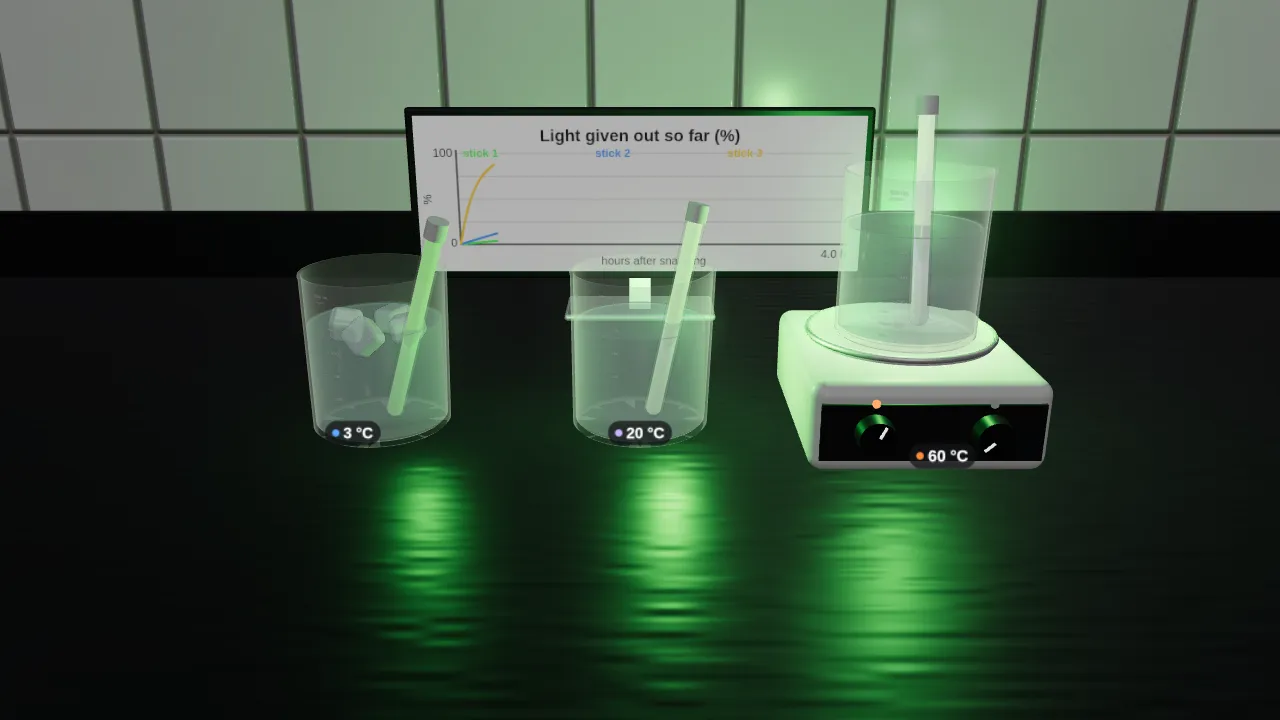
How to play
- Tap a glow stick to snap the glass vial inside: it starts to glow faintly.
- Shake it: drag it quickly to and fro. Each shake mixes the two liquids and it gets brighter.
- Drag it into the ice water, the room-temperature water or the hot bath. Turn the hot plate’s knob to set the hot bath.
- Try the three Challenges, or open Lab to change the dye and the time-lapse.
Challenges
- Snap a glow stick and shake it until it glows at full brightness
- Put one glowing stick in the ice and another in the hot bath
- Wait until the cold stick outshines the hot one
Try this
- Snap all three and read the brightness. The hot stick starts many times brighter than the cold one.
- Speed time up to “1 s = 20 minutes” and watch the hot stick burn through its light while the cold one keeps going.
- Raise the hot bath by 10 °C and check the half-life readout: it roughly halves.
Fun facts
- A glow stick makes light without getting hot. Light from a chemical reaction is called chemiluminescence.
- Fireflies use a similar trick, but their reaction is driven by an enzyme called luciferase, so it is called bioluminescence.
- The colour comes from a fluorescent dye, not from the reaction that powers it: change the dye and you change the colour.
- Putting a glow stick in the freezer slows the reaction, so it glows more dimly but lasts longer.
Light from a chemical reaction
A glow stick is two chemical solutions kept apart. The flexible plastic tube holds an oxalate ester and a fluorescent dye dissolved in a solvent. Floating inside it is a thin glass vial of hydrogen peroxide. Bend the stick, the vial cracks, the liquids mix, and the stick starts to glow.
Where the light comes from
Hydrogen peroxide reacts with the oxalate ester to form a short-lived, energy-rich molecule, 1,2-dioxetanedione. It quickly falls apart into two molecules of carbon dioxide, and in doing so hands its energy to a nearby dye molecule. That lifts one of the dye’s electrons into an excited state. When the electron drops back, the dye releases the energy as a photon of light. Because the energy goes into light rather than heat, the stick stays cool: this is chemiluminescence, “cold light”.
The reaction itself has no colour of its own. The dye decides. 9,10-Bis(phenylethynyl)anthracene gives the classic green, diphenylanthracene blue, rubrene yellow-orange and rhodamine B red.
Hot and cold
Like most reactions, this one speeds up when it is warmer, because molecules move faster and collide more often and with more energy. A faster reaction makes light faster, so a warm glow stick shines brighter. But there is only so much ester and peroxide inside. Every molecule that reacts gives roughly the same amount of light, so the total light is fixed: the brighter the glow, the sooner it runs out. A stick in iced water glows dimly but lasts much longer.
For the curious: the model
The simulation treats the reaction as first order: brightness falls as I(t) = I₀e−kt, giving a half-life of ln 2/k. Since every reacting molecule produces the same light, I₀ is proportional to k, and the total light, the integral of I over time, is I₀/k, the same at any temperature. The rate constant follows the chemists’ rule of thumb that rates roughly double for every 10 °C: k(T) = k₂₀·2(T − 20)/10, with a two-hour half-life at 20 °C. Real glow sticks are more complicated (the reaction isn’t perfectly first order, and very cold sticks can be dimmer than the rule predicts), but the trade-off between brightness and lifetime is real.
Safety
Never cut a glow stick open. The contents irritate skin and eyes and there are sharp glass fragments inside. If a stick leaks, wash skin with soap and water. Please read our disclaimer.
Questions people ask
How does a glow stick work?
Snapping it breaks a glass vial of hydrogen peroxide, which then reacts with an oxalate ester. The reaction produces a high-energy intermediate that passes its energy to a dye, and the dye releases that energy as light.
Why do glow sticks glow brighter in hot water?
Heat speeds up the chemical reaction, so more light is produced each second. The total amount of light is fixed, though, so a warm glow stick also fades sooner.
Can you recharge a glow stick?
No. Once the chemicals have reacted they are used up. Putting a glowing stick in the freezer only slows the reaction down so the remaining glow lasts longer.