Gingerbread House
Glue gingerbread walls with icing, get the roof on and decorate.
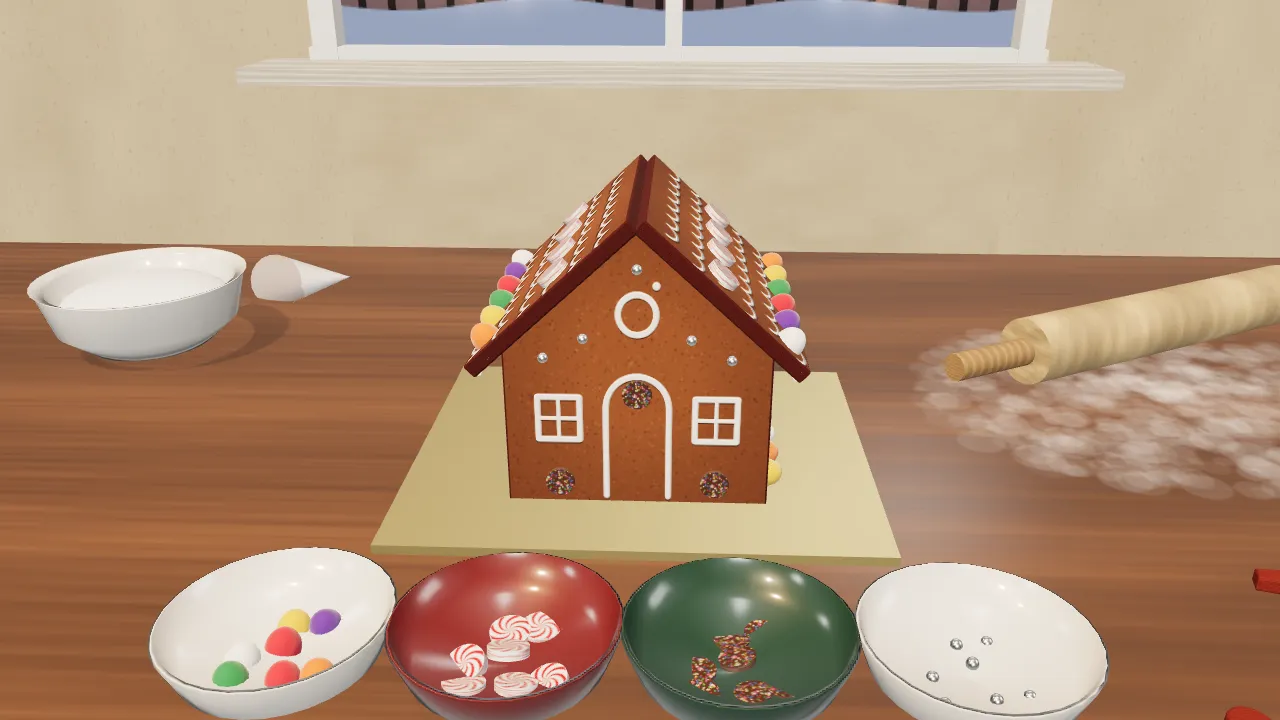
How to play
- Drag a gingerbread wall onto its outline on the silver board. It stands up in place: keep holding it a moment while the icing grips, then let go.
- Stand all four walls. Corners glued to their neighbours make the box much stiffer than any single wall.
- Watch the icing lose its wet shine as it sets, then drag the two roof panels on top and hold each one briefly. Too soon, and the roof pushes the walls apart.
- Drag sweets from the bowls onto the house: they stick wherever you drop them. Try the three Challenges, or start a new house in Lab.
Challenges
- Stand all four gingerbread walls on the board at once
- Get both roof panels on without the house collapsing
- Decorate the house with 10 sweets
Try this
- Let go of a wall the moment it snaps into place. Wet icing can’t hold it, and it topples about its bottom edge in about half a second.
- Stand the first wall alone, then add a neighbour at its corner. The second wall needs much less holding, because the corner joint helps it.
- Put the roof on straight after the fourth wall, then try again after waiting for the icing to go matte. Fresh joints give way under the roof’s outward push.
Fun facts
- Royal icing is icing sugar beaten with egg white or meringue powder. It hardens as the water evaporates, which is why it works as an edible glue.
- Decorated gingerbread houses grew popular in Germany in the 1800s, around the time the Brothers Grimm published the tale of Hansel and Gretel.
- Bakers often make construction gingerbread with less raising agent, so it bakes flat and hard, and they prop the walls with cans while the icing sets.
- Sugar draws moisture from the air, so in a steamy kitchen a gingerbread house can slowly soften and sag.
How a gingerbread house stands up
Building a gingerbread house is a favourite Christmas tradition in many homes, a mix of baking, building and decorating that families enjoy together. It is also a small lesson in structural engineering: the same ideas that hold up real houses decide whether your gingerbread walls stand or fall.
Glue that needs time
Royal icing is a thick paste of icing sugar and egg white. While it is wet it is soft and barely holds anything; as the water evaporates, the sugar locks into a hard, crystalline glue. Its grip grows quickly at first and then levels off, roughly as 1 − e−t/τ, where τ is a drying time. Here τ is a second or two so you don’t have to wait; in a real kitchen the icing grips in minutes and hardens over hours, which is why bakers prop their walls up with cans or hold them in place.
Why a lone wall topples
A wall standing on its edge is an inverted pendulum: the moment it leans a little, gravity pulls its centre further past the edge and the lean grows. Without glue a wall falls in about half a second. Two walls glued at a corner are a different thing: an L-shape cannot fold over its own corner joint, so each wall braces the other. Four walls glued at four corners make a box, and a box is stiff.
The roof pushes outwards
The two roof panels lean against each other at the ridge, like the rafters of a real roof. Their weight pushes down, but because they slope, it also pushes outwards on the tops of the side walls. That horizontal push, the thrust, is what spreads the walls of a roof that has not been tied together. Real buildings resist it with ties, collar beams or thick walls; a gingerbread house resists it with well-set icing at its corners. Put the roof on too soon, while the joints are still soft, and the walls splay and the house collapses.
For the curious
A wall of height H tipping about its bottom edge follows φ̈ = (3g / 2H)·sin φ, so for a 9-centimetre wall a small lean doubles in well under a tenth of a second. For a roof panel of weight W at pitch θ resting on the ridge, taking moments about its lower edge gives the horizontal thrust on each wall top, H = W / (2·tan θ). A steeper roof (bigger θ) pushes outwards less, which is one reason steep roofs suit soft materials. In the simulation each joint’s strength grows with its age, corner joints add to a wall’s strength, and the house stands under its roof only when the side walls and their corners are well set.
Questions people ask
How long does royal icing take to set on a gingerbread house?
It starts to grip within minutes but needs a few hours to harden properly. Many bakers let the walls dry for an hour or more before adding the roof, and leave the finished house overnight before decorating heavily.
Why does my gingerbread house keep collapsing?
Usually the icing is still soft when the roof goes on. The sloping roof panels push outwards on the walls, and wet joints give way. Let the walls set first, prop them up, and use thick royal icing rather than runny icing.
Why does a steep roof push less on the walls?
Each panel’s weight acts straight down, but its slope turns part of it into a sideways push at the wall tops, H = W/(2·tan θ). The steeper the roof, the larger tan θ and the smaller that outward push.