Geneva Drive
Crank a Geneva drive and feel smooth turning become stop-start steps.
How to play
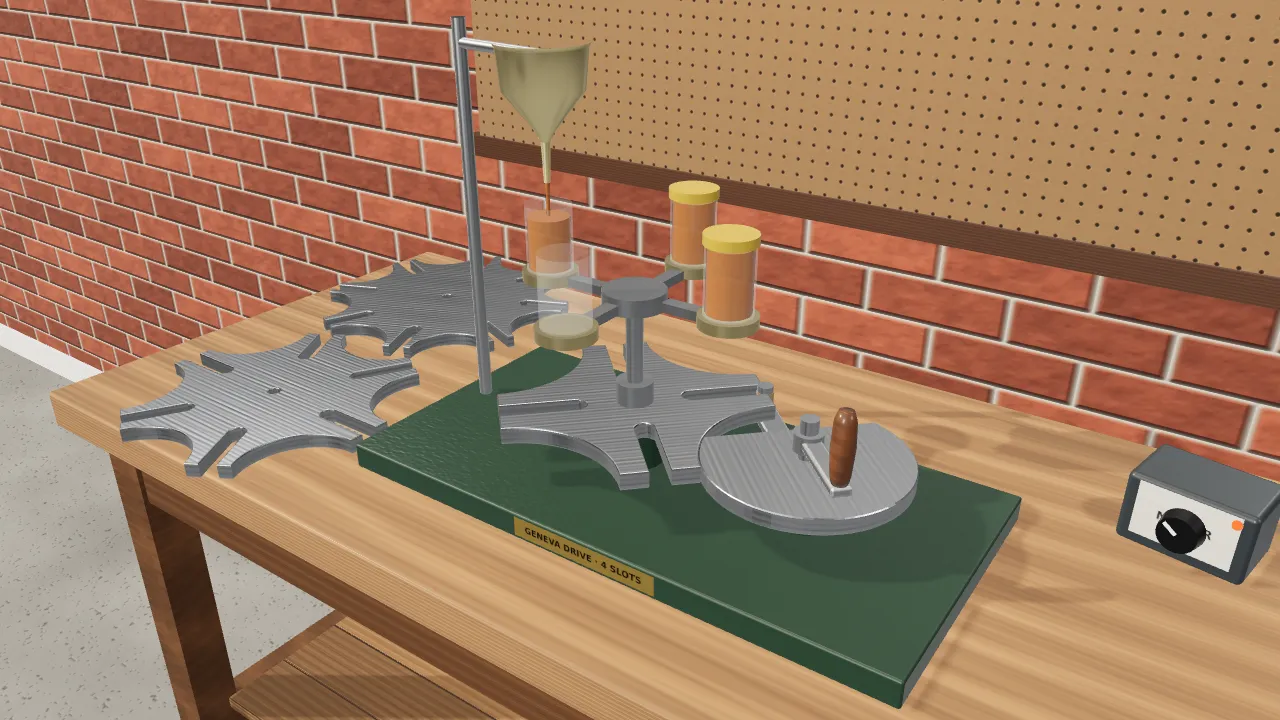
- Grab the wooden handle on the drive shaft and turn it. The steel Geneva wheel jumps one step, then waits while you keep turning.
- While the table is locked still, the filler pours honey into the jar beneath it. Keep turning to fill every jar.
- Drag a spare wheel from the bench and drop it on the output shaft to fit a 6-slot or 8-slot wheel.
- Turn the black dial on the motor box to let a motor drive it, or try the three Challenges.
Challenges
- Crank by hand until the table has stepped four times
- Fill every jar on the table to the brim
- Fit the eight-slot wheel from the bench and fill all eight jars
Try this
- Turn the drive slowly by hand and feel the moment the pin slides into a slot.
- Compare 4 slots with 8 slots. More slots means smaller steps and a shorter pause.
- Watch the start and end of each step: the wheel eases in and out instead of jerking.
Fun facts
- The Geneva drive is also called the Maltese cross mechanism, after the shape of its four-slot wheel.
- Film projectors used intermittent mechanisms such as the Geneva drive to hold each frame still in front of the lens.
- With four slots, the output stands still for three-quarters of every turn of the driving wheel.
Turning smooth motion into steps
Many machines need to move something, stop, do a job, then move again: a film frame held in front of a lamp, a bottle under a filling nozzle, a jar under a honey pump. The Geneva drive does this with only two moving parts and no electronics at all.
How it works
The drive wheel turns steadily and carries a pin on an arm of radius a. The Geneva wheel has n radial slots. Each time round, the pin slides into a slot, pushes the wheel on by one slot, and slides out again. For the rest of the turn a raised locking disc on the drive wheel fits snugly against a curved cut-out on the Geneva wheel, holding it still. The pin always enters and leaves along the slot, so the wheel starts and stops gently rather than with a bang.
Steps and pauses
The two wheels’ centres are a distance C = a / sin(π/n) apart, which makes the pin meet each slot head-on. Each step turns the output by 360°/n. The drive spends (n − 2)/2n of each turn moving the output and (n + 2)/2n waiting. For four slots that is a quarter moving and three-quarters still. With more slots, the steps get smaller and the pauses shorter.
The motion during a step
While the pin is in a slot, the output angle is β = atan(sin φ / (C/a − cos φ)), measured from the middle of the step, with φ the drive angle from the same point. The output speeds up gradually from rest, is fastest in the middle and slows smoothly back to rest. That gentle start mattered in film projectors, where a sudden jerk would tear the film.
Where you’ll find it
Besides film projectors, Geneva drives turn indexing tables in factories and appear in some mechanical watches. The name is usually traced to the Geneva stop, a related mechanism used in watches to stop the mainspring being over-wound.
For the curious
The simulation computes the output angle with exactly this formula, adds one step for every completed index, and holds the wheel in place during the dwell. The centre distance stays at 24 cm, so each wheel comes with its own pin radius a = C·sin(π/n). The honey pump is driven by the same shaft, so it pours only while the table is locked, in proportion to how far you turn.
Questions people ask
What is a Geneva drive used for?
It turns continuous rotation into intermittent, step-by-step rotation. It has been used to advance film in projectors, to index work tables in factories and in some watches and instruments.
How long does a Geneva wheel stop for?
For an external Geneva drive with n slots, the output is still for (n + 2)/2n of each turn of the drive wheel. With four slots that is 75 percent of the time.
Why is it called a Maltese cross mechanism?
A four-slot Geneva wheel, with its slots and curved cut-outs, looks rather like a Maltese cross, so the mechanism is often called by that name.