Gas Syringe: Boyle’s Law
Squeeze a sealed syringe of air, warm it and read the pressure gauge.
How to play
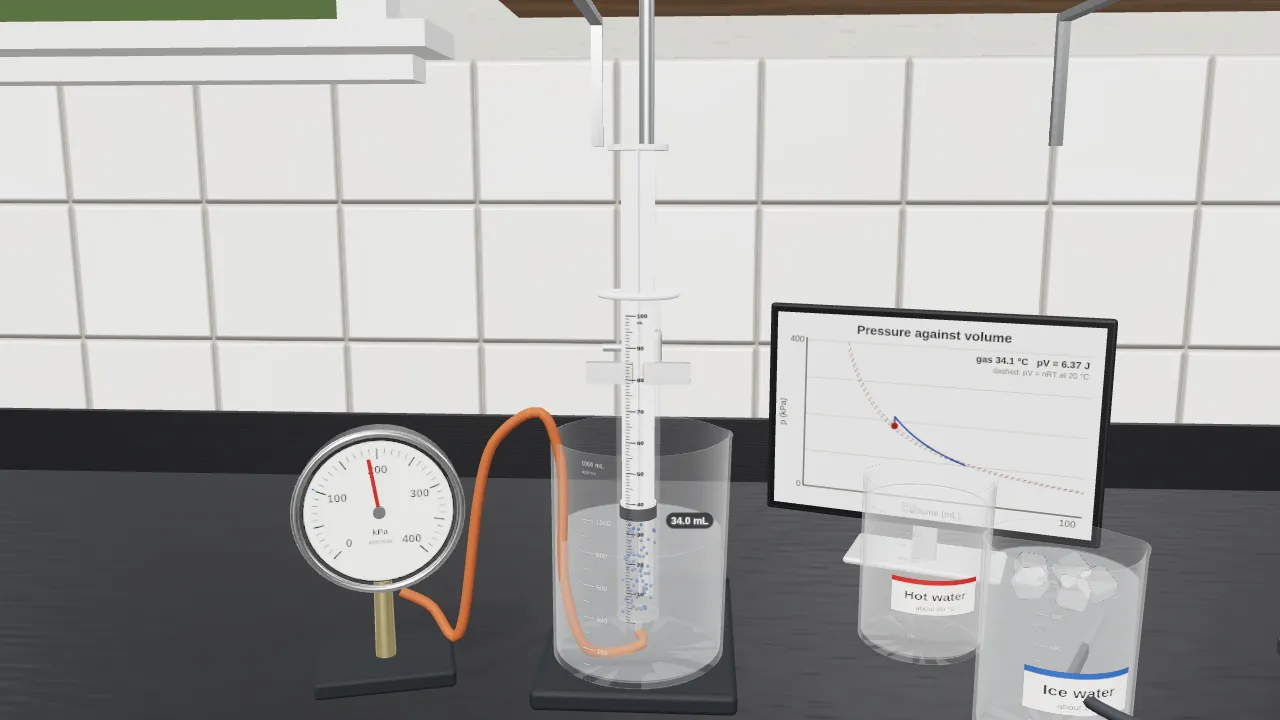
- Drag the white thumb plate on top of the plunger down to squeeze the air, or up to stretch it. The gauge shows the pressure, and the particles inside crowd together.
- Push fast and the gas warms up (the display shows its temperature); hold still and it cools back, and the pressure settles.
- Tip the hot-water or ice-water beaker over the big beaker to warm or chill the syringe in a water bath.
- Let go and the rubber seal grips the barrel, so the plunger stays put unless the pressure difference grows large. Lab resets the syringe or empties the bath.
Challenges
- Push the plunger in until the pressure doubles
- Halve the volume at constant temperature: hold it until the gas cools
- Warm the gas past 40 °C while keeping the gauge at 101 kPa
Try this
- Squeeze from 60 mL to 30 mL quickly and read the gauge, then hold still for ten seconds. The pressure sinks back to about 203 kPa as the gas cools to room temperature.
- Pour in ice water and watch the pressure fall as the gas cools, even though nothing touches the plunger.
- Move the plunger slowly and watch the red dot on the display trace the curve where pressure times volume stays the same.
Fun facts
- Robert Boyle published the link between the pressure and volume of a gas in 1662.
- Atmospheric pressure at sea level is about 101 kilopascals, roughly the weight of 10 tonnes on every square metre.
- Air molecules at room temperature move at roughly 500 metres per second on average.
- Squeezing a gas quickly heats it: diesel engines ignite their fuel this way, with no spark.
Squeezing air, molecule by molecule
A gas is mostly empty space. Its molecules fly about at hundreds of metres per second, bouncing off each other and off the walls of their container. Every bounce gives the wall a tiny push, and countless pushes every instant add up to the steady force we call pressure. The syringe here holds a fixed amount of air, 60 mL at atmospheric pressure, sealed in by the plunger and connected to a pressure gauge.
Boyle’s law
Squeeze the gas into half the space and each molecule reaches a wall twice as often, so the pressure doubles. Pull the plunger out and the pressure falls. As long as the temperature stays the same, pressure times volume stays constant: pV = constant. This is Boyle’s law, published by Robert Boyle in 1662 from experiments with air trapped in a J-shaped glass tube.
The catch: squeezing warms the gas
Push quickly and the plunger does work on the gas: molecules bounce off the advancing seal faster than they arrived, so the gas heats up and for a moment the pressure is higher than Boyle’s law predicts. Hold still and the warm gas gives its heat to the syringe wall within a few seconds, and the pressure settles to the Boyle value. That is why “at constant temperature” matters, and why careful experiments wait for each reading to settle. Squeeze hard and fast enough and air gets hot enough to ignite fuel, which is how a diesel engine works.
Warming at constant pressure
Heat the gas and its molecules move faster, hitting the walls harder and more often. With the plunger held still, the pressure rises. If instead you let the volume grow so that the pressure stays the same, the volume rises in proportion to the absolute temperature: Charles’s law, V ÷ T = constant. Both laws are parts of one rule, the ideal gas law.
Safety
Hot water from a kettle can scald, and sealed glass under high pressure can burst: real experiments need an adult in charge, a plastic syringe and modest pressures. Please read our disclaimer.
For the curious
The ideal gas law is pV = nRT, with R = 8.314 J/(mol·K) and T in kelvin (°C + 273.15). For the 60 mL of air here, n ≈ 2.49 mmol and pV ≈ 6.08 J at 20 °C. A quick, insulated squeeze follows pVγ = constant with γ ≈ 1.4 for air, so halving the volume fast raises the pressure about 21.4 ≈ 2.6 times rather than 2, and the absolute temperature about 20.4 ≈ 1.3 times. Kinetic theory links pressure to molecular motion, p = ⅓ρ⟨v²⟩, so the average kinetic energy of the molecules is proportional to the absolute temperature.
Questions people ask
What does Boyle’s law say?
For a fixed amount of gas at constant temperature, pressure and volume are inversely proportional: halve the volume and the pressure doubles, so pressure times volume stays the same.
Why does the pressure drop after I push the plunger in quickly?
A fast push heats the gas, which lifts the pressure above the Boyle value. As the gas cools back to the temperature of the syringe, the pressure falls and settles where pressure times volume is back to its starting value.
What is the difference between Boyle’s law and Charles’s law?
Boyle’s law keeps the temperature fixed and relates pressure to volume. Charles’s law keeps the pressure fixed and says the volume is proportional to the absolute temperature. Both follow from the ideal gas law, pV = nRT.