Fourth of July Fireworks
Launch red, white and blue fireworks over a calm summer lake.
How to play
- Press the sky over the lake to aim: a ring shows where the shell will burst. Let go to fire it.
- Your shells come in turn: red, white, then blue. Spread them across the sky to compare the three chemistries.
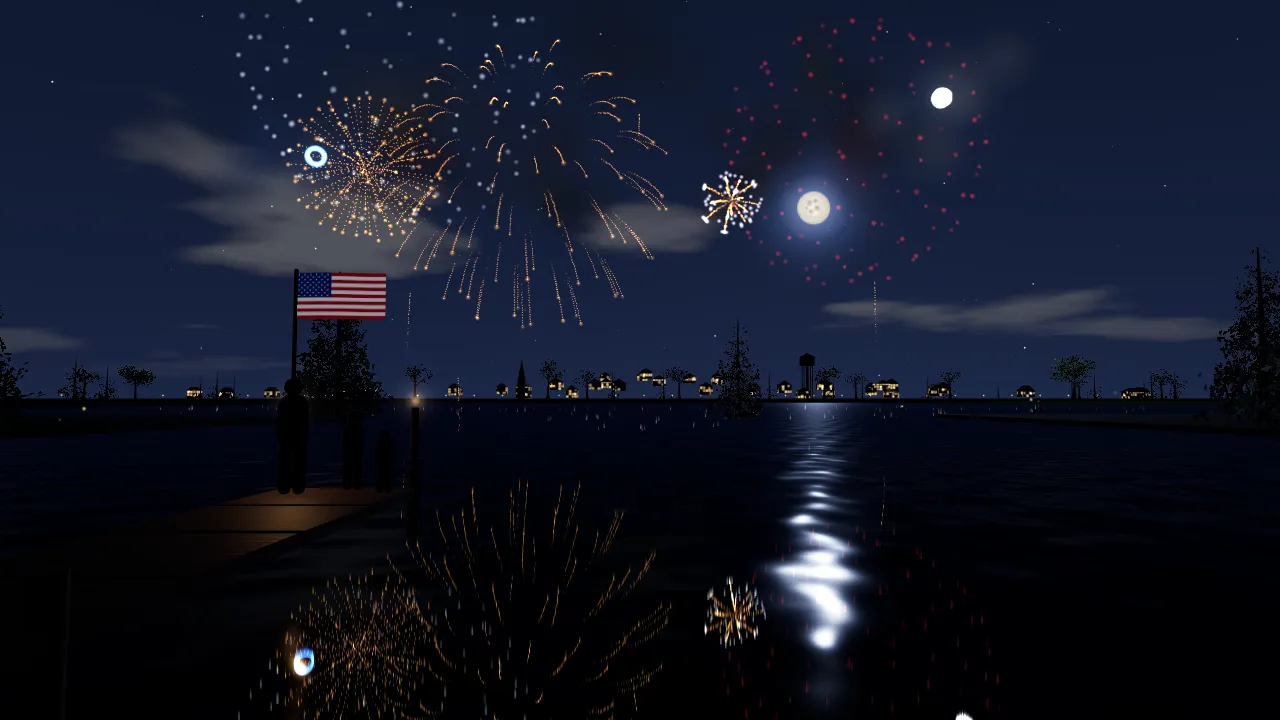
- Watch the lake: every burst, the shore lights and the low moon are mirrored in the water.
- Try the three Challenges, or open Lab for a Red, white and blue volley, metal salts and shell sizes.
Challenges
- Burst red, white and blue side by side over the lake
- Burst a shell right above the water tower on the far shore
- Burst a shell far enough away that its boom takes over 1.2 s to reach you
Try this
- Fire the red, white and blue volley and compare the colours. Red and blue come from glowing molecules, but white comes from metal particles glowing white-hot.
- Watch the reflections in the lake. Each burst appears below the horizon at the same angle as it sits above the far shore.
- Choose copper for blue and fire a few shells. Notice how much paler the blue looks next to strontium red.
Fun facts
- The Continental Congress approved the final text of the Declaration of Independence on 4 July 1776.
- In a letter to his wife Abigail in July 1776, John Adams predicted that independence would be celebrated with “illuminations” from one end of the continent to the other.
- White fireworks get their colour from tiny particles of metals such as magnesium or aluminium burning white-hot, a glow that mixes every colour.
- Blue is the hardest firework colour to make, because the copper chloride that produces it breaks apart if the flame is too hot.
Red, white and blue: three kinds of light
Independence Day in the United States marks the adoption of the Declaration of Independence in 1776, and fireworks have been part of the celebration since the earliest anniversaries. Displays over lakes, rivers and harbours are popular, because the water doubles every burst. The three national colours turn out to need three quite different kinds of chemistry.
Red: strontium
Red stars contain a strontium compound together with a chlorine donor. In the flame, they form short-lived molecules such as strontium monochloride that give out light mostly between about 600 and 690 nanometres, the red end of the spectrum. Strontium gives a deep, reliable red, which is why it appears in almost every display.
White: metals glowing white-hot
White is made differently. Fine particles of magnesium, aluminium or titanium burn so fiercely that the solid particles become white-hot. A hot solid gives out a continuous spread of colours, and when every colour is present together our eyes see white. This is incandescence, the same reason an old filament bulb glows.
Blue: copper, the tricky one
Blue light comes from copper(I) chloride molecules, which emit around 420 to 460 nanometres. The difficulty is temperature. If the star burns too cool, the blue is faint; if it burns too hot, the copper chloride falls apart and the colour washes out to white. Firework makers have to balance the fuel, the oxidiser and the chlorine donor carefully, and good blues are still a sign of a skilled maker.
Reflections on the lake
A calm lake works like a slightly rippled mirror. Each light appears below the horizon at the same angle that it sits above it, stretched into a vertical streak by the small waves. The scene draws every star and window light a second time, mirrored in the water and nudged by gentle ripples, so the reflections move with the show.
For the curious
The energy of each photon is E = hc/λ. Red light at 650 nm carries about 1.9 electronvolts, while blue at 440 nm carries about 2.8 eV. Molecules can only release particular amounts of energy as their electrons drop between levels, which is why each salt has its own colour. A white-hot particle, by contrast, follows Planck’s law and glows across the whole visible range.
Questions people ask
Why are blue fireworks rare?
Blue comes from copper chloride molecules, which only survive in a narrow range of flame temperatures. Too hot and they break apart, so the blue fades to white. Getting a deep blue takes careful chemistry.
What makes white fireworks white?
Tiny particles of metals such as magnesium, aluminium or titanium burn so hot that they glow white. A white-hot solid gives out every colour at once, which our eyes see as white.
Why do people watch fireworks over water?
Water reflects the bursts, so you see each one twice, and lakes and rivers give a clear, open space for both the launch site and the crowd.