Fireworks Colour Lab
Fire one metal salt at a time and read its light in a spectroscope.
How to play
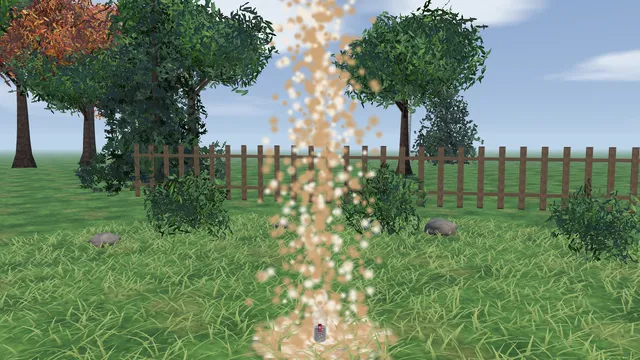
- Tap a jar of salt on the bench: that salt is loaded and a shell of it is fired. The powders are white or pale; the colour only appears in the flame.
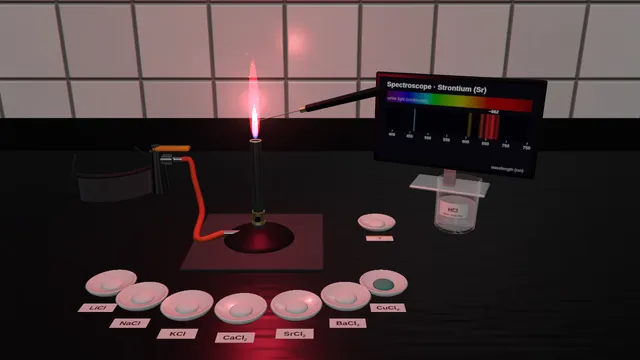
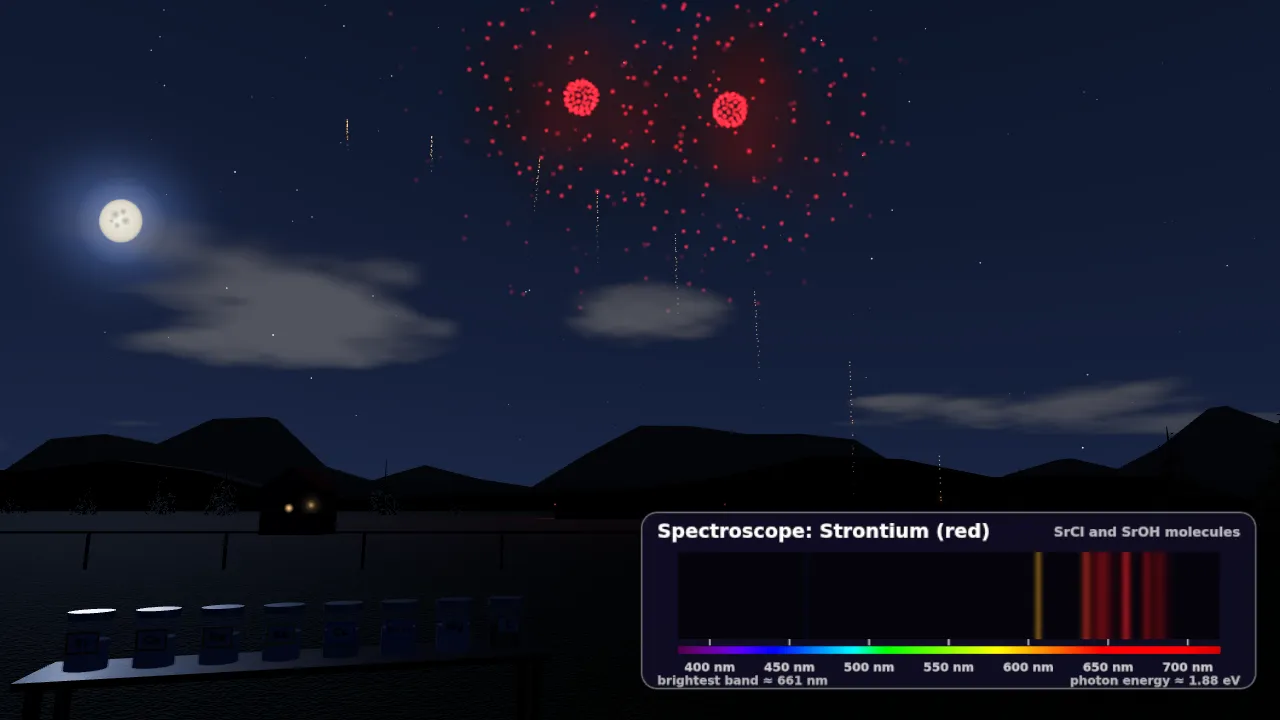
- Read the spectroscope: its lines and bands brighten while that salt’s stars are burning.
- Press the sky to aim more shells of the same salt, and let go to fire.
- Try the three Challenges, or press Compare all eight in Lab to fire every salt in a row.
Challenges
- Fire sodium and see its light squeeze into one yellow line
- Fire all eight salts and compare their spectra
- Burst strontium red and copper blue together to mix purple
Try this
- Fire sodium and look at the spectroscope: almost all of its yellow light sits in one place, the famous pair of D lines near 589 nm.
- Compare strontium and copper with the purple mix. The spectroscope shows the purple is simply red bands and blue bands together.
- Fire magnesium and then charcoal. Neither has sharp lines; both glow across the spectrum like hot solids, but charcoal is cooler, so its light leans red.
Fun facts
- Sodium’s yellow light comes mainly from two lines very close together, at about 589.0 and 589.6 nanometres, known as the sodium D lines.
- Many firework colours come from short-lived molecules made in the flame, such as strontium monochloride (red), barium monochloride (green) and copper(I) chloride (blue).
- A photon of 589-nanometre yellow light carries about 2.1 electronvolts of energy.
- Astronomers use spectroscopes in the same way to work out which elements are present in distant stars.
Each salt sings its own colour
A firework star is a pellet of fuel, an oxidiser, a binder and a colourant. When it burns, the colourant’s atoms and molecules are heated so strongly that they glow. Each one can only give out light of certain wavelengths, so a spectroscope, which spreads light out by wavelength, shows a pattern that works like a fingerprint. This lab fires one salt at a time and shows its fingerprint along the bottom of the screen.
Electrons and energy levels
Electrons in atoms and molecules can only hold certain amounts of energy, called energy levels. Heat in the flame kicks an electron up to a higher level, and when it falls back it releases the difference as a single packet of light, a photon. The bigger the drop, the shorter the wavelength: big drops give blue light, small drops give red. Because the levels are fixed, the light comes out at particular wavelengths, which show as bright lines in the spectroscope.
Lines and bands
Free atoms give sharp single lines, like sodium’s pair near 589 nm. Most firework colours, though, come from small molecules formed in the flame, and molecules can also vibrate and rotate, which smears each line into a band of closely spaced lines. Strontium monochloride and hydroxide give a cluster of red bands, barium monochloride gives green bands near 505 to 535 nm, and copper(I) chloride gives blue bands near 420 to 460 nm. That is why red, green and blue stars contain a chlorine donor as well as the metal: the chlorine is needed to form the molecules that glow. The wavelengths shown here are approximate band positions.
Glowing because they are hot
White and gold work differently. Burning magnesium or aluminium makes tiny solid particles that become white-hot, and charcoal sparks glow orange-gold. Hot solids give out a continuous spectrum with no gaps, and the hotter they are, the more their light shifts towards blue and white.
Safety note
Real colourants are hazardous: barium compounds are toxic, the oxidisers used in fireworks can explode, and mixing pyrotechnic compositions at home is dangerous and illegal in many places. Please only enjoy these colours virtually or at professional displays, and see our disclaimer.
For the curious
A photon’s energy is E = hc/λ ≈ 1240 eV·nm / λ. Red light at 650 nm carries about 1.9 eV and blue at 440 nm about 2.8 eV. A hot solid follows Planck’s law, and the peak of its glow moves to shorter wavelengths as it gets hotter (Wien’s law, λmax ≈ 2.9 × 10⁻³ m·K / T).
Questions people ask
How do fireworks get their colours?
Metal compounds in the stars are heated until their electrons jump to higher energy levels. As the electrons fall back, they give out light of particular wavelengths: strontium makes red, barium green, copper blue and sodium yellow.
What does a spectroscope show?
It spreads light out by wavelength. A glowing element or molecule shows bright lines or bands at its own wavelengths, which act like a fingerprint for identifying it.
Can I do a firework colour experiment at home?
Not with firework chemicals: they are toxic, explosive or both, and making pyrotechnics at home is dangerous and often illegal. Supervised flame tests with simple salts are done in school labs with proper safety equipment.