Erosion Stream Table
Pour water down a sand table and carve rivers and deltas.
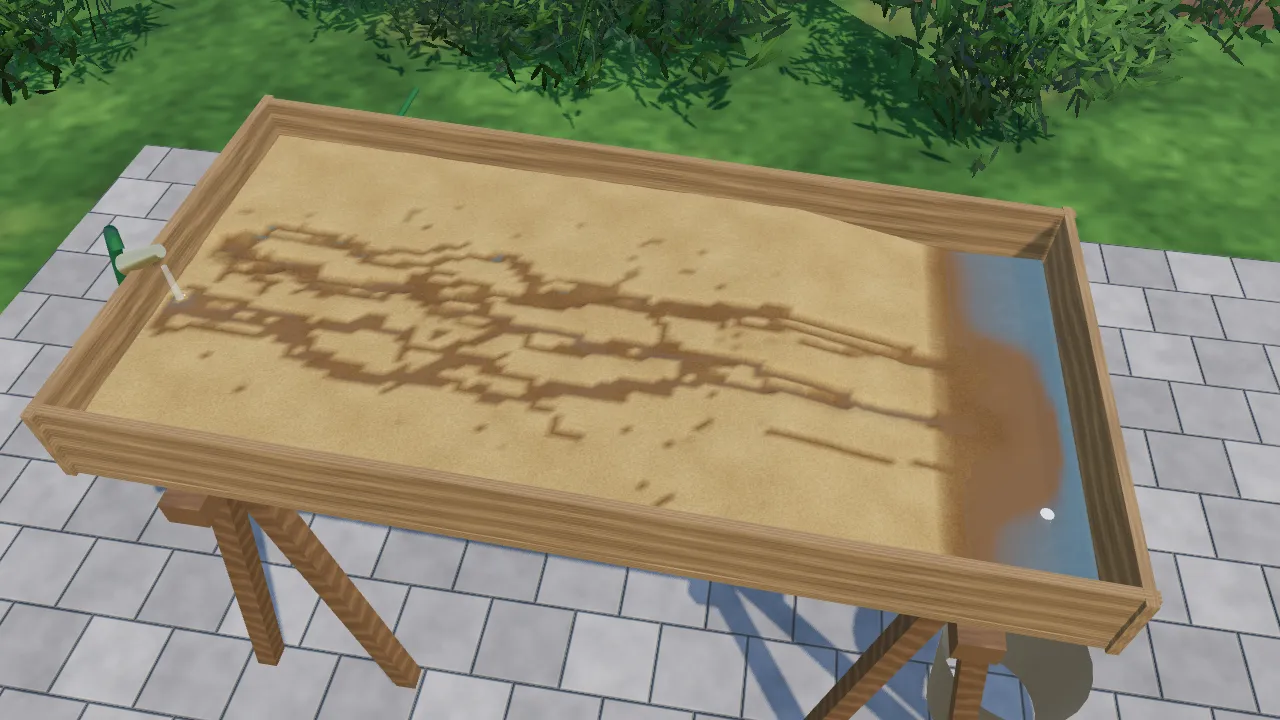
How to play
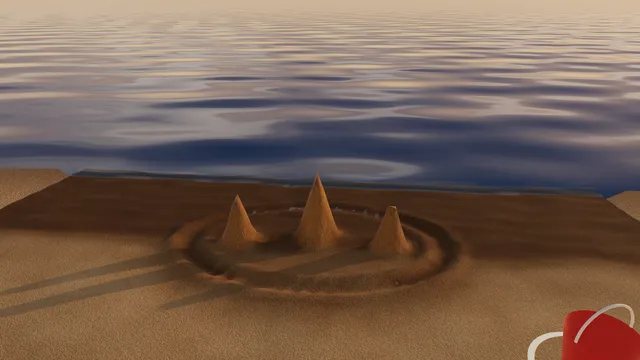
- Drag the brass nozzle of the hose along the top of the table to choose where the water pours in. Tap it to turn the water off or on.
- Draw in the sand with your finger to make a groove, and see whether the water follows it.
- Drag the white overflow pipe in the pool up or down to raise or lower the water at the bottom.
- Try the three Challenges, or open Lab to change the flow or smooth the sand.
Challenges
- Carve a channel all the way from the hose down to the pool
- Build a delta fan where the river runs into the pool
- Move the hose so the river leaves its bed and cuts a second channel
Try this
- Pour in one place for a minute, then move the hose a hand’s width sideways. The old channel dries out and the water finds a new route.
- Raise the pool with the overflow pipe. The river slows where it meets the deeper water and drops its sand further upstream.
- Turn the flow up in Lab. Faster water carries more sand, so the channel deepens quickly and the delta grows.
Fun facts
- Geologists, engineers and teachers use stream tables, trays of sand with water running across them, to study how rivers carve channels and build deltas.
- The word delta comes from the Greek letter Δ, because the mouth of the Nile spreads out into a triangle of land.
- Rivers move sediment in two ways: sand that rolls and hops along the bed, and fine mud held up in the water, which is why floodwater looks brown.
- Dry sand piles up to a slope of about 30 to 35 degrees, its angle of repose. Steeper banks slump until they reach it.
How running water shapes the land
Water always runs downhill, but how it runs depends on the ground. On smooth sand it first spreads as a thin sheet. Any small hollow carries a little more water, a little faster, and so it is scoured a little more. That is a feedback loop: deeper grooves draw in more water, and soon most of the flow gathers into a single channel. Nobody designs a river; it chooses its own path.
Carrying capacity
Moving water can hold a certain amount of sediment, and that amount grows with its speed and with the steepness of the ground. Clear water below its carrying capacity picks grains up, so it digs. Water that slows down, because the slope eases or it flows into deeper water, can no longer hold its load and drops it. This one rule explains much of a river’s life: it cuts down where it runs fast and builds up where it slows.
Deltas
Where the river meets the still pool at the bottom of the table, its speed falls away almost at once. The sand it has been carrying settles out in a fan, the coarsest grains first. As the fan grows, the river spreads across it in shallow, shifting branches and pushes the new land out into the water. Real deltas, from the Nile to the Mississippi, grow the same way, only with millions of tonnes of mud.
Banks that slump and rivers that wander
Sand cannot stand at any slope. When the water undercuts a bank and makes it steeper than the angle of repose, the bank slumps into the channel, which widens it. Over time a river can also block itself with its own deposits. Then a small change, like moving the hose, sends the water down a new route and the old channel dries out. Geologists call this jump an avulsion.
For the curious
The water uses the virtual-pipe method: each cell of the sand pushes water to its four neighbours through imaginary pipes, with the flow in a pipe growing by g·Δh·Δt·Δx each step, where Δh is the difference in water-surface height. The sediment capacity is C = Kc·|v|·(sin α + 0.02), where v is the water speed and α the local slope. Below capacity the bed is eroded at a rate Ks(C − s); above it, sand settles at Kd(s − C). Sand travels with the water it is in, so none is lost except the fine silt that spills over the outlet.
Questions people ask
What is a stream table?
A stream table is a long tray of sand, tilted at one end, with water running down it. It shows in minutes how rivers form channels, carry sand, build deltas and change course, processes that take years or centuries in nature.
Why do rivers build deltas?
A river carries sand and mud while it flows fast. When it reaches a lake or the sea it slows down suddenly and can no longer hold its load, so the sediment settles out and builds new land at the river mouth.
Why do rivers change course?
A river slowly fills parts of its bed and its delta with its own sediment. When the old path becomes higher than the land beside it, a flood or a small change in the flow can send the water down a new, lower route.