Eclipse Maker
Steer the Moon to make its phases, a solar eclipse and a blood Moon.
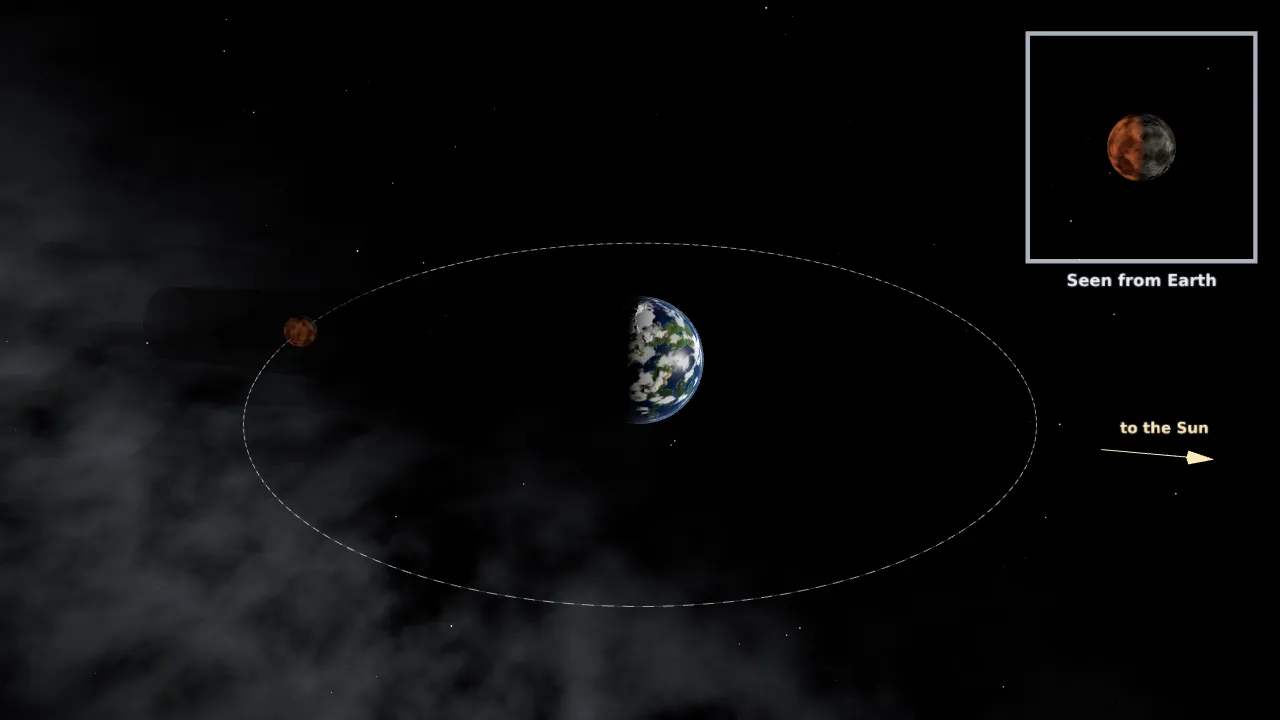
How to play
- Drag the Moon round its orbit. The inset shows it as seen from Earth, so you can watch its phases change.
- Put the Moon opposite the Sun for a full Moon, or between Earth and the Sun for a new Moon.
- Usually the shadows miss, because the orbit is tilted. Grab the dashed ring and drag up or down to tilt it until the yellow nodes point at the Sun.
- Dragging the Moon slightly in or out changes its distance: a total solar eclipse needs it nearer than average. Drag empty space to look around; the Lab has more options.
Challenges
- Drag the Moon round to make a full Moon
- Make a total solar eclipse: put the Moon’s dark shadow on Earth
- Turn the Moon blood red by steering it right into Earth’s shadow
Try this
- Make a new Moon with the real 5° tilt and watch the Moon’s shadow pass above or below the Earth. That is why there is no eclipse every month.
- Set up a central solar eclipse, then drag the Moon a little farther out. Its shadow no longer reaches the ground and the eclipse turns annular: a ring of fire.
- Slide the Moon slowly into Earth’s shadow and watch it dim at the edge before the coppery red sets in.
Fun facts
- The Sun is about 400 times wider than the Moon and about 400 times farther away, so the two look almost the same size in our sky.
- At any one place, the total phase of a solar eclipse lasts at most about seven and a half minutes.
- A total lunar eclipse can be seen from anywhere on Earth’s night side, but the total phase of a solar eclipse only along a narrow path.
- The Moon’s orbit is tilted about 5° to the plane of Earth’s orbit around the Sun.
Phases, shadows and why eclipses are rare
The Moon makes no light of its own. The Sun always lights half of it, and the phase is how much of that lit half faces us. When the Moon sits between Earth and the Sun we see its dark side: a new Moon. When it is opposite the Sun we see the whole lit face: a full Moon. In between come the crescents, quarters and gibbous Moons, and the inset shows each one as it looks from Earth.
Shadows in space
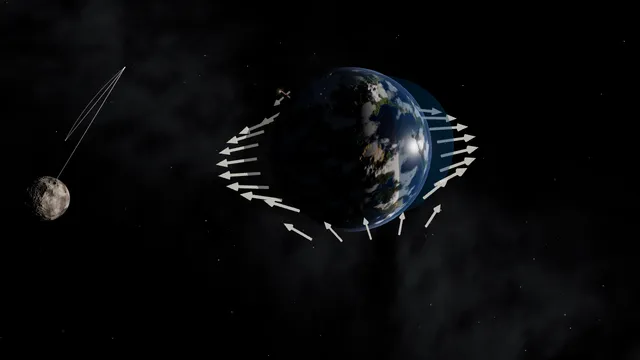
Every lit body trails two shadows. In the dark umbra the Sun is completely hidden; in the wider penumbra it is only partly covered. A solar eclipse happens when the Moon’s shadow falls on Earth; a lunar eclipse when the Moon passes through Earth’s shadow. The toy works these out with the real sizes and distances, even though the drawing squeezes the Moon’s orbit to fit.
A tilted orbit
If the Moon circled in the same plane as Earth goes round the Sun, there would be a solar eclipse at every new Moon and a lunar eclipse at every full Moon. Its orbit is tilted about 5°, though, so usually the Moon passes a little above or below the line to the Sun and the shadows miss. Eclipses can only happen when a new or full Moon falls near one of the two nodes, where the orbit crosses Earth’s orbital plane. That lines up in two eclipse seasons a year, about 173 days apart.
Total or annular?
The Moon’s full shadow is a narrow cone about 374,000 km long, while the Moon’s distance swings between about 356,500 and 406,700 km. When the Moon is near, the tip of the cone reaches the ground and a narrow strip of Earth sees a total eclipse, with the Sun’s pearly corona around the black Moon. When it is far, the cone falls short and the Moon cannot quite cover the Sun, leaving a bright ring: an annular eclipse.
Why the blood Moon is red
Even inside Earth’s umbra the Moon is not black. Earth’s atmosphere bends some sunlight into the shadow, and on the way through the air most of the blue is scattered out, so mainly red light arrives. The eclipsed Moon is lit by the glow of every sunrise and sunset on Earth at once.
For the curious
Illuminated fraction: k = (1 + cos ψ)/2, with ψ the angle Sun–Moon–Earth. Umbra length: L = d·RM/(RS − RM), with d the Sun–Moon distance. Earth’s umbra radius at distance x behind it: r = RE − x(RS − RE)/dS, about 4,600 km at the Moon, a little more because of the atmosphere.
Questions people ask
Why isn’t there an eclipse every month?
The Moon’s orbit is tilted about 5° to Earth’s. At most new and full Moons it passes above or below the line to the Sun, so the shadows miss. Eclipses need a new or full Moon close to a node, which happens in two seasons each year.
Why does the Moon turn red in a lunar eclipse?
Earth’s atmosphere bends some sunlight into its shadow. Passing through the air scatters most of the blue away, so mainly red light reaches the Moon: the light of all the sunrises and sunsets around the Earth.
What is an annular eclipse?
When the Moon is farther away than average it looks slightly smaller than the Sun, so even when it crosses the Sun’s centre a bright ring is left showing around it: a ring of fire.