Easter Egg Roll
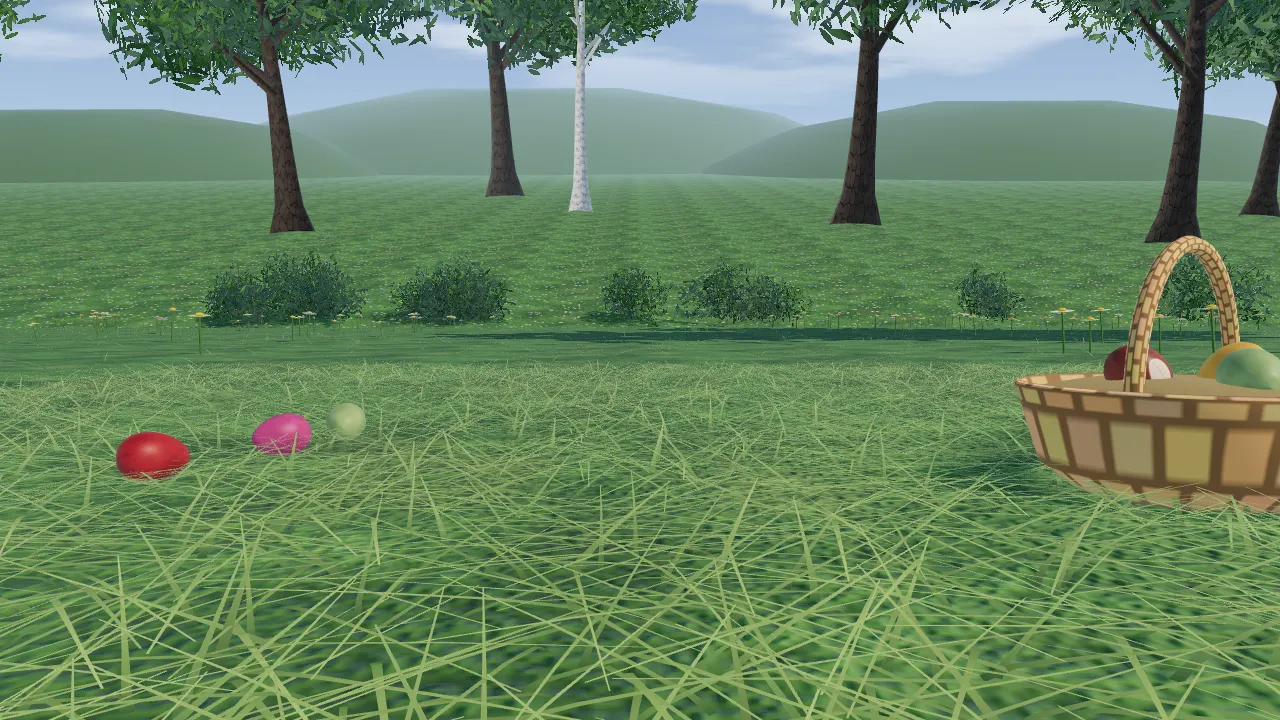
Flick dyed eggs down a spring grass bank and see them curve and wobble.
How to play
- Press an egg and flick it down the grass bank, or tap it for a gentle push.
- Watch it curve towards its narrow end and wobble as it slows down.
- Flick one egg into another to make them clack, and tap the basket for fresh eggs at the top.
- Open Lab to change the slope and the grass, and whether the eggs are hard-boiled or raw.
Challenges
- Flick an egg downhill and let it curve round until it heads back uphill
- Roll one egg into another so they clack together
- Flick an egg hard enough to roll four metres in one go
Try this
- Flick an egg straight down the slope and watch its path bend into loops. Like a paper cup, an egg rolls in circles because one end is fatter than the other.
- Compare the short lawn with long grass. Long grass soaks up far more energy, so the eggs stop much sooner.
- Race a raw egg against a boiled one. The raw egg starts quicker, because its liquid insides are slow to start turning, but its sloshing wastes energy.
Fun facts
- Rolling decorated eggs down hills at Easter is an old custom in parts of Britain, especially northern England and Scotland.
- The White House Easter Egg Roll has been held on the White House lawn since 1878. Children push their eggs along with long-handled spoons.
- A hard-boiled egg spins smoothly on a table, but a raw egg wobbles and slows quickly, because its liquid insides lag behind the shell.
- In Ukraine, pysanky are Easter eggs decorated with designs drawn in wax and dyed in layers.
Why an egg rolls in circles and wobbles
Easter is the Christian festival of the resurrection of Jesus, celebrated in spring on a date that moves each year: the first Sunday after the first full moon on or after the spring equinox, by the church’s reckoning. Eggs are a widespread symbol of new life at Easter. They are dyed and painted, hunted for in gardens, and in some places rolled down grassy hills, a custom some link to the stone rolled away from Jesus’ tomb. Customs vary from country to country and family to family. This lawn is for the rolling.
Rolling takes energy for spinning
A sliding object on a slope speeds up at g·sin θ. A rolling one is slower, because some of the energy from gravity goes into spinning. For an object of mass m and radius r with rotational inertia I, the acceleration is a = g·sin θ / (1 + I/mr²). A hard-boiled egg rolling on its side is close to a solid ellipsoid, with I = (2/5)mr², so it accelerates at about 70% of the sliding rate.
Why the path curves
Lay a paper cup on its side and push it: it rolls round in a circle, because its wide end travels further on each turn than its narrow end. An egg is the same, only less extreme. One end is blunter than the other, so it tilts slightly on the ground and curves towards its narrow end. On a slope, gravity speeds the egg up whenever it heads downhill and slows it when it turns uphill, so the circles stretch into loops that drift down the hill.
Wobbles and stopping
A real egg is not perfectly balanced: the yolk and air pocket put its centre of mass slightly off its axis. As it rolls, that heavy side rises and falls, so the egg speeds up and slows down in a bumpy rhythm. When it is nearly out of energy it can no longer lift the heavy side over the top, so it rocks back and forth and settles with the heavy side down. Grass makes everything shorter: blades bend and spring back on each roll, soaking up energy as rolling resistance.
Raw or boiled?
Inside a raw egg the liquid is only loosely coupled to the shell. At first it hardly turns, so less energy goes into spinning and the egg starts faster. But the sloshing liquid rubs against itself and the shell, turning motion into heat, so it loses energy as it goes.
For the curious
The simulation integrates (m·r² + I)·ω′ = m·g·r·sin θ·cos ψ − m·g·e·sin φ − crr·m·g·r·cos θ·sign(ω) − cslosh·ω, where ψ is the heading, φ the roll angle, e the off-centre distance and crr the rolling resistance. The heading turns as ψ′ = κ·v, with κ = sin α / r from the egg’s taper angle α. For the simulated hen’s egg, 5.8 cm long and 4.3 cm across, that makes a circle about 18 cm in radius on level ground.
Questions people ask
Why do eggs roll in a circle?
An egg is fatter at one end than the other, so it rests slightly tilted and its wide end covers more ground on each turn than its narrow end. Like a paper cup on its side, it rolls round in a curve towards the narrow end.
Does a raw or a boiled egg roll faster?
It depends on the slope and the distance. A raw egg can start faster because its liquid insides do not spin at first, but the sloshing wastes energy, so a boiled egg often rolls more steadily and further on long runs.
Why do people roll eggs at Easter?
Eggs are a symbol of new life at Easter, and rolling them down hills is an old spring custom in several countries. Some link it to the stone rolled away from Jesus’ tomb, while for many families it is simply a fun Easter game.