Earthquake P and S Waves
Set off quakes and time the P and S waves at three seismographs.
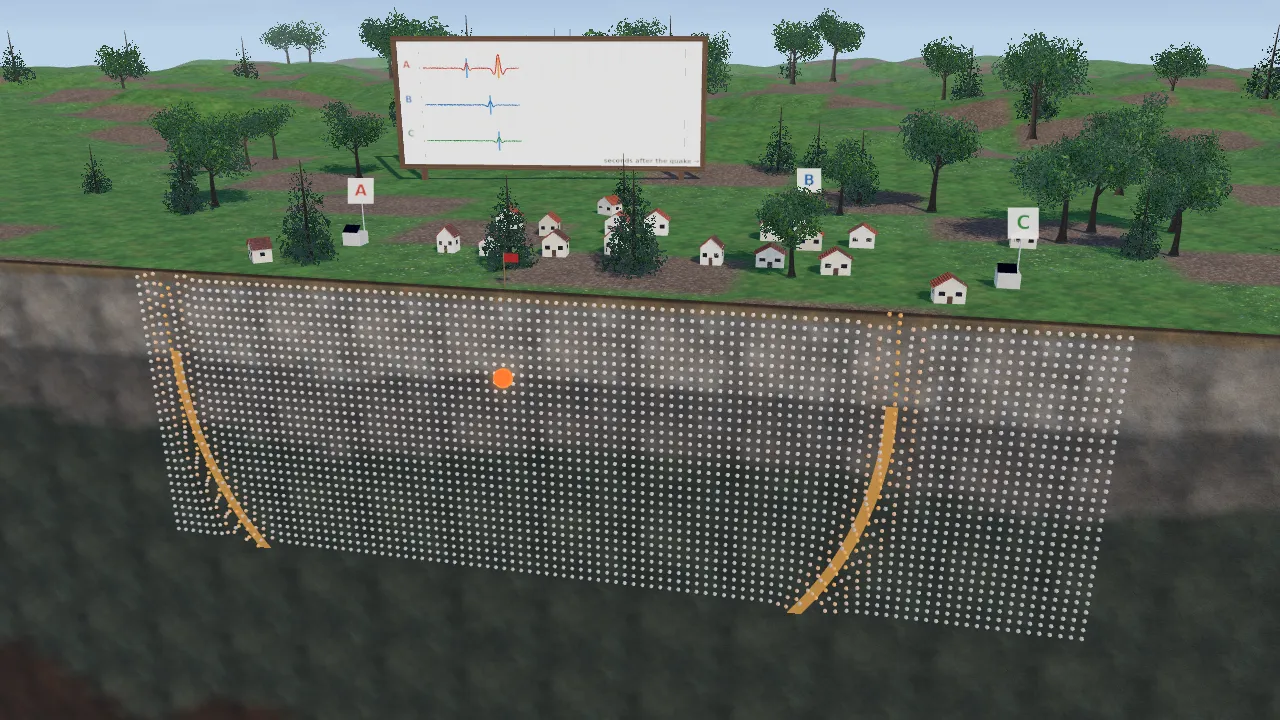
How to play
- Tap the land to start an earthquake under that spot, or tap the cut face to put the focus at that depth.
- Drag the glowing focus through the rock and let go to set it off. The deeper or farther away it is, the later the waves arrive.
- Watch the dots on the cut face: P waves push and pull them, S waves shake them sideways. The houses and station huts shake too.
- Read the chart: the gap between each station’s blue P mark and orange S mark gives its distance, and the three circles meet at the epicentre.
- Try the three Challenges, or open Lab for the magnitude, the rock type and the playback speed.
Challenges
- Set off a quake and let all three stations pin down its epicentre
- Start a quake far enough from station A that its S−P gap is over 8 seconds
- Place a quake so its P wave reaches stations B and C at the same moment
Try this
- Read the S−P delay at station A and multiply it by about 8. That is its distance from the focus in kilometres.
- Switch the rock to a sedimentary basin. Both waves slow down, and the gap between them grows.
- Make the quake deeper. The waves reach the surface later, and the shaking above is gentler.
Fun facts
- P waves are pressure waves that push and pull the rock along their direction of travel. They are the fastest seismic waves and arrive first.
- S waves shake the rock from side to side and cannot travel through liquids, which is how seismologists found that the Earth’s outer core is liquid.
- Charles Richter introduced his magnitude scale in 1935. Today seismologists mostly use the moment magnitude scale.
- Each whole step up in magnitude means roughly 32 times more energy released.
Two waves, one quake and the gap between them
An earthquake starts when stressed rock suddenly slips along a fault. The point underground where the slip begins is the focus, or hypocentre, and the point on the surface directly above it is the epicentre. The released energy spreads out through the rock as seismic waves.
P waves and S waves
Two kinds of wave travel through the body of the Earth. P waves, or primary waves, are pressure waves: they squeeze and stretch the rock along the direction they travel, like a push travelling down a spring. In granite they move at about 6 km/s. S waves, or secondary waves, shear the rock from side to side, at right angles to their travel, and are slower, about 3.5 km/s in granite. On the cut face of the block you can see both: blue dots jostle back and forth as the P wave passes, and orange dots swing sideways in the larger S wave that follows. Liquids cannot be sheared, so S waves cannot cross them.
Reading a seismograph
A seismograph records the ground’s motion over time. At a station near the quake the P and S waves arrive close together; farther away the gap grows, because the faster wave pulls further ahead with every kilometre. That gap, the S−P time, tells you the distance. With granite speeds, every second of delay means about 8.4 km.
Finding the epicentre
One station gives a distance but no direction: the quake could lie anywhere on a circle around it. Two stations narrow it down to two points where their circles cross. With three stations the circles meet at one place, the epicentre. When all three stations in this simulation have recorded both waves, it draws the three circles for you.
Why buildings feel two jolts
The P wave usually arrives as a sharp jolt or rumble. Seconds later the S wave brings stronger side-to-side shaking, which is more damaging to buildings. Early-warning systems use that delay: by detecting the fast P wave, they can sometimes send an alert seconds before the S wave arrives.
For the curious
For rock with bulk modulus K, shear modulus μ and density ρ, the speeds are vP = √((K + 4μ/3)/ρ) and vS = √(μ/ρ). A liquid has μ = 0, so S waves cannot exist in it. The distance from the S−P delay Δt is d = Δt·vPvS/(vP − vS), which with 6.0 and 3.5 km/s is d ≈ 8.4 km per second of delay. This is a hypocentral distance, so the circles on the surface use √(d² − h²), where h is the depth. Each wave is drawn as a short pulse, a Ricker wavelet, whose amplitude falls with distance; magnitude scales the shaking logarithmically.
Questions people ask
What is the difference between P waves and S waves?
P waves compress and stretch the rock along their direction of travel and are the fastest, about 6 km/s in granite. S waves shake the rock sideways, are slower at about 3.5 km/s, and cannot pass through liquids.
How do seismologists find the epicentre of an earthquake?
They measure the time between the P and S wave arrivals at several stations. Each delay gives a distance, so each station defines a circle on the map. Where the circles from three or more stations cross is the epicentre.
Why do you sometimes feel a jolt before the strong shaking?
The first jolt is usually the P wave, which travels fastest. The stronger shaking a few seconds later comes from the slower S wave and from surface waves.