DNA Double Helix
Pull DNA’s strands apart, swap base pairs and heat it until it melts.
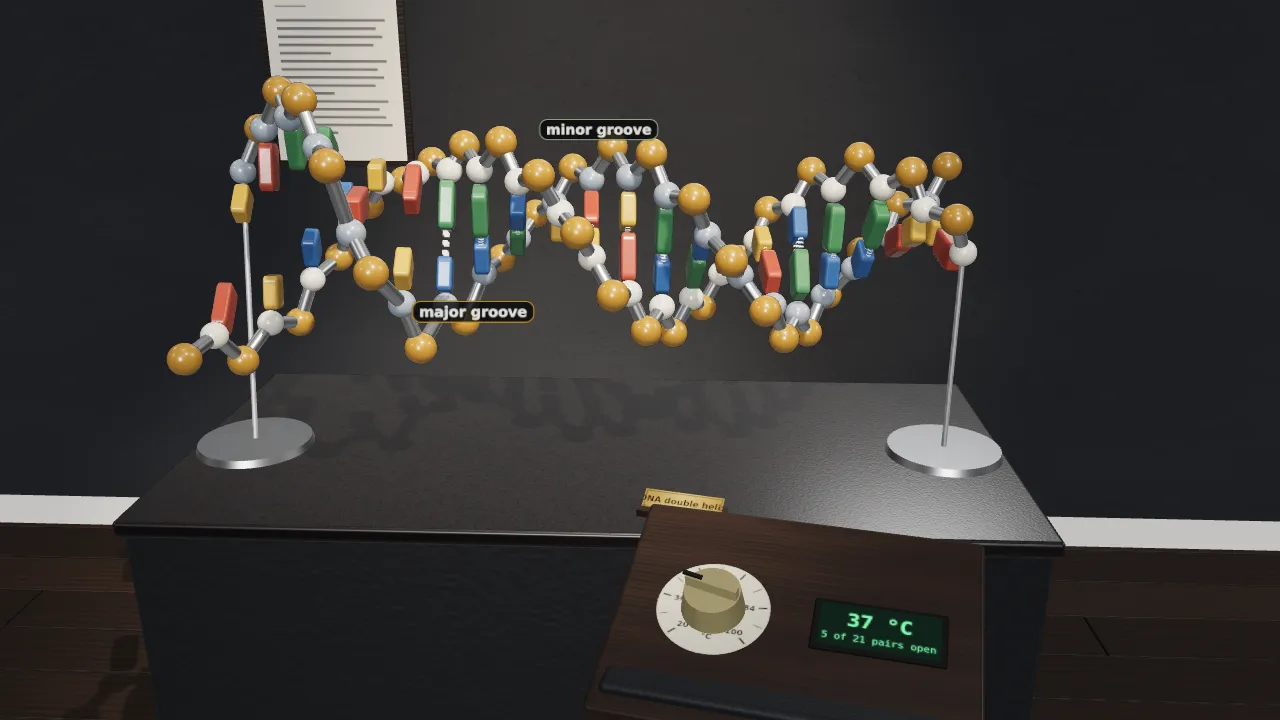
How to play
- Grab a bead on one strand and pull it away from the helix. Pairs near it open: from an end it unzips like a zip, in the middle it opens a bubble. Let go and it zips up again.
- G–C pairs have three hydrogen bonds and need a longer pull to open than A–T pairs, which have two.
- Tap a base pair to change it (A–T, T–A, G–C, C–G). The G–C content sets the melting temperature.
- Turn the brass knob on the console to heat the DNA. Open Lab for the sequence, base letters and a helicase unzip slider.
Challenges
- Pull one strand away and unzip ten base pairs at once
- Heat the DNA until its two strands come apart
- Tap base pairs to make the DNA G–C rich enough to melt above 95 °C
Try this
- Heat the A–T rich sequence and the G–C rich one. The A–T rich DNA starts to come apart at a much lower temperature.
- Follow one strand with your eyes from end to end. It twists to the right, like an ordinary screw thread.
- Look along the helix and find the wide groove and the narrow one. Proteins that read DNA usually fit into the wide, major groove.
Fun facts
- The double-helix structure was published in 1953 by James Watson and Francis Crick, using X-ray data from Rosalind Franklin and Maurice Wilkins.
- A–T pairs are held together by two hydrogen bonds, G–C pairs by three.
- Stretched out, the DNA in a single human cell would be about 2 metres long.
- PCR, the method behind many medical tests, works by repeatedly heating DNA to separate its strands and cooling it so each strand can be copied.
A twisted ladder that stores information
DNA is two long chains wound around each other. Each chain has a backbone of alternating sugar (deoxyribose) and phosphate groups, and from every sugar sticks one of four bases: adenine (A), thymine (T), guanine (G) or cytosine (C). The bases point inwards and pair up across the middle, A always with T and G always with C, like the rungs of a twisted ladder. Because the pairing is fixed, each strand carries all the information needed to rebuild the other.
The numbers of the helix
In the common form, called B-DNA, the base pairs are stacked about 0.34 nm (3.4 Å) apart, and the helix turns once every 10.5 base pairs or so, about 3.5 nm. It is roughly 2 nm across, and it twists to the right. The two strands run in opposite directions, which chemists describe as antiparallel.
Major and minor grooves
The two sugars of a base pair are not directly opposite each other: they are attached on the same side of the pair. So the two backbones are closer together on one side of the helix than the other, and two grooves wind around it, a wide major groove and a narrow minor groove. The edges of the bases are exposed in the grooves, and many proteins that switch genes on and off recognise their target sequence by fitting into the major groove.
Unzipping and melting
Before a cell divides it must copy its DNA, and enzymes called helicases unzip the strands so each can serve as a template. Heat can do the same: warm DNA enough and the hydrogen bonds and stacking that hold the strands together give way. This is called melting. G–C pairs have three hydrogen bonds rather than two and also stack more strongly, so G–C rich DNA melts at a higher temperature. Laboratory PCR machines cycle between about 95 °C, to separate the strands, and lower temperatures, to copy them.
For the curious: the model
This is a simplified model. Each nucleotide is shown as a phosphate bead 8.9 Å from the axis, a sugar bead and a base slab, using a rise of 3.38 Å and a twist of 360°/10.5 per pair. The sugars of a pair sit 10.5 Å apart, which places the backbones about 126° apart on one side and 234° on the other, creating the grooves. Melting uses the classic Marmur–Doty estimate for long DNA in salty solution, Tm ≈ 69.3 + 0.41 × (%GC) °C, applied to a seven-pair window so that A–T rich stretches open first. Real melting also depends on salt concentration and the exact sequence.
Questions people ask
Why is DNA a double helix?
The two strands are held together by base pairs, which stack on top of each other most stably when the ladder twists. The sugar–phosphate backbones wind around the outside, giving the right-handed double helix.
What are the major and minor grooves of DNA?
They are the two spiral grooves along the helix. Because both sugars of a base pair are attached on the same side of it, the backbones are closer together on one side, making one narrow (minor) groove and one wide (major) groove.
What temperature does DNA melt at?
It depends on the sequence and the salt in the solution, but long DNA typically melts somewhere between about 70 °C and 100 °C. DNA with more G–C pairs melts at higher temperatures.