Diamond vs Graphite
Pull diamond’s rigid atoms, then slide and peel graphite’s sheets.
How to play
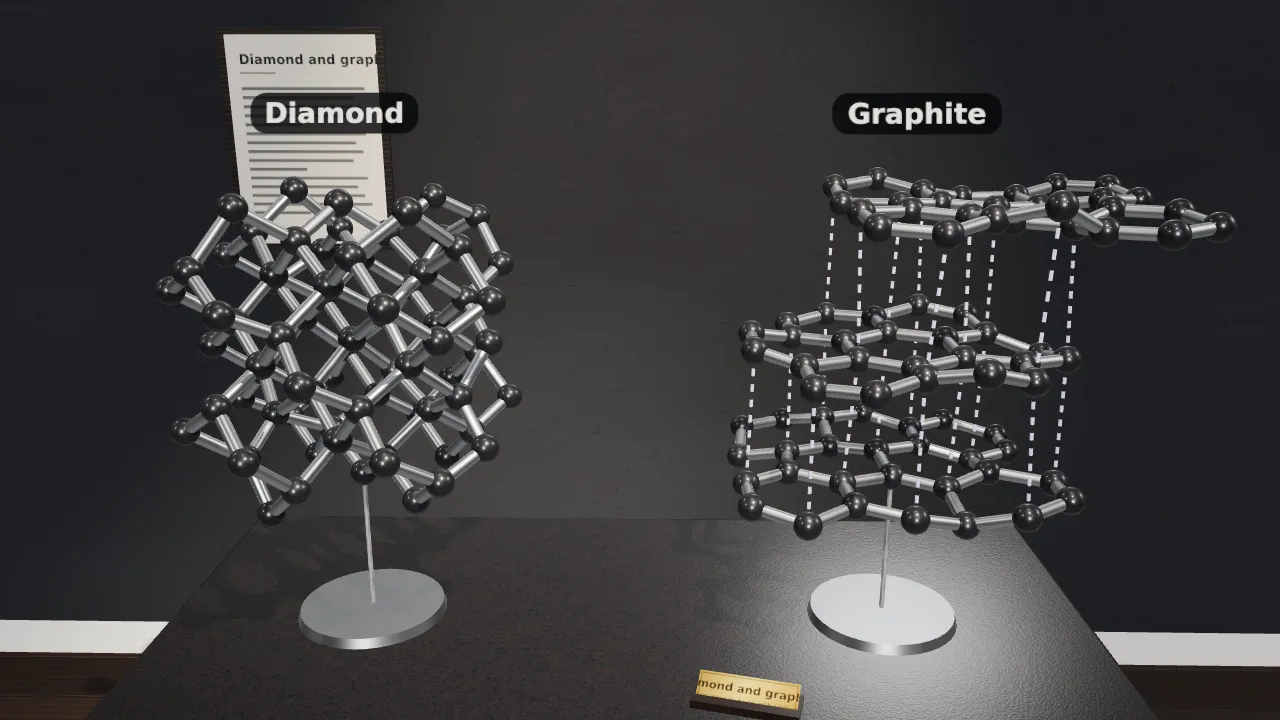
- Grab a carbon in the diamond block and pull it. Four strong bonds hold it, and the whole network rings when you let go.
- Drag graphite’s top sheet sideways. It clicks past each stacking position and settles into the nearest one when you let go.
- Drag the top sheet upwards to peel it off: a single sheet is graphene. Let go and the weak forces pull it back down.
- Open Lab for space-filling or sticks, the weak forces between the sheets and the temperature.
Challenges
- Pull a diamond atom and feel its four bonds hold the network together
- Slide graphite’s top sheet one whole hexagon along
- Peel the top sheet off the stack: one layer on its own is graphene
Try this
- Count the bonds on an atom in the middle of each crystal: four in diamond, three in graphite.
- Slide graphite’s top sheet. Nothing holds it in place except weak attraction, so it glides; that is what happens when a pencil writes.
- Look at a graphite sheet face-on: it is a honeycomb of hexagons. Diamond, seen from the right angle, hides chair-shaped rings.
Fun facts
- Diamond is the hardest natural material, scoring 10 on the Mohs scale; graphite is soft enough to leave marks on paper.
- Pencil “lead” is not lead at all but graphite mixed with clay.
- At everyday pressures graphite is the more stable form of carbon; diamonds last only because changing into graphite is extremely slow.
- A single layer of graphite is graphene, first isolated in 2004 by Andre Geim and Konstantin Novoselov, who won the 2010 Nobel Prize in Physics.
One element, two very different materials
Diamond and graphite are both pure carbon, yet one is a transparent gem that can cut glass and the other is a soft, grey, slippery solid that conducts electricity. The difference is entirely in how the atoms are bonded together. Different structural forms of the same element are called allotropes.
Diamond: a rigid 3D network
In diamond every carbon atom is bonded to four others, arranged at the corners of a tetrahedron with 109.5° angles, each bond 1.54 Å long. The bonds link up in every direction into one giant molecule: a crystal of diamond is, in effect, a single molecule. To scratch or break it you must break strong covalent bonds, which is why diamond is so hard. All four outer electrons of each carbon are locked into bonds, so there are none free to carry current: diamond is an electrical insulator, although it conducts heat extremely well.
Graphite: stacked sheets
In graphite each carbon bonds to only three neighbours, at 120° in a flat plane, forming sheets of hexagons like chicken wire. The bonds within a sheet are short (1.42 Å) and very strong. The fourth electron of each carbon is spread over the whole sheet, so electrons can move freely along the layers: graphite conducts electricity. The sheets themselves are stacked 3.35 Å apart, held only by weak van der Waals forces. They slide over one another easily, which makes graphite soft and slippery, useful as a dry lubricant and in pencils.
Density and stability
Diamond packs its atoms more tightly. From its unit cell (8 atoms in a cube 3.567 Å across) its density works out at about 3.51 g/cm³; graphite’s layered structure gives about 2.27 g/cm³. Squeezing favours the denser form, which is why natural diamonds form deep in the Earth’s mantle, under enormous pressure and heat, and why synthetic diamonds are made at high pressure and temperature. At the surface graphite is actually the more stable form, but the change from diamond back to graphite is so slow that diamonds are, practically speaking, forever.
For the curious: the model
The diamond block is two by two by two cubic cells of the diamond lattice: a face-centred cubic arrangement with a second atom offset by a quarter of the cube’s diagonal. The graphite block is three honeycomb sheets in the common ABA stacking, where half the atoms of each sheet sit directly over atoms of the next; the dashed lines link those pairs to show the weak interlayer attraction. Lengths are measured values, and thermal vibrations are drawn larger than life. The springs between atoms are tuned so the model vibrates at the measured frequencies: diamond’s Raman line at 1332 cm⁻¹ and graphite’s G band at 1582 cm⁻¹, slowed about 40 trillion times.
Questions people ask
Why is diamond hard and graphite soft?
In diamond every carbon is held by four strong bonds in a 3D network, so breaking it means breaking covalent bonds. Graphite’s strong bonds are only within flat sheets; the sheets are held together by weak forces and slide over each other easily.
Why does graphite conduct electricity but diamond does not?
Each carbon in graphite uses three electrons for bonding and shares the fourth across its sheet, so electrons can move along the layers. In diamond all four electrons are locked in bonds, leaving none free to carry a current.
Can graphite turn into diamond?
Yes, but only under very high pressure and temperature, conditions found deep in the Earth or created in industrial presses that make synthetic diamonds.