Día de Muertos Marigold Path
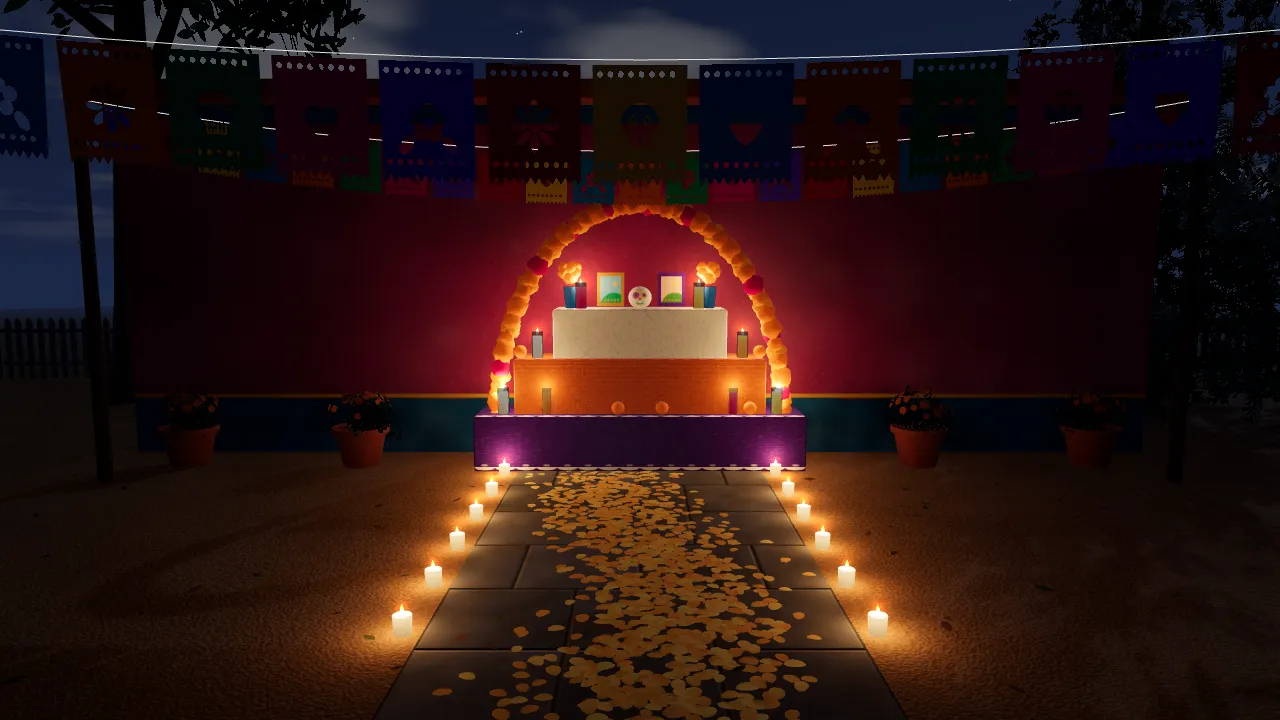
Scatter marigold petals to make a path to a glowing ofrenda.
How to play
- Drag along the path to scatter marigold petals. They flutter down and settle.
- Tap a candle beside the path to light it. When your petals reach all the way to the ofrenda, its candles light one by one.
- Press and hold on the papel picado to blow on it. Light tissue paper lifts high, heavier plastic barely moves.
- Open Lab to choose the flowers and the paper of the papel picado, change the breeze, or have a path scattered for you.
Challenges
- Tap each candle along the path until all twelve are glowing
- Press and hold on the papel picado to blow a flag up past 60°
- Scatter an unbroken marigold path all the way to the ofrenda
Try this
- Switch the papel picado from tissue paper to plastic sheet. The heavier flags lift less in the same breeze.
- Turn the breeze down to zero, then up to 4 m/s, and watch the lift readout. Wind drag grows with the square of the wind speed.
- Scatter petals in a strong breeze and watch them drift sideways as they fall, because they sink at only about 0.6 m/s.
Fun facts
- Día de Muertos is celebrated mainly on 1 and 2 November, in Mexico and in Mexican communities around the world.
- Cempasúchil, the Mexican marigold (Tagetes erecta), is traditionally laid on ofrendas and paths. Its bright colour and scent are said to guide the spirits of loved ones home.
- Papel picado means “perforated paper”: tissue paper cut into delicate patterns such as flowers, birds and smiling skulls.
- In 2008 UNESCO inscribed the Indigenous festivity dedicated to the dead in Mexico on its list of the Intangible Cultural Heritage of Humanity.
Petals, paper flags and the push of the wind
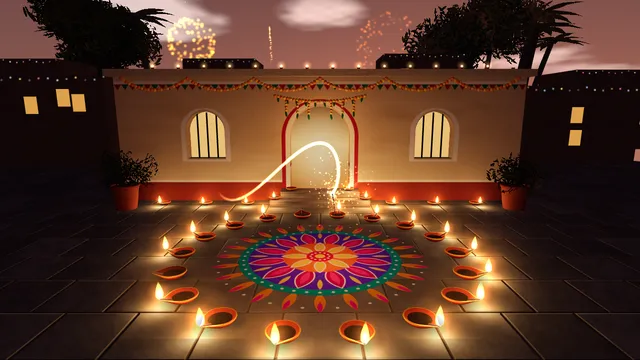
Día de Muertos, the Day of the Dead, is a joyful remembrance of family and friends who have died. Families build an ofrenda, an altar of offerings, with photographs, candles, the person’s favourite foods and drinks, pan de muerto, sugar skulls and armfuls of orange cempasúchil. Many also visit and decorate graves, sharing food, music and stories through the night. The festival blends Indigenous traditions with Catholic All Saints’ and All Souls’ days, and customs vary a great deal between regions and families. This scene follows one well-loved custom: a path of marigold petals leading to the ofrenda, so that loved ones can find their way.
Why petals fall so gently
A marigold petal is very thin and very light. As it falls, the air pushes back on its flat face with a drag force that grows with the square of its speed. It stops speeding up at its terminal speed, where drag balances weight: v ≈ √(2σg/ρCd), with σ the petal’s mass per area and ρ the density of air. For a petal that works out at only about 0.6 m/s. Because drag on its face is far larger than drag along its edge, a tilted petal glides sideways, flips and tumbles, so it zigzags down rather than dropping straight.
Flags that fly
Papel picado flags hang from a string like small pendulums hinged along their top edge. A breeze pushes on their face with a force of ½ρCdAv², while gravity pulls them back down. The flag settles where the turning effects balance. As it lifts, it presents less of its face to the wind, so the push weakens, and that is why it rarely blows completely flat. Tissue paper weighs only about 17 grams per square metre, so even a light breeze lifts it high. Heavier plastic sheet, used for outdoor decorations because it survives rain, lifts less. The cut-out holes also matter: they let air through and reduce the force.
Candlelight
The candles on the ofrenda and along the path light the scene through a many-light shader. The light from each flame spreads over a growing sphere, so its brightness falls with the square of the distance, which is why the petals closest to each candle glow brightest.
For the curious
Each flag is simulated as a rigid plate rotating about the string with moment of inertia I = mh²/3. The wind’s normal force acts at mid-height, and the weight acts at the centre. Each petal is a flutter piece with separate face-on and edge-on drag coefficients (1.4 and 0.14), and its spin rate follows its speed through the air.
Questions people ask
What is Día de Muertos?
It is a Mexican celebration, mainly on 1 and 2 November, in which families joyfully remember loved ones who have died. They build ofrendas with photos, candles, favourite foods and marigolds, and often visit and decorate graves.
Why are marigolds used on the Day of the Dead?
Cempasúchil, the Mexican marigold, has a bright orange colour and a strong scent. By tradition these are said to help guide the spirits of loved ones back to their families, so petals are scattered in paths and the flowers decorate ofrendas and graves.
Is Día de Muertos the same as Halloween?
No. They fall close together, but they are different traditions. Día de Muertos is a joyful remembrance of loved ones rooted in Indigenous and Catholic traditions in Mexico, while Halloween grew from Gaelic and European autumn customs.