Darts
Throw darts at a real board: play 301, 501 or Round the Clock.
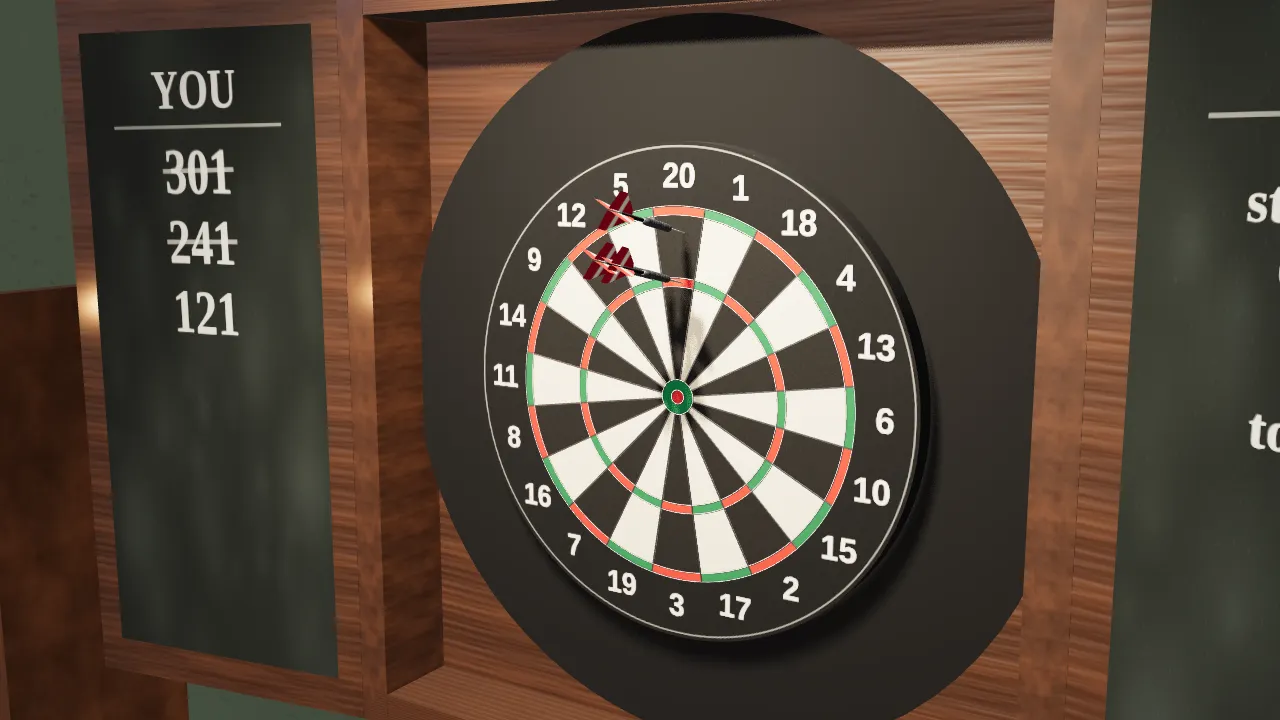
How to play
- Pull back on the dart and let go to throw. Pull further back to aim higher on the board, and a little to one side to aim left or right.
- The small ring on the board shows where the dart is heading. Your hand sways slightly, so let go when the ring sits where you want it. You can switch the guide off in the Lab.
- Three darts make a turn. In 301 and 501 you count down to exactly zero; with double out the last dart must land in a double or the bull. In Round the Clock you hit 1, then 2, all the way to 20, then the bull.
- Open the Lab to change the game, play against the computer, or choose how steady your hand is. The chalk scoreboards inside the cabinet doors keep the score.
Challenges
- Hit the bull: the green outer bull (25) or the red bullseye (50)
- Score 100 or more with the three darts of one turn
- Win a leg: check out to exactly zero, or go all the way round the clock
Try this
- Aim at the treble 20 for a few turns and see where the misses go. The 20 sits between the 5 and the 1, so a dart that drifts a little sideways costs a lot of points.
- Watch a dart from behind as it flies. It leaves your hand climbing, then curves down into the board: that drop is why you aim above the spot you want to hit.
- Switch the aim guide off in the Lab and try to land all three darts of a turn inside the same number by feel alone.
Fun facts
- The centre of the bull is 1.73 m (5 ft 8 in) above the floor, and the throw line, called the oche, is 2.37 m (7 ft 9¼ in) from the face of the board.
- Clockwise from the top the numbers run 20, 1, 18, 4, 13, 6, 10, 15, 2, 17, 3, 19, 7, 16, 8, 11, 14, 9, 12, 5. Low numbers sit beside high ones, so a near miss usually costs points.
- The most you can score with three darts is 180: three trebles of 20.
- In 501 with double out, the highest finish in one turn is 170: treble 20, treble 20 and the bull.
The physics of a dart: a short arc, a steady flight and a small target
A dart looks as if it flies straight, but every throw is a little arc. Here the dart leaves your hand at about 6 metres per second from roughly 2.1 m in front of the board. It is in the air for a little over a third of a second, and in that time gravity pulls it down by more than half a metre compared with the straight line it was thrown along. That is why players release the dart pointing above the number they want, and why a soft throw has to be aimed higher than a firm one.
Why the flights matter
Most of a dart’s mass sits in the metal barrel near the front, while the light flights at the back catch the air. The push of the air on the flights acts behind the centre of mass, so whenever the dart is turned a little away from its direction of travel, the air swings the tail back into line. A dart therefore points along its path like a weathervane, nose dipping as the arc curves down. A release is never perfect, so a fresh dart fishtails for a moment; the flights damp that wobble away within the first part of the flight. Air drag along the path is small for such a slim, heavy object: over one throw the dart loses only a little of its speed.
Sticking in the board
A traditional board is made of sisal fibres packed tightly end-on. The sharp steel point pushes the fibres apart, and their grip on the point holds the dart. A dart whose point meets one of the thin wires that divide the board can glance off instead: a bounce-out, which scores nothing.
Aiming and accuracy
The target is small. The treble and double rings are only about 8 mm wide, and an angle error of one degree at the moment of release moves the dart about 4 cm on the board. Real throws scatter around the aim point, so the best place to aim depends on how widely your darts spread: for a very steady thrower the treble 20 is the best spot, while for a wilder one a point that keeps misses in friendly numbers can score more. The number order punishes sideways misses near the 20, which is one reason players sometimes switch to the treble 19.
For the curious
Ignoring the small drag, a dart thrown at speed v and angle θ above the horizontal follows y = x·tan θ − g·x² / (2v²·cos²θ). The time to cover a horizontal distance L is t = L / (v·cos θ), and the drop below the line of the throw is Δy = ½·g·t². With v = 6.2 m/s, L = 2.1 m and θ ≈ 17°, t ≈ 0.35 s and Δy ≈ 0.6 m. A small angle error δ (in radians) shifts the landing point by about L·δ. The flights give a restoring torque roughly proportional to ½ρv²·A·ℓ·sin α, where A is the flight area, ℓ its distance behind the centre of mass and α the angle of attack, so the wobble is a damped oscillation that settles in a fraction of the flight.
Questions people ask
How high is a dartboard, and how far away do you stand?
The centre of the bull is 1.73 m above the floor, and the oche, the line you throw from, is 2.37 m from the face of the board, measured along the floor.
What does double out mean in 501?
You must reach exactly zero, and the last dart has to land in the double ring or the bull, which counts as double 25. A dart that would take you below zero, leave exactly 1, or reach zero without a double is a bust, and the whole turn’s score is cancelled.
Why do darts have flights?
The flights add drag at the back of the dart, so the push of the air acts behind its centre of mass. Like a weathervane, the dart then turns to point along its path, and the wobble from your release dies away early in the flight.