Copper Plating a Nail
Hang iron nails in copper sulfate and watch copper coat them.
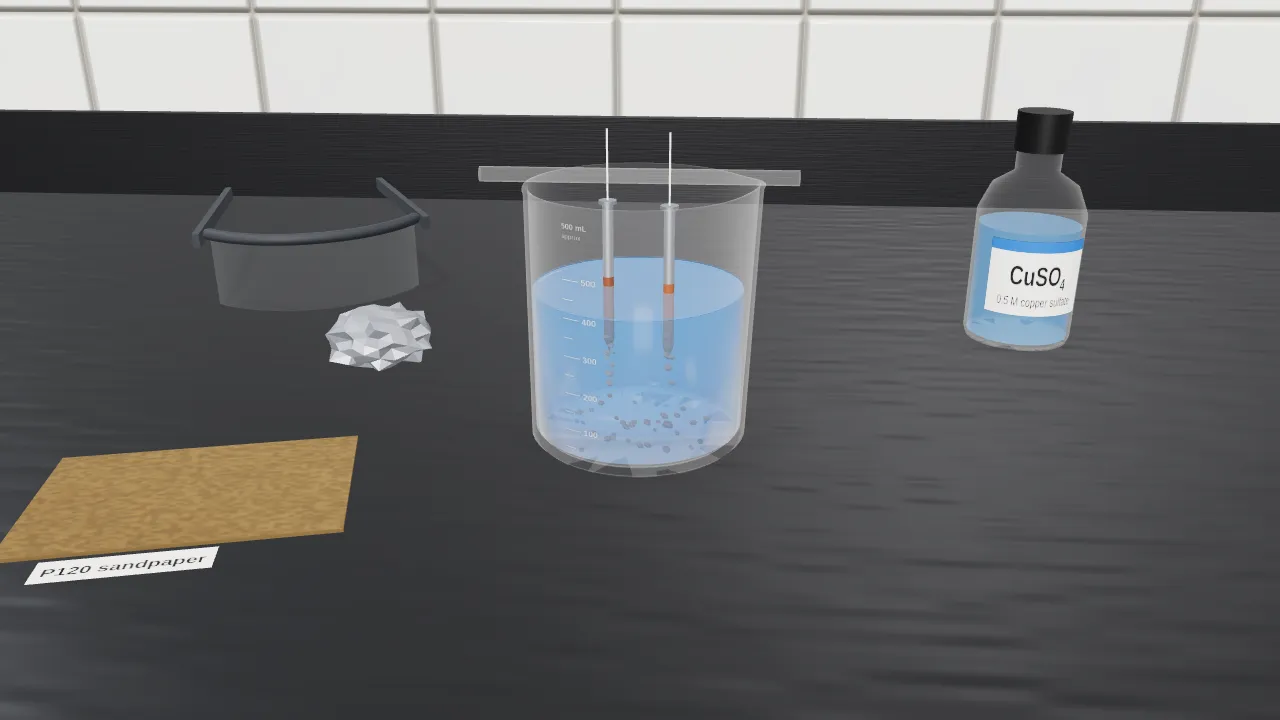
How to play
- Drag a nail over the beaker of blue copper sulfate and let go: it hangs from the glass rod with its point in the solution.
- Rub the other nail to and fro on the sandpaper first. Clean, bright iron plates far faster than oily, oxidised iron.
- Drag a nail back out to look at the coat, or drop the steel wool in to strip copper out of the solution quickly.
- Try the three Challenges, or open Lab for the concentration, temperature and time-lapse.
Challenges
- Hang a nail in the copper sulfate and see it turn copper-coloured
- Clean a nail on the sandpaper first, then give it a thick copper coat
- Fade the blue: take most of the copper out of the solution
Try this
- Switch from nails to steel wool. Its huge surface area makes the blue fade in hours instead of days.
- Untick “Iron cleaned with sandpaper”. An oily or rusty surface slows the reaction dramatically.
- Compare the copper deposited with the iron lost. The nail ends up heavier, because copper atoms are heavier than iron atoms.
Fun facts
- This is a displacement reaction: a more reactive metal pushes a less reactive one out of its compound.
- Copper(II) sulfate solution is blue because the hydrated copper ions absorb red and orange light.
- Recovering copper by placing scrap iron in copper-rich mine water, called cementation, is a mining technique that goes back centuries.
- The iron gains mass overall: each iron atom (about 56 g per mole) is replaced by a heavier copper atom (about 64 g per mole).
Iron swaps places with copper
Hang an iron nail in blue copper sulfate solution and, within minutes, the iron turns a pinkish-brown copper colour. Leave it long enough, especially with a lot of iron, and the blue solution fades to a pale green. Copper has come out of the solution and iron has gone in. This is a displacement reaction:
Fe(s) + Cu²⁺(aq) → Fe²⁺(aq) + Cu(s)
Electrons on the move
The reaction is a transfer of electrons. Each iron atom at the surface gives up two electrons and dissolves as an iron(II) ion: Fe → Fe²⁺ + 2e⁻. A copper ion arriving at the surface picks those electrons up and becomes a copper atom, stuck to the nail: Cu²⁺ + 2e⁻ → Cu. Losing electrons is called oxidation and gaining them reduction, so this is a redox reaction.
Why does iron give its electrons to copper and not the other way round? Iron is higher in the reactivity series: it holds its outer electrons less tightly. Chemists measure this with standard electrode potentials. Copper’s is +0.34 V and iron’s −0.44 V, a difference of 0.78 V, which is the push driving the electrons from iron to copper. Try it the other way, a copper coin in iron sulfate, and nothing happens.
Why the blue fades
The blue colour comes from copper ions surrounded by water molecules, which absorb red and orange light. As copper ions are turned into metal, fewer are left to absorb, so the colour pales. The iron(II) ions that replace them give a faint green tint.
What controls the speed
The reaction only happens at the iron’s surface, and in still water it is limited by how fast fresh copper ions can drift there. So surface area is everything: a nail takes days to use up the copper in a beaker, while steel wool, with a hundred times more surface, can do it in an hour or two. A clean surface matters too; a layer of grease or rust keeps the solution away from the metal.
For the curious: the model
The rate follows a mass-transfer law, dn/dt = kₘ·A·[Cu²⁺], where A is the iron’s wetted area and kₘ, about 3 micrometres per second, describes how quickly ions diffuse to the surface in still water. Because the rate is proportional to the remaining copper, its concentration decays exponentially with a time constant V/(kₘA). A mild temperature factor reflects faster diffusion in warmer water, and an uncleaned surface reacts at 15% of the rate. The coating’s colour follows its thickness, computed from the copper deposited and the density of copper.
Safety
Copper sulfate is harmful if swallowed and irritates skin and eyes, and it is toxic to aquatic life. Wear gloves and goggles, and do not pour it down the drain. Please read our disclaimer.
Questions people ask
Why does copper form on an iron nail in copper sulfate?
Iron is more reactive than copper, so iron atoms give electrons to copper ions in the solution. The copper ions become copper metal on the nail, while the iron dissolves as iron(II) ions.
Why does the blue copper sulfate solution fade?
The blue colour comes from dissolved copper ions. As the iron turns them into copper metal, fewer copper ions remain, so the solution becomes paler, with a faint green tint from the iron(II) ions.
How long does it take to copper-plate a nail?
A copper colour appears within minutes. Using up the copper in the solution takes much longer: days for a single nail in a beaker, but only an hour or two with steel wool, because of its much larger surface area.