Cloud in a Bottle
Pump up a bottle, pull the stopper and make a cloud appear.
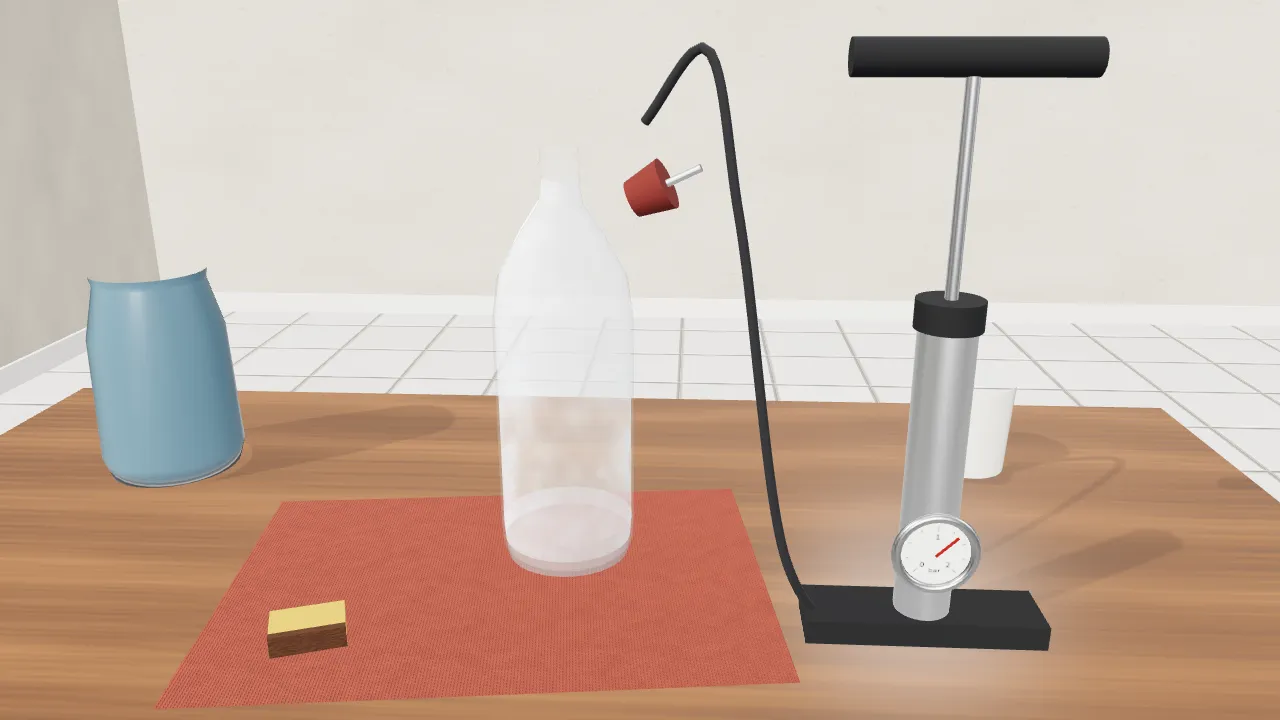
How to play
- Drag the pump’s T-handle up and down a few times. The gauge on the pump shows the pressure rising in the bottle.
- Wait a few seconds for the squeezed air to cool, then drag the rubber stopper up to pull it out.
- Tap the matchbox to drop a burning match into the open bottle, then tap the stopper to push it back in.
- Try the three Challenges, or open Lab to pump, release or air out the bottle with buttons.
Challenges
- Pump up the bottle, then pull the stopper to make a cloud
- Drop a burning match in for smoke, then make a thick white cloud
- Make a cloud you can see clearly from a single pump stroke
Try this
- Pump and release straight away, then try again after waiting ten seconds. Freshly pumped air is still warm, so the second cloud is better.
- Push the stopper back in while the cloud is there and give one pump. The squeezed air warms up and the cloud vanishes.
- Compare one pump stroke with smoke and without. The same water spread over many more droplets makes the cloud look far whiter.
Fun facts
- Air cools when it expands and warms when it is squeezed, even when no heat flows in or out. This is called adiabatic cooling and heating.
- Dry air rising through the atmosphere cools by close to 10 °C for every kilometre it climbs, because the pressure around it falls and it expands.
- Every cloud droplet forms on a tiny particle, such as dust, sea salt, pollen or smoke, known as a cloud condensation nucleus.
- C. T. R. Wilson made clouds by expanding moist air. His cloud chamber, which showed the tracks of charged particles, earned him a share of the 1927 Nobel Prize in Physics.
How a puff of expanding air makes a cloud
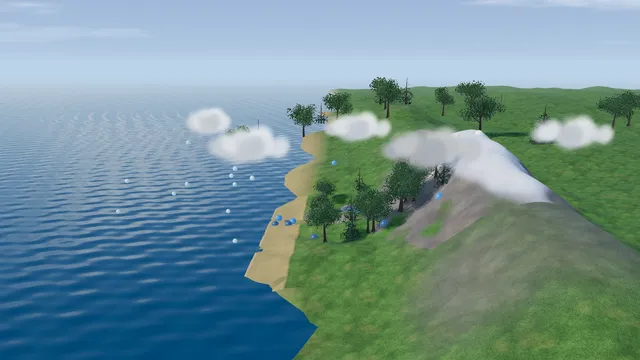
Real clouds form when moist air rises. Higher up the pressure is lower, so the rising air expands, and expanding air cools. Once it is cool enough, some of its water vapour condenses into droplets. A bottle and a pump let you do the same thing on a table: squeeze the air, let it cool back to room temperature, and then let it expand all at once.
Squeeze, wait, release
Each pump stroke pushes about a fifth of a litre more air into the bottle. Squeezing it does work on the air, so it warms up a little, and over the next few seconds that heat leaks out through the plastic. The water at the bottom keeps the air inside humid. When you pull the stopper, the air rushes out and the rest expands back to room pressure in a fraction of a second. There is no time for heat to flow in from the walls, so the air pays for the expansion from its own heat and its temperature drops, often below freezing for a moment. The vapour is spread through the larger volume too, but cold air can hold so much less that the air becomes supersaturated.
Why smoke helps
Water vapour does not easily form droplets on its own. It needs something to condense on: tiny particles called condensation nuclei. Room air already holds hundreds or thousands of them in each cubic centimetre, which is why a faint cloud can appear without smoke. A burning match adds a huge number more. The same amount of water is then shared among many more, much smaller droplets, and many small droplets scatter far more light than a few big ones. The cloud turns from a faint haze to a thick white fog. The same effect makes clouds over polluted regions brighter than clouds over clean ocean air.
Clouds that vanish
As droplets form they release heat, which limits how cold the air gets. Then the bottle walls warm it back towards room temperature and the droplets evaporate again within seconds. Squeeze the bottle or pump it up and the cloud disappears at once, because compressed air warms up.
If you try this at home, use a sturdy plastic drinks bottle, never glass, keep the pressure modest, point the stopper away from faces and let an adult handle the matches. Please read our disclaimer.
For the curious
For a sudden expansion from pressure P₁ to P₀, the temperature falls to T₂ = T₁ (P₀/P₁)(γ−1)/γ, with γ = 1.4 for air. From half an atmosphere above room pressure that is a drop of about 30 °C. The air then condenses water until the latent heat released, about 2.5 MJ per kilogram, warms it back to saturation. The optical depth of the cloud grows as N1/3 × LWC2/3, where N is the number of droplets and LWC the liquid water per cubic metre: a hundred times more nuclei make the cloud about four and a half times thicker to the eye.
Questions people ask
Why does a cloud appear when you open the bottle?
The squeezed air expands suddenly when the stopper comes out, and expanding air cools. The cold air cannot hold as much water vapour, so some of it condenses into tiny droplets, which is a cloud.
Why does smoke make the cloud thicker?
Water droplets need tiny particles to form on. Smoke adds a great many of them, so the water is shared among many more, smaller droplets, and lots of small droplets scatter much more light than a few large ones.
Is this how real clouds form?
Yes. Air that rises into lower pressure expands and cools in the same way, and when it cools below its dew point water condenses on particles in the air to form clouds.