Cloth in the Wind
Grab a silk scarf on a washing line and play with the breeze.
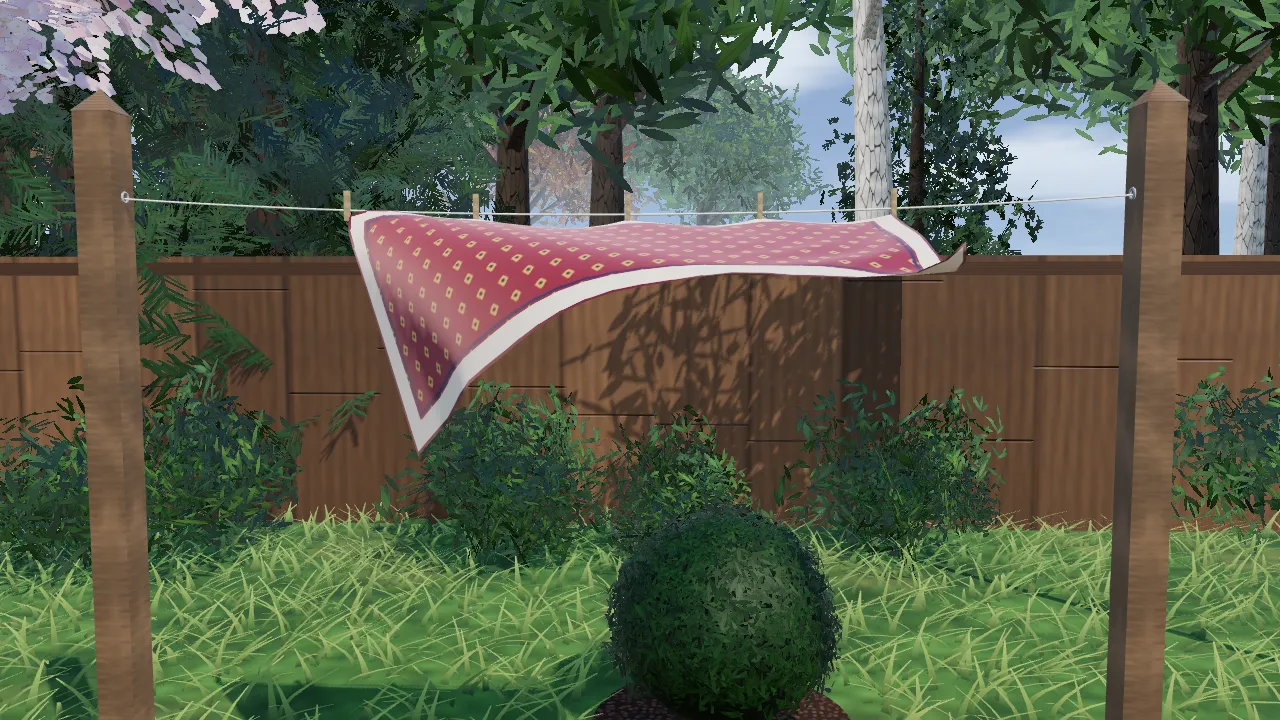
How to play
- Grab any part of the scarf and drag it. Pull hard and the pegs pop off the line.
- Swipe across the sky or the trees to make the wind. A fast swipe is a strong wind, a slow one calms it, and the wind blows the way you swipe.
- Tap a peg to unpeg the scarf there. To peg it back, tap an empty peg beside the scarf, or let go of the scarf with your finger on the peg.
- Tap the scarf to poke it, or open Lab for exact wind speeds, the wind direction and gusts.
Challenges
- Swipe up a strong breeze until the pegged scarf flies out level with the line
- Calm the wind with a slow swipe, then drape the scarf over the box ball
- Keep only the pegs at one end and blow the scarf flat along the line like a flag
Try this
- Make a gentle breeze, then one twice as fast. The push of the air grows four times over, so the scarf swings far closer to level.
- Unpeg the three middle pegs and keep the two at the ends. The loose silk billows between them like a sail.
- Pull the scarf off the line and let it settle on the lawn. Lying flat, it barely stirs: the air near the grass is slow, and wind slides over a flat sheet instead of pushing it.
Fun facts
- The push of moving air grows with the square of its speed, so a wind twice as fast presses four times as hard on a sheet.
- Wind is slower near the ground, because grass, hedges and the ground itself drag on the lowest layer of air. A washing line catches a weaker breeze than the treetops.
- The Beaufort scale of wind force was devised in 1805 by the Royal Navy officer Francis Beaufort. A light breeze on it is 1.6 to 3.3 m/s.
- Many films and video games animate clothes and flags with the same kind of method used here: particles held together by distance rules, solved many times a second.
How a scarf flies: air pressure, weight and friction
A silk scarf is light, usually 70 grams per square metre or less, so even a gentle breeze can lift it. What it does depends on a contest between three things: the push of the air, the pull of gravity and the grip of whatever it touches.
The push of the wind
When air meets a sheet, it slows down against the side facing the wind and presses on it. That pressure grows with the square of the speed of the air across the sheet. A scarf hanging straight down faces the wind squarely and catches its full force. As the wind lifts it, the scarf tilts, the air strikes it at a glancing angle and the push weakens, while the turning effect of its weight grows. The scarf settles where the two balance, and a stronger wind makes that angle steeper, until it streams out almost level with the line.
Why fabric flaps
A flag in a perfectly steady wind still flutters. A flat sheet in moving air is unstable: if a small ripple appears, the pressure of the air on the curved cloth tends to make the ripple grow and travel towards the free edge. The gusts in the garden add to it. In the simulation the same pressure law acts on every little triangle of the scarf, so the flapping is not drawn by hand. It comes out of the physics.
The breeze near the ground
The air right next to the lawn hardly moves at all, because grass and the ground drag on it. The wind speed rises roughly with the logarithm of the height above the grass, so a scarf lying on the lawn feels only a whisper of wind, while the top of the washing line feels nearly the full breeze. The air close to the leaves of the box ball is slowed in the same way.
Friction and draping
Fabric grips a surface with friction: a little sliding is stopped outright (static friction), and faster sliding is braked (kinetic friction). The small leaves and twigs of a clipped box ball snag silk, so it holds the scarf far better than polished stone would. A scarf laid on by its middle balances, with equal cloth hanging down each side. Hang it on by one edge and almost all its weight hangs down one side, and it slides off.
For the curious
Each triangle of area A with unit normal n feels F = ½ρCNA(v·n)|v·n| along n, plus a small drag along the cloth, where v is the wind relative to the cloth, ρ = 1.2 kg/m³ and CN = 1.2. The breeze follows u(z) = uref·ln(z/z₀)/ln(zref/z₀) with z₀ = 3 cm for grass. The cloth is 338 particles joined by distance constraints and solved with extended position-based dynamics (XPBD) in sub-steps of h = 1/240 s: each constraint C gets the correction Δλ = (−C − α̃λ)/(w₁ + w₂ + α̃), with compliance α̃ = α/h². Contacts use Coulomb friction with μ ≈ 1.5 on the box leaves.
Questions people ask
Why do flags flap even when the wind is steady?
A flat sheet in a stream of air is unstable. Any small ripple changes the pressure of the air on the cloth in a way that makes the ripple grow and travel towards the free edge, so the flag keeps waving. Gusts and the swirling wake add to the motion.
Why does washing dry faster on a windy day?
Water evaporating from damp cloth makes the air right next to it humid, which slows further drying. Wind keeps replacing that humid layer with drier air, and a flapping sheet stirs the air even more, so the water escapes faster.
How do computers simulate cloth?
A common way is to treat the cloth as a grid of small particles joined by rules that keep neighbouring particles at the right distance. Each frame the particles move under gravity and wind, then the rules pull them back into shape. Solving the rules several times in short steps keeps the cloth stable.