Christmas Tree Decorating
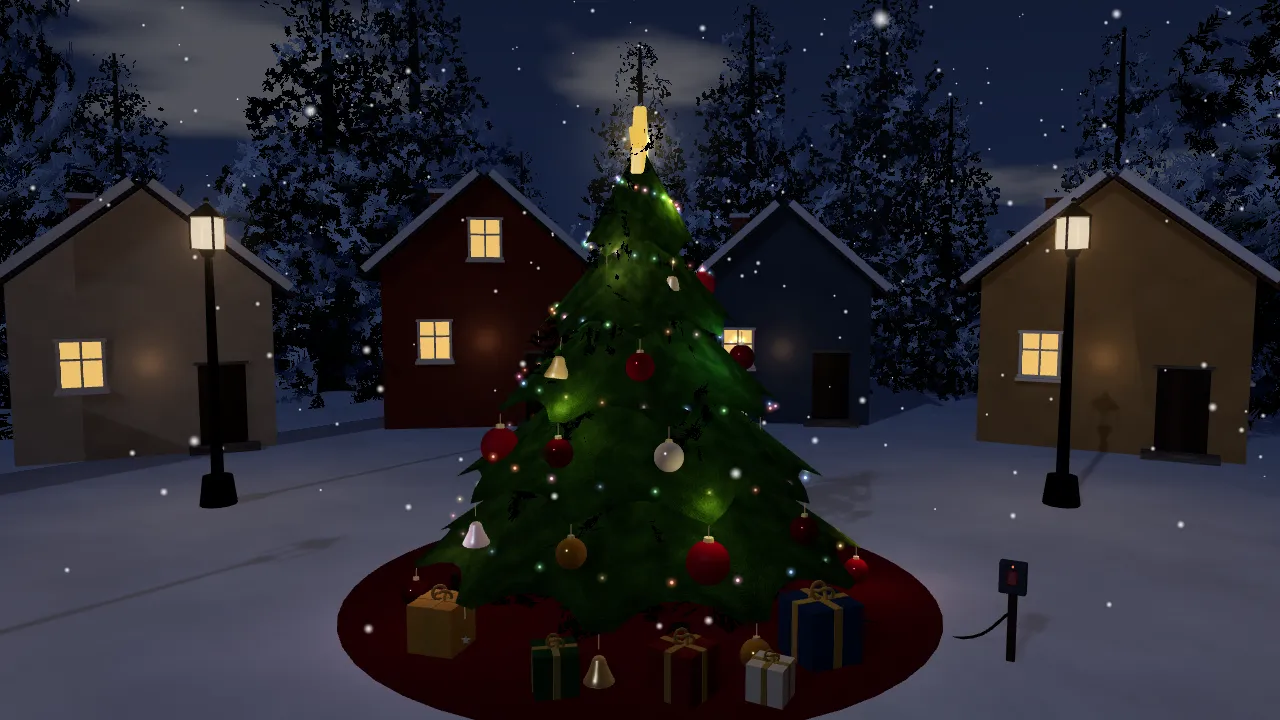
Hang swinging baubles on a big fir in a snowy village square.
How to play
- Tap the tree to hang a bauble. It drops onto the nearest free branch tip and swings on its string.
- Tap a hanging bauble to set it swinging again.
- Flip the red switch on the post beside the tree to light the fairy lights and the star.
- Open Lab to choose the bauble and the colours, change the string length or the breeze, or let it Decorate for me.
Challenges
- Flip the switch by the tree to light the fairy lights
- Hang ten baubles on the tree
- Set five baubles swinging at the same time
Try this
- Hang a big satin ball and a glass ball side by side. The heavy one makes its branch dip more, but both swing to the same rhythm.
- Set the string length to 4 cm and hang a bauble, then try 22 cm. The longer pendulum swings more slowly, because the period grows with the square root of the length.
- Turn the breeze up to 3 m/s. Light paper stars sway much more than heavy balls: the wind pushes on their area, while gravity pulls on their mass.
Fun facts
- Decorating evergreen trees at Christmas is a custom that grew up in Germany and spread widely in the 19th century.
- Hand-blown glass baubles are closely linked with Lauscha, a glassmaking town in Germany.
- A pendulum’s swing time depends on its length and on gravity, not on its weight. Galileo studied this around 1600.
- Many Orthodox Christians celebrate Christmas on 7 January, because their churches follow the older Julian calendar.
Why every bauble swings like a pendulum
Christmas is celebrated on 25 December by Christians around the world, and on 7 January by many Orthodox churches. Decorating an evergreen tree is one of its best-loved customs: green branches in the depth of winter, hung with lights and shining ornaments. Customs vary from family to family and country to country, from village squares with one huge tree to a small tree in the corner of a room.
A bauble is a pendulum
Each bauble hangs from a string, so once it is nudged it swings back and forth like a pendulum. For small swings the time of one full swing is T = 2π√(L/g), where L is the distance from the hook to the bauble’s centre and g is the strength of gravity. Notice what is missing: the mass. A heavy satin ball and a light glass ball on the same string length keep exactly the same rhythm. That is because a heavier bauble feels a bigger pull from gravity, but it also needs a bigger push to get moving, and the two effects cancel.
When you tap the tree, the bauble starts a little above and away from its branch, falls, and is caught when its string goes tight. The simulation treats the string as something that can go slack, so you see that small drop and jolt before the swinging starts.
Springy branches
A fir twig behaves like a spring. Hang a weight on it and it dips until its springiness balances the weight: the dip is δ = mg/k, where k is how stiff the twig is. Heavier baubles make their branches sag more, and each branch bounces a few times before it settles. Watch the Branch dip readout as you hang different baubles.
Wind, drag and stillness
Every swing slowly dies away. Air drag takes a little energy on each pass. Wind pushes on a bauble in proportion to its area and the square of the wind speed, while gravity pulls back in proportion to its mass. A paper star has a large area and almost no mass, so even a light breeze makes it dance, while a heavy glass ball barely moves.
For the curious
Each bauble is simulated with position Verlet integration at 240 steps per second. Its string is a distance constraint that only acts when the string is taut, and air drag is ½ρCdAv² against the wind. The branch tips are damped springs with a natural frequency of about 3 Hz. The fairy lights also light the snow and the baubles through a many-light shader, in which the brightness from each bulb falls off with the square of the distance.
Questions people ask
Why do Christmas baubles swing?
Each bauble hangs from a string, so it is a small pendulum. Any nudge, a breeze or a bump to the branch makes it swing, and gravity keeps pulling it back towards the lowest point until air drag slowly calms it.
Does a heavier bauble swing more slowly?
No. For a pendulum the swing time depends only on the length of the string and on gravity. A heavier bauble feels a stronger pull but is also harder to accelerate, so the two effects cancel and it keeps the same rhythm.
When do people put up and take down Christmas trees?
Customs vary. Many families decorate during Advent, the weeks before Christmas, and take the tree down around Epiphany on 6 January, but others keep their own traditions.