Christmas Snow Globe
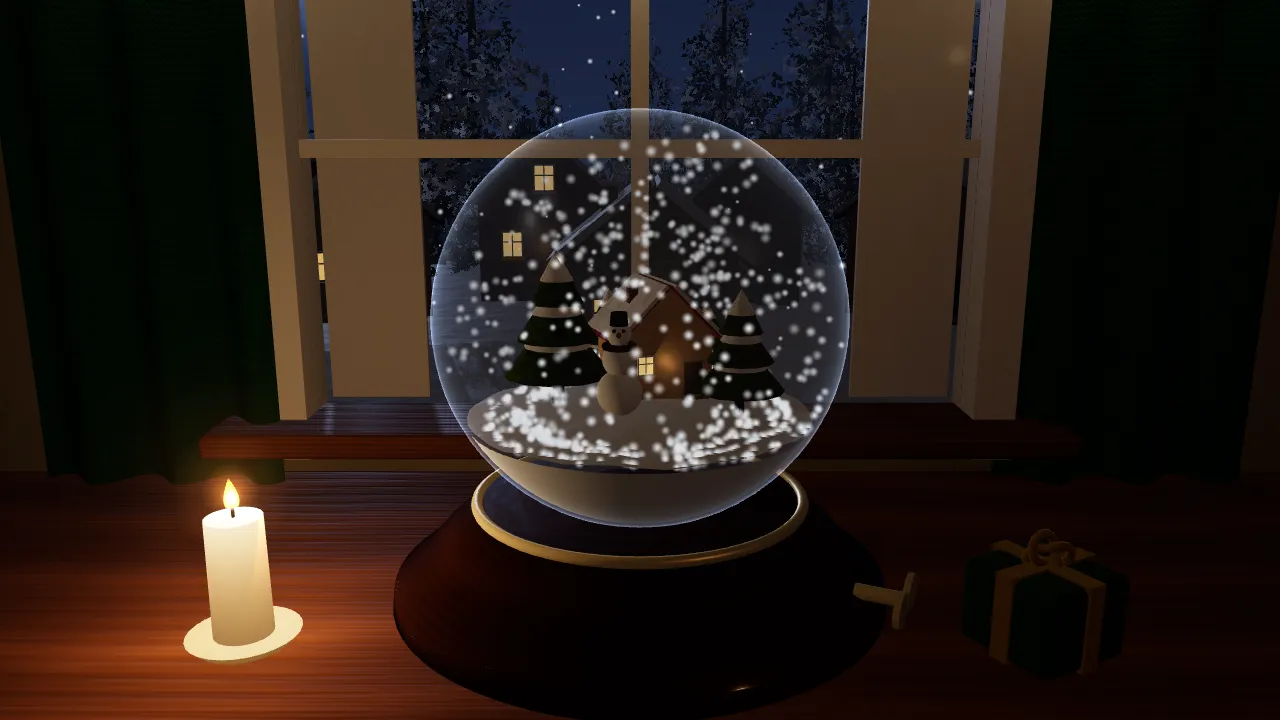
Shake a glass snow globe and watch the flakes swirl and settle.
How to play
- Press and drag the globe from side to side to shake it, or tap it for a gentle nudge.
- Watch the snow swirl, then drift down onto the little cottage and snowman.
- Turn the brass key on the side of the base: drag around it to wind the music box, then let go.
- Try the three Challenges, or open Lab to change the liquid, the flake material and the flake size.
Challenges
- Shake the globe hard enough to whirl snow up into the top of the dome
- Wind the key on the base so the music box plays and the scene turns
- Shake the globe, then wait until the very last flake has settled
Try this
- Switch the liquid to plain water. The flakes fall in a few seconds, while the water itself keeps swirling for much longer.
- Choose polystyrene flakes in 50% glycerine. They are lighter than the liquid, so they float up and gather under the dome instead of falling.
- Double the flake size and compare the settling speed. In thick liquid it rises almost four times, because Stokes’ law makes the speed grow with the square of the size.
Fun facts
- Snow globe makers often add glycerine (glycerol) to the water. It is far more viscous than water, so the snow falls more slowly.
- Pure glycerol at room temperature is around 1,400 times more viscous than water.
- George Gabriel Stokes published his law for the drag on a small sphere moving slowly through a viscous fluid in 1851.
- In Vienna the Perzy family has made snow globes since about 1900. The firm says Erwin Perzy I hit on the idea while trying to make a brighter lamp for surgeons.
Why the snow in a globe falls so slowly
Christmas is celebrated on 25 December by Christians around the world, and on 7 January by many Orthodox churches that follow the older Julian calendar. Alongside its religious meaning it has gathered many winter traditions, and the snow globe is one of the best loved: a tiny wintry world you can stir into a blizzard with a flick of the wrist. Customs differ from country to country, and in the southern hemisphere Christmas falls in summer, but snowy scenes remain a favourite decoration.
A race between weight and drag
Each flake is a little heavier than the liquid around it. Its weight, minus the buoyancy of the liquid it pushes aside, pulls it down. As it starts to sink, the liquid pushes back with a drag force that grows with speed. Within a fraction of a second the two forces balance and the flake falls at a steady terminal speed.
For small, slow flakes in a syrupy liquid, the drag follows Stokes’ law: F = 3πμdv, where μ is the liquid’s viscosity and d the flake’s size. Setting this equal to the flake’s weight in the liquid gives v = (ρflake − ρliquid)gd² / 18μ. Two things slow the snow: a thicker liquid (bigger μ), and flakes only slightly denser than the liquid.
Why glycerine?
Mixing glycerine into water raises the viscosity enormously. Half-and-half is about six times as viscous as water, and 80% glycerine about sixty times. In the simulation, plastic flakes 0.6 mm across take around fifteen seconds to settle in the half-and-half mix but only about three seconds in water. If a flake is less dense than the liquid, the same formula gives a negative speed, and the flake floats up instead.
The swirl after a shake
Shaking the globe sets the whole liquid turning. In the globe the liquid spins like a solid body and rolls over in a doughnut-shaped loop (a Hill’s vortex), plus small random eddies. Friction at the glass slowly brakes this motion. The braking time is roughly R/√(νΩ), where ν is the kinematic viscosity and Ω the spin rate, so a thicker liquid calms down faster. In plain water the snow falls quickly but the water keeps swirling, which is why water-only globes look rushed and restless.
For the curious
The ratio of inertia to viscous forces on a flake is its Reynolds number, Re = ρvd/μ. Stokes’ law is accurate when Re is well below 1, which is true in the glycerine mixes. In water, Re climbs into the tens, so the kit switches to the Schiller–Naumann drag law to stay realistic. Real flakes are flat, and flat things fall more slowly than a sphere of the same weight, so the flake size in the Lab is an equivalent sphere size.
Questions people ask
What liquid is inside a snow globe?
Usually water, often mixed with glycerine (glycerol). The glycerine makes the liquid more viscous, so the snow sinks slowly and the swirl after a shake dies down gently.
Why does the snow in a snow globe fall so slowly?
The flakes are only slightly denser than the liquid, and the liquid is viscous, so drag almost cancels their weight. By Stokes’ law their falling speed is proportional to the density difference and the square of their size, and inversely proportional to the viscosity.
Can you make a snow globe at home?
Yes. A clean jar with a tight lid, water with some glycerine added, and plastic glitter or flakes are enough. Glue a small figure to the inside of the lid, fill the jar almost to the brim, seal it and turn it upside down. More glycerine gives slower snow.