Catapult Castle
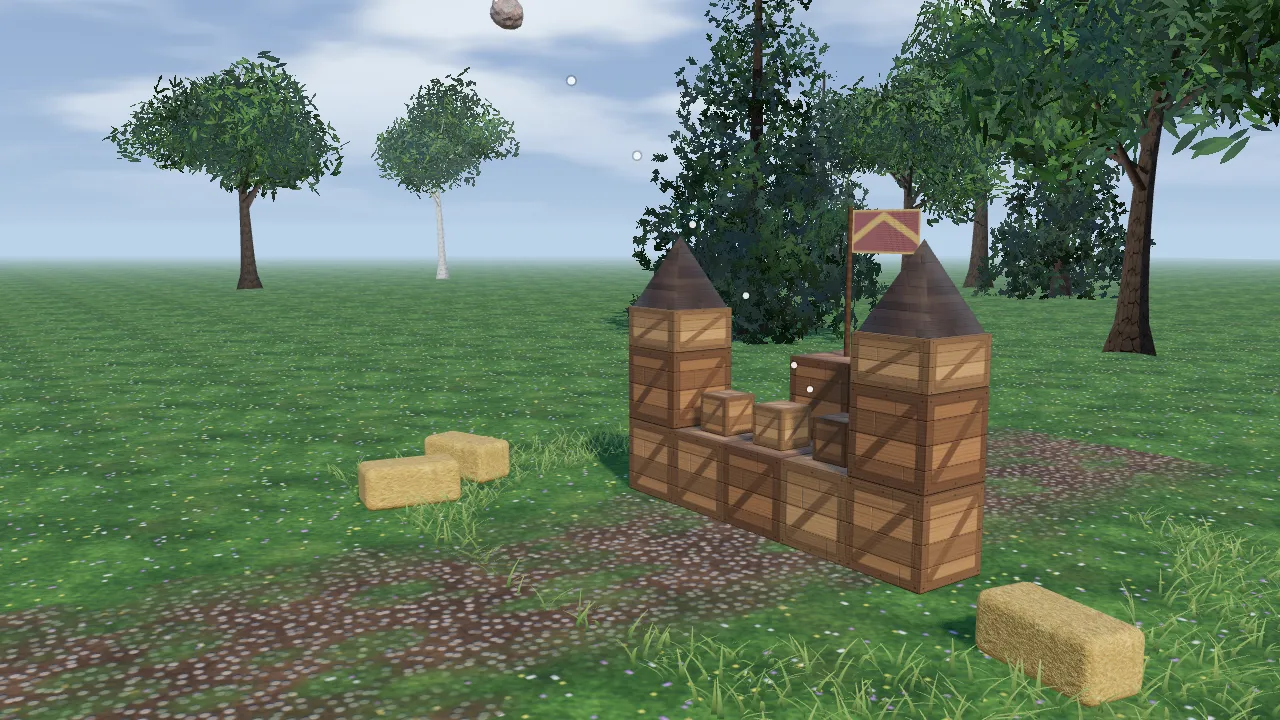
Fire a timber catapult and topple a mock castle of wooden crates.
How to play
- Drag back from anywhere and let go to fire. The further you pull, the faster the stone flies.
- Drag a little to the left or right to turn the catapult.
- Grab the padded stop bar and drag it up or down: it sets the launch angle, from a flat 25° to a steep 65°.
- You get five stones per castle. Try the three Challenges, or switch to the Moon’s gravity in Lab.
Challenges
- Knock down the crate that carries the banner
- Topple three crates with a single stone
- Bring down ten crates of one castle with its five stones
Try this
- Hit a tower near the top, then hit another one at the bottom. Which topples more blocks?
- Drag the stop bar to 30° and then to 60°, and find the pull that reaches the castle each time.
- Switch gravity to the Moon. The same pull sends the stone far over the castle.
Fun facts
- The Roman onager was a one-armed torsion catapult. Its arm was driven by a tightly twisted bundle of rope or sinew, like the coil in this model.
- Kinetic energy grows with the square of speed, so a stone thrown twice as fast carries four times as much energy.
- Without air resistance, a projectile launched at 45° travels furthest. With air resistance the best angle is a little lower.
Range, momentum and the art of toppling a wall
A catapult is a machine for storing energy slowly and releasing it quickly. Winding the arm back twists the rope coil, storing elastic energy. When it’s released, the coil whips the arm up until it slams into the padded stop bar. The arm stops but the stone does not: it leaves the cup moving at right angles to the arm. That is why moving the stop bar changes the launch angle.
How far will it fly?
Without air, a stone launched at speed v and angle θ lands at a distance R = v² sin 2θ / g from where it started (when it lands at the same height). The sin 2θ part is largest at 45°, so that angle gives the greatest range for a given speed. Notice the v²: double the speed and the range grows four times. A 30 kg stone barely notices the air at these speeds, so the formula works well here. To reach the castle about 17 m away at 45°, the stone needs roughly 13 m/s.
Energy and momentum
At 13 m/s the stone carries about 2.5 kilojoules of kinetic energy (½mv²) and a momentum of about 400 kg·m/s (mv). Momentum is what knocks the blocks over. In a collision it is shared between the stone and the block, so a heavy, fast stone shoves a block much harder than a light one. This mock castle is built from big hollow wooden crates of about 45 kg each, so one good hit can send the top of a tower flying. A real stone wall weighs many tonnes per metre and simply absorbs the blow, which is why sieges took so long.
Why hitting high works
A block falls over when its centre of mass is pushed past the edge it pivots on. A push near the top of a tower has a long lever arm about the base, so the same impulse produces a much larger turning effect. A hit low down mostly slides blocks along the ground, while friction with the blocks above holds them in place. Stones that come down steeply also drive blocks into the ones beneath them, where friction soaks up the sideways shove.
For the curious
The stone is integrated 240 times a second with gravity and drag F = ½ρCdAv². The blocks are rigid bodies in the cannon-es physics engine. When the stone touches a block, the impulse J = −(1 + e)vn / (1/mstone + 1/mblock + rotational term) is applied equally and oppositely to both, so momentum is conserved and the block both slides and spins. That is how a single stone can make a whole tower tumble.
Questions people ask
What is the best angle to launch a catapult?
Without air resistance, 45 degrees gives the longest range for a given launch speed. Air resistance lowers the best angle slightly, and if you need to clear a wall or hit a target high up, a steeper or flatter shot may work better.
How did catapults store energy?
Torsion catapults, like the Roman onager, used tightly twisted bundles of rope or sinew. Twisting the bundle stores elastic energy, which is released when the arm is let go. Trebuchets instead used a heavy falling counterweight.
Why does the stone keep going when the arm stops?
Because of inertia. The padded bar stops the arm, but nothing stops the stone in the cup, so it carries on in a straight line at the speed and direction it had at that moment, then gravity curves it into an arc.