Carnival Confetti Parade
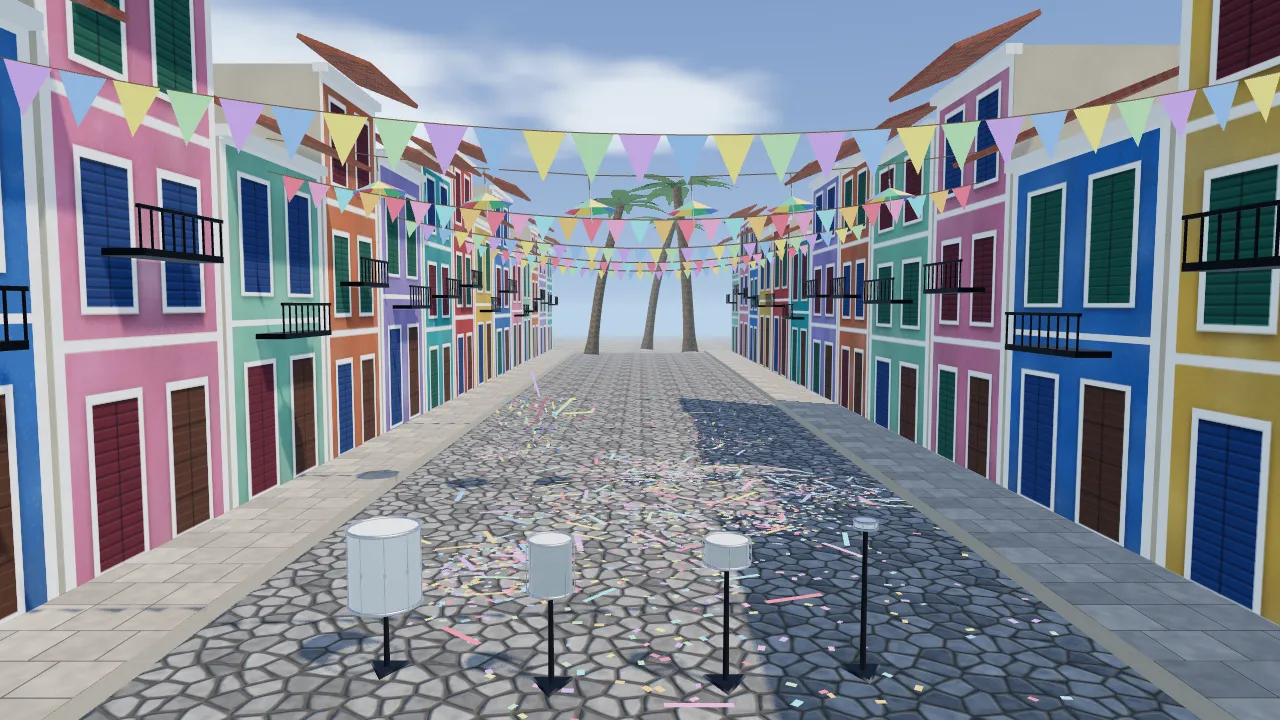
Fire confetti over a colourful Brazilian street and play samba drums.
How to play
- Tap the street to fire a confetti cannon there, or tap the sky for a burst in mid-air. Hold to keep firing.
- Tap a drum to play it: the big surdo, the repinique, the caixa snare and the little tamborim.
- Play along with the bateria: hit the surdo on the beat, where its deep note falls.
- Open Lab to change the paper weight and piece size, the drum tension and the breeze, or switch off the groove. Sweep the street clears the cobbles.
Challenges
- Play all four drums of the bateria: surdo, repinique, caixa and tamborim
- Fire enough confetti to carpet the cobbles in front of you
- Hit the surdo exactly on the beat four times in a row
Try this
- Change the paper weight from 30 to 120 g/m² and watch the fall speed readout: four times the weight per area falls twice as fast.
- Make the pieces 2 cm, then 10 cm. Bigger pieces tumble more slowly, yet they fall at the same speed, because what matters is weight per area.
- Tighten the drum tension to 140% and listen: the surdo’s note rises by about 18%, because pitch grows with the square root of tension.
Fun facts
- Carnival in Brazil takes place in the days before Ash Wednesday, the start of Lent, so its date moves each year along with Easter.
- Rio de Janeiro’s samba schools parade in the Sambódromo, an avenue designed by the architect Oscar Niemeyer that opened in 1984.
- In Recife and Olinda, the fast frevo dance is performed with small, brightly coloured umbrellas.
- A drum head’s lowest note depends on its size, its tension and its mass per area, and its overtones are not whole-number multiples of that note.
Why confetti flutters and drums go boom
Carnival is Brazil’s great festival, held in the days before Ash Wednesday, when the Christian season of Lent begins. Every city celebrates in its own way. In Rio de Janeiro, samba schools parade with huge floats, costumes and drum sections of hundreds of players. In Salvador, music trucks roll through the streets. In Recife and Olinda, people dance the fast frevo with little umbrellas, and giant puppets lead the crowds. Everywhere, neighbourhood street bands called blocos fill the streets with music, costumes, streamers and confetti.
Why confetti falls so slowly
A piece of confetti is a tiny flat plate. Falling face-down, it pushes a lot of air out of the way, and drag soon balances its weight. Its terminal speed is v ≈ √(2σg/ρCd), where σ is the paper’s mass per square metre, ρ the density of air and Cd a drag coefficient of about 1.5 for a flat plate. Notice that the size of the piece does not appear, only its weight per area. Ordinary 80 g/m² paper falls at under a metre per second, and quadrupling the paper weight only doubles the speed.
Flutter and tumble
Air pushes much harder on a piece’s face than on its edge. If the piece tilts, the stronger push on its face makes it glide sideways, and the glide tips it the other way. So it zigzags down, and if it starts to spin it tumbles over and over, a motion called autorotation. These paths are hard to predict exactly, which is part of what makes falling confetti so lively.
Drums are vibrating membranes
A drum head is a stretched circular skin. Strike it and it vibrates in patterns called modes. For a membrane of radius a, tension T (force per unit length) and mass per area σ, the lowest mode has frequency f = (2.405/2πa)·√(T/σ). Bigger heads sound lower and tighter heads sound higher. The big surdo carries the deep pulse of samba, often leaning on the second beat, while the small, tight tamborim gives sharp, high accents.
The other modes of a membrane sit at about 1.59, 2.14 and 2.30 times the lowest frequency. Because these are not whole-number multiples, as a string’s overtones are, drums produce a thud or a crack rather than a clear sung note.
For the curious
The numbers 2.405, 3.832, 5.136 and 5.520 are zeros of Bessel functions, which describe waves on a circular membrane. In the simulation each piece of confetti has a face-on drag coefficient of 1.5 and an edge-on one of 0.1, integrated with an implicit drag step, and its spin rate is proportional to its speed through the air divided by its size.
Questions people ask
When is carnival in Brazil?
Carnival takes place in the days leading up to Ash Wednesday, the start of Lent. Because it is tied to the date of Easter, it usually falls in February or early March and moves from year to year.
Why does confetti fall so slowly?
Confetti is very light for its area, so air drag on its face almost cancels its weight. It reaches a terminal speed of under a metre per second for ordinary paper, and its fluttering and tumbling slow it down even more.
What drums are played in samba?
A samba drum section, the bateria, includes the deep surdo, the snare-like caixa, the high-pitched repinique and the small tamborim, along with instruments such as the agogô bell and shakers called chocalhos.