Carbon Dioxide Molecule
Bend CO₂ and tune an infrared lamp to find the light it absorbs.
How to play
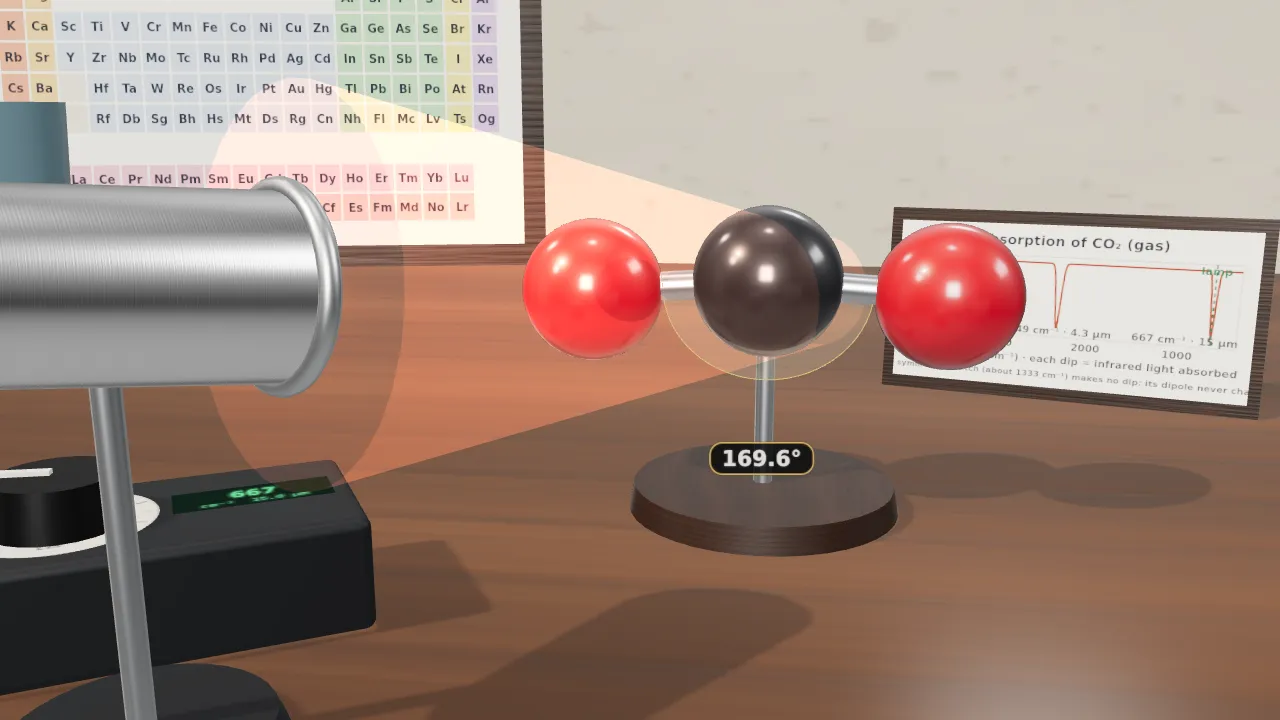
- Turn the dial on the infrared lamp. When it matches one of CO₂’s vibrations, the molecule absorbs and starts to swing.
- Pull an oxygen sideways to bend the molecule and watch the dipole readout jump up from zero.
- Try 1333 cm⁻¹, the symmetric stretch: nothing happens, because that vibration never changes the dipole.
- The framed chart shows where CO₂ absorbs. Open Lab for a fine-tuning slider, the three vibrations and a space-filling view.
Challenges
- Bend the molecule with your finger until it has a dipole
- Tune the infrared lamp until CO₂ starts to absorb
- Find both infrared bands, near 15 µm and near 4.3 µm
Try this
- Pick the symmetric stretch. The molecule stays perfectly balanced, the dipole stays at zero, and there is no infrared band.
- Pick the bend. The dipole swings back and forth: this is the vibration that absorbs infrared near 15 micrometres.
- Watch the O=C=O angle readout. It reads 180° at rest and dips during the bend.
Fun facts
- CO₂ is linear: its two C=O bonds point in exactly opposite directions, so their polarities cancel.
- Its bending vibration absorbs infrared near 15 micrometres, in the middle of the range of heat that Earth radiates to space.
- Solid carbon dioxide, dry ice, turns straight into gas (sublimes) at −78.5 °C at normal atmospheric pressure.
- In 1856 Eunice Foote showed that carbon dioxide warms more in sunlight than ordinary air, and in 1859 John Tyndall measured it absorbing heat radiation.
A straight molecule that traps heat
Carbon dioxide is one carbon atom between two oxygens, joined by two double bonds, each about 1.16 Å long. Carbon has no lone pairs left over, so there are only two regions of electrons around it, and the VSEPR rule says two regions point in opposite directions. The molecule is perfectly straight: O=C=O, with a bond angle of 180°.
Polar bonds, non-polar molecule
Each C=O bond is polar: oxygen pulls electrons away from carbon. But the two bonds point exactly opposite ways, so their pulls cancel. Carbon dioxide therefore has no overall dipole moment, unlike water, whose bent shape keeps its charges lopsided.
How molecules absorb infrared
Infrared light is an oscillating electric field. A molecule can soak up its energy only if one of its vibrations makes the molecule’s charge distribution swing back and forth at the same frequency: in other words, if the vibration changes the dipole moment. Carbon dioxide has three kinds of vibration:
- Symmetric stretch: both oxygens move out and in together. The molecule stays balanced, the dipole stays zero, and this vibration does not absorb infrared.
- Bend: the molecule flexes, carbon moving one way and the oxygens the other. A dipole appears and disappears with each flex, so it absorbs infrared, at 667 cm⁻¹, a wavelength of about 15 micrometres.
- Asymmetric stretch: one bond lengthens as the other shortens. This also creates a changing dipole and absorbs strongly, at 2349 cm⁻¹ (about 4.3 micrometres).
The greenhouse connection
Earth’s warm surface radiates heat as infrared, most strongly at wavelengths around 10 micrometres. The bending band of carbon dioxide at 15 micrometres sits squarely in that outgoing radiation. Molecules that absorb it re-emit the energy in all directions, including back down, so more CO₂ in the air means more heat is held near the surface. Nitrogen and oxygen, which make up 99% of the atmosphere, are symmetric two-atom molecules whose vibration never creates a dipole, so they let this infrared pass.
For the curious: the model
Bond length and wavenumbers are measured values for gas-phase CO₂. The dipole readout uses simple model charges (carbon +0.70, each oxygen −0.35) and recalculates μ = Σ q·r from the moving atoms, in debye. The atoms are joined by springs fitted to the three measured wavenumbers and slowed about 40 trillion times. The lamp pushes on the partial charges with an oscillating electric field, so only the bend and the asymmetric stretch can soak up its energy; the framed chart plots idealised absorption bands.
Questions people ask
Why is CO2 a linear molecule?
The carbon atom forms two double bonds and has no lone pairs, so there are just two regions of electrons around it. They repel each other as far apart as possible, which puts the two oxygens on opposite sides at 180°.
Why does CO2 absorb infrared but oxygen and nitrogen do not?
A molecule absorbs infrared only if a vibration changes its dipole moment. Carbon dioxide’s bending and asymmetric stretching vibrations do, while the single stretching vibration of symmetric two-atom molecules such as N2 and O2 does not.
Is carbon dioxide polar?
Its bonds are polar, but the molecule is not. The two C=O bonds point in exactly opposite directions, so their dipoles cancel and the molecule has no overall dipole moment.