Car Differential
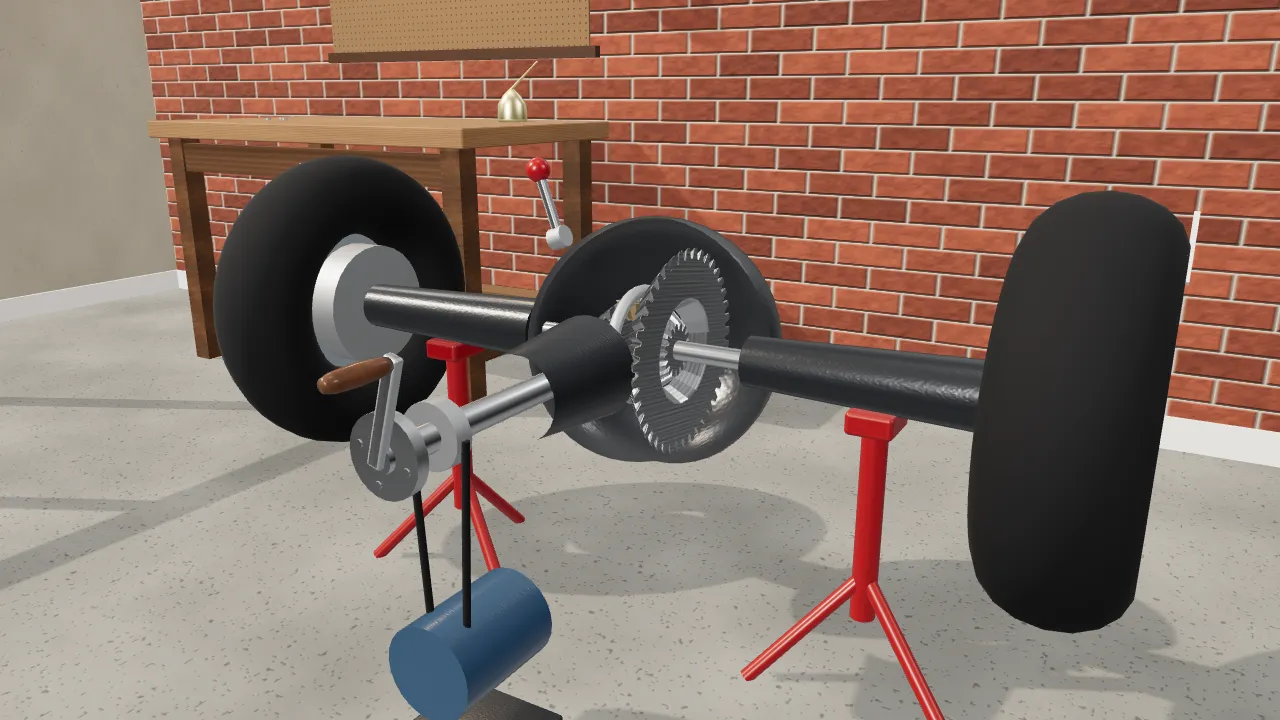
Crank a cutaway car axle and hold its wheels to see the differential.
How to play
- Grab the wooden handle on the propshaft and turn it. Both wheels turn together, carried round by the crown wheel.
- Grab a wheel and hold it still while the motor runs: the other wheel spins twice as fast. Turn the small speed dial on the floor to run the motor.
- With the motor off, turn one wheel by hand. The propshaft is held, as if the car were in gear, so the other wheel turns backwards.
- Tap the red lever on the housing to lock the differential. Now both wheels are tied together and turn as one.
Challenges
- Turn the crank until both wheels have made a full turn together
- With the motor off, turn one wheel by hand and make the other turn backwards
- Run the motor, then hold one wheel still so the other spins twice as fast
Try this
- Crank slowly and watch the bronze spider gears. While both wheels turn together they ride round with the carrier without spinning on their pin.
- Hold the left wheel and run the motor. Add the two wheel speeds and halve them: you get the crown wheel speed every time.
- Lock the differential and try to turn one wheel by hand. The other wheel, the crown wheel and the crank all turn with it.
Fun facts
- When a car turns, its outside wheels travel further than its inside wheels, so they must turn faster.
- In an open differential, the average of the two wheel speeds always equals the speed of the carrier and crown wheel.
- If one driven wheel is on ice, an open differential lets that wheel spin and the car can get stuck.
Why the wheels of a car need to turn at different speeds
Follow a car round a corner and look at its tyre tracks. The outside wheels trace a bigger circle than the inside wheels, so in the same time they cover more ground. If both rear wheels were fixed to one solid axle, one of them would have to skid. The differential is the clever gearbox that lets each wheel turn at its own speed while the engine drives them both.
How far each wheel goes
For a car turning on a circle of radius R, with its two wheels a distance w apart, the inside wheel follows a circle of radius R − w/2 and the outside one R + w/2. With the car moving at speed v, each wheel turns at ω = v(R ± w/2)/(R·r), where r is the wheel radius. On a tight turn, the difference is large. Here, with a track of 1.5 m, a turn of 6 m radius makes the outside wheel turn about 1.3 times as fast as the inside one.
The gears
The engine’s propeller shaft turns a small pinion, which drives a big crown wheel bolted to the differential’s carrier. Inside the carrier, two small bevel gears called spider gears sit on a cross pin. They mesh with two side gears, one on each half-shaft to a wheel. Driving straight, the spiders don’t spin at all: they carry both side gears round together. In a turn, the spiders roll round the side gears, speeding one up and slowing the other by the same amount. The result is the neat rule ωcarrier = (ωleft + ωright)/2.
The weakness
An open differential always gives the same torque to both wheels, and that torque is limited by the wheel with less grip. If one wheel is on ice, it needs almost no torque to spin, so the other wheel gets almost none either. The icy wheel spins at twice the carrier speed and the car stays put. Off-road vehicles use locking or limited-slip differentials for this reason, at the cost of tyre scrub in tight turns.
For the curious
The crown wheel has 41 teeth and the pinion 11, a final-drive ratio of about 3.7 : 1, so the carrier turns 11/41 as fast as the propshaft. In the simulation the crank or motor turns the pinion; a wheel you hold or turn sets its own angle, and the other wheel takes the rest: θother = 2θcarrier − θyours. The spider gears turn at (ωright − ωleft)/2 × Zside/Zspider, with 16 and 10 teeth.
Questions people ask
What does a differential do?
It lets the two driven wheels on an axle turn at different speeds while both receive drive from the engine. That is needed in every turn, because the outside wheel travels further than the inside one.
Why does a car get stuck when one wheel is on ice?
An open differential sends equal torque to both wheels, limited by the wheel with less grip. A wheel on ice needs very little torque to spin, so the wheel on good ground gets very little too, and the car doesn’t move.
What is a locked differential?
A differential that is locked makes both wheels turn at the same speed, like a solid axle. It gives good traction off-road but makes the tyres scrub and skid in tight turns on grippy surfaces.