Buoyancy Tank
Drop wood, ice, steel and an egg in a tank and squeeze a diver.
How to play
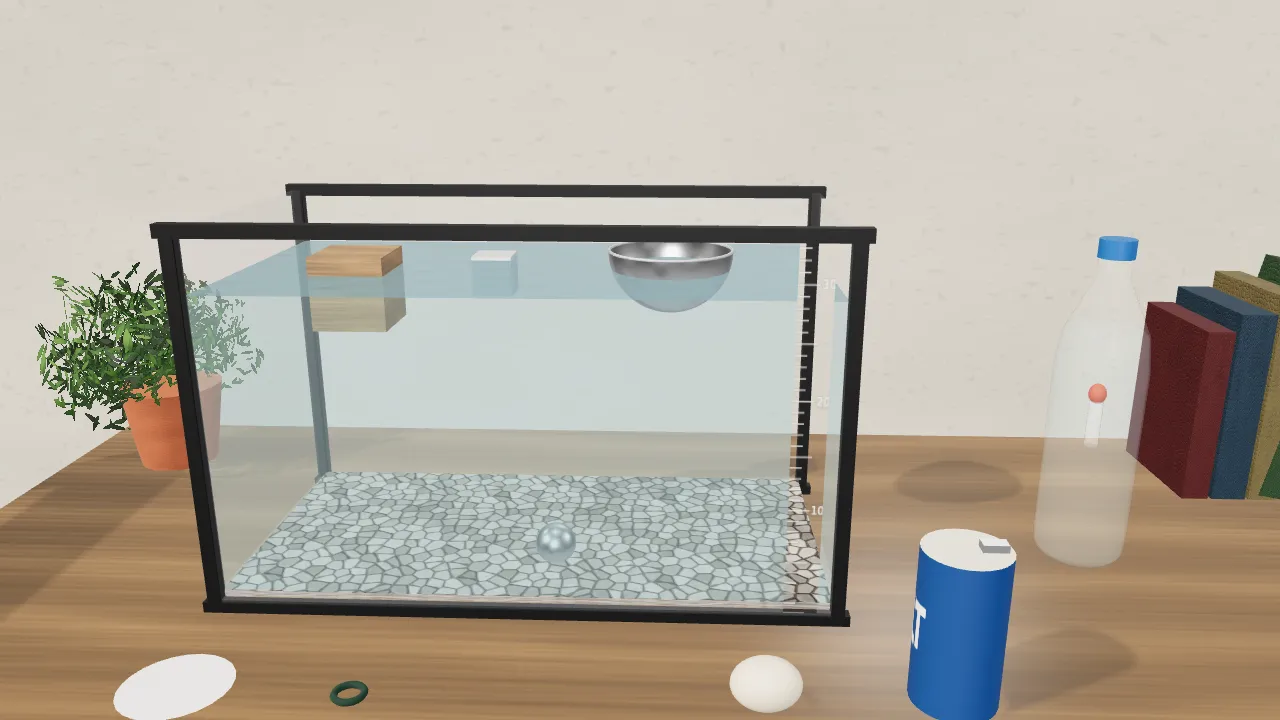
- Drag the oak block, the ice cube, the steel ball, the steel bowl or the egg into the tank. Let go above the water to drop it in, or push a floating thing under and let it bob back up.
- Hold the salt carton over the open tank to pour salt in. The readout shows the water’s density rising.
- Drag across the plastic bottle to squeeze it, and watch the air bubble in the little diver shrink.
- Drag something back out onto the table to put it away. Lab has exact salt amounts and fresh water.
Challenges
- Float the steel bowl and sink the steel ball: both are 260 g of the same steel
- Find the thing that sinks in fresh water but floats once you add salt
- Squeeze the bottle gently until the diver hovers halfway down
Try this
- Push the floating oak block right under and let go. The extra water it pushes aside lifts it back up, fast.
- Watch the ice cube. About nine tenths of it sits below the surface, just like an iceberg.
- Sink the steel bowl by pushing its rim under. Full of water, it is just 260 g of steel again, and down it goes.
Fun facts
- Archimedes’ principle: anything in a fluid is pushed up by a force equal to the weight of the fluid it pushes aside.
- Ice is about nine tenths as dense as water, which is why roughly nine tenths of an iceberg is hidden below the surface.
- Salt water is denser than fresh water, so a ship floats a little higher at sea than in a river. Ships carry load-line marks for both.
- The Cartesian diver is traditionally named after the French philosopher René Descartes.
Why things float: weight, density and the push of the water
Put something in water and two forces fight over it. Its weight pulls it down. The water pushes it up with a force called buoyancy. More than two thousand years ago Archimedes saw how big that push is: it equals the weight of the water the object pushes out of the way. Watch the scale on the glass: every object you add raises the water a little, by exactly the volume it pushes aside.
Density decides
A solid oak block weighs less than the same volume of water, so it only needs to push aside part of its own volume to be held up. It floats with about three quarters of itself under water, because oak here is 0.75 times as dense as water. Ice at 0.917 floats with about nine tenths under. A steel ball is nearly eight times as dense as water: even fully under, the water it pushes aside weighs far less than the ball, so it sinks.
Shape matters too
The steel bowl is made of the same 260 grams of steel as the ball, yet it floats. Its thin walls enclose a large space, so as it settles it pushes aside a lot of water before it is anywhere near its rim. What counts is the average density of everything below the waterline, steel and air together. That is how steel ships float. Let water pour over the rim and the air is gone: the bowl is just steel again, and it sinks.
Salt water
Dissolving salt makes water denser: 10 % salt by mass gives about 1.07 g/cm³. Denser water pushes harder on the same volume, so everything floats a little higher. An egg in this simulation is 1.06 g/cm³, so it rests on the bottom in fresh water and rises once there is enough salt.
The Cartesian diver
The diver is a small glass dropper holding a bubble of air, floating in a closed bottle. Squeezing the bottle raises the pressure inside. The bubble shrinks, as Boyle’s law says it must, the diver’s average density rises and it sinks. Let go and the bubble swells again. Hovering is tricky: a diver that drifts a little deeper feels more water pressure, its bubble shrinks further and it sinks faster, so you have to keep easing your squeeze.
For the curious
Buoyancy is F = ρw·g·Vsub; a floating object settles where Vsub/V = ρ/ρw. Each object here also feels water drag ½ρwCdAv² and is helped along by half the displaced water as added mass. Brine follows ρw ≈ 998 + 7.05S + 0.016S² kg/m³ for S % salt. The diver’s bubble obeys V = V₀·p₀/(p₀ + Δp + ρgd), with your squeeze Δp up to 25 kPa and depth d.
Questions people ask
Why does a steel ship float when a steel ball sinks?
A ship’s hull encloses a huge volume of air, so the ship pushes aside a great deal of water while it is still high in the water. Its average density, steel and air together, is less than that of water. A solid ball of the same steel has no air inside and pushes aside far too little water.
Why does an egg float in salty water?
A fresh egg is a little denser than fresh water, so it sinks. Dissolving salt makes the water denser. Once the water is denser than the egg, the water it pushes aside weighs more than the egg, and it floats.
How does a Cartesian diver work?
The diver traps a bubble of air. Squeezing the closed bottle raises the pressure, which squashes the bubble into a smaller volume. The diver then pushes aside less water, so it sinks. When you let go, the bubble expands and the diver rises again.