Archimedes’ Screw
Crank an Archimedes’ screw and lift pond water to a garden.
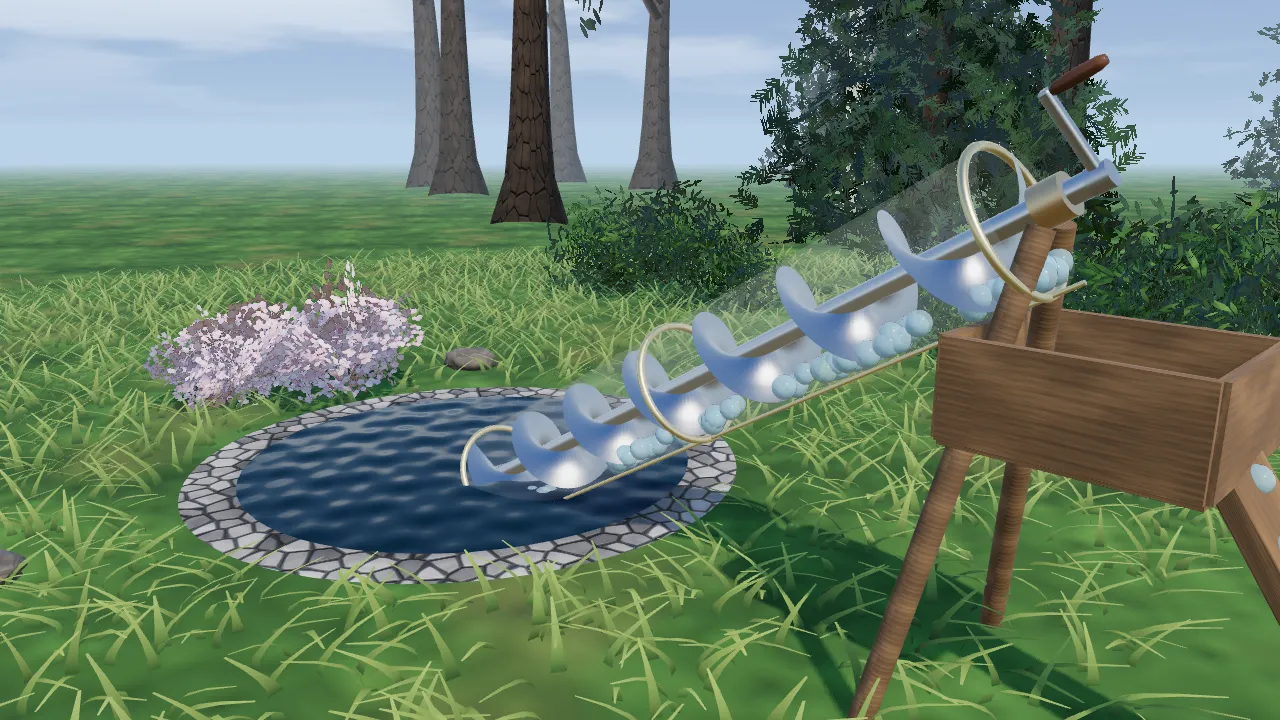
How to play
- Grab the wooden crank handle at the top of the screw and turn it. Water rides up in the pockets between the turns of the steel flight.
- Grab the tube and swing it up or down about its pivot in the pond to change the tilt.
- At the top the water spills into the hopper and runs down the chute to the vegetable beds.
- The readouts show the water and the energy lifted per turn. Lab adds a motor and two or three flights.
Challenges
- Crank the screw until 10 litres have poured into the hopper
- Swing the screw so steep that the water slides back, and crank a full turn
- Find the tilt that lifts the most energy per turn, and crank a full turn there
Try this
- Tilt the screw to 15°, then 60°. The flow drops sharply as it gets steeper.
- Find the tilt where the water stops climbing altogether. For this screw it is just over 70°.
- Switch to three flights. Each turn now carries three pockets up instead of one.
Fun facts
- The screw pump is named after Archimedes of Syracuse, who lived in the third century BC, though it may be older still.
- Archimedes’ screws are still used today, for example at sewage works and as fish-friendly turbines in small hydropower schemes.
- A screw can only hold water in its pockets if it is tilted less steeply than its flights allow.
How a turning spiral carries water uphill
An Archimedes’ screw is a spiral blade, the flight, wrapped round a shaft inside a tube, with its lower end in water. Turn it and water climbs out of the top. It looks like magic, but the water never actually moves uphill relative to the screw. It simply sits still at the bottom of each pocket while the spiral turns around it.
The moving pocket
At the low point of the tube, each turn of the flight traps a small pool of water between two blades, a pocket. Gravity holds the water at the lowest point. As the screw turns, the blades slide past, and the pocket’s position moves up the axis by one pitch, the spacing between turns, every revolution. The water stays at the bottom of the moving pocket, and the pocket carries it to the top, where it spills out. A screw with two or three flights carries two or three pockets per turn.
Why steeper is worse
A pocket can only hold water if the edge of the flight dips down and rises again, making a bowl. Follow the outer edge of the flight round one turn: its height changes because the screw climbs along its tilt, and because the edge goes up and down around the tube. If the tilt θ is too steep, the climb wins and the dip disappears. The condition is tan θ < 2πR/p, where R is the radius and p the pitch. For this screw (R = 16 cm, p = 32 cm) the limit is about 72°. Long before that, the pockets get shallow and spill back, so real screws are usually tilted around 30°.
Flow and lift
The flow is pockets per second times the water in each pocket. Tilting the screw lifts water higher but carries less of it, so the useful lifting power, flow times height, peaks at a moderate angle. Turned at 16 revolutions a minute, this screw delivers about 93 L/min at 15°, about 38 L/min at 45° and almost nothing at 70°. Per turn it lifts the most energy, about 44 joules, at a tilt of about 31°.
For the curious
The height of the flight’s edge is z(φ) = (p·φ/2π)·sin θ + R·cos θ·sin φ. It has dips that can hold water only if k = p·tan θ/(2πR) is less than 1. This simplified model takes the pocket depth as proportional to √(1 − k²) − k·acos(k) and the pocket volume as roughly the square of that, which gives the falling flow you see as the tilt increases.
Questions people ask
How does an Archimedes’ screw lift water?
Water collects in pockets between the turns of a spiral blade at the bottom of a tilted tube. As the screw turns, those pockets move up the axis, carrying the water with them until it spills out of the top.
What is the best angle for an Archimedes’ screw?
Moderate angles, often around 30 degrees, work best. Steeper screws lift water higher but each pocket holds less, and past a limit set by the radius and pitch the pockets vanish and no water is lifted.
Are Archimedes’ screws still used today?
Yes. They lift water and wastewater in pumping stations, move grain and other materials, and are run in reverse as slow, fish-friendly turbines in small hydropower schemes.