Buckyball (C₆₀)
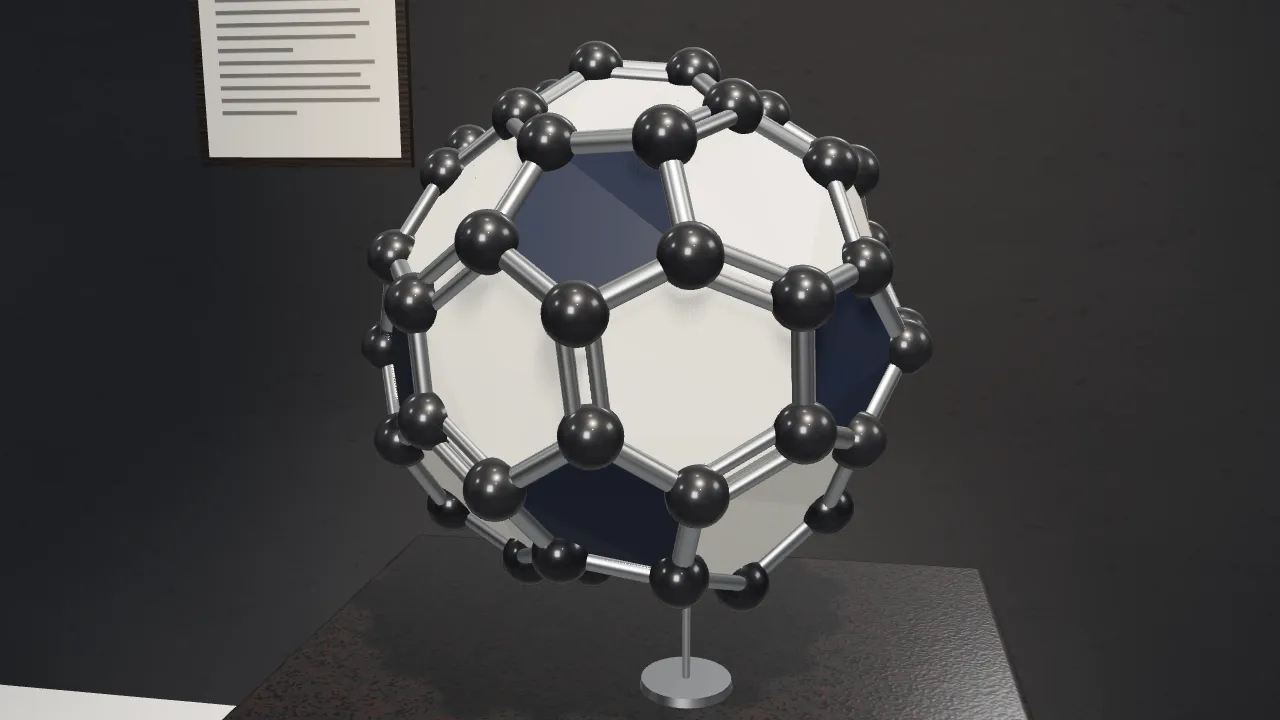
Pluck a C₆₀ carbon to ring the cage, then count its 12 pentagons.
How to play
- Grab any carbon and pull it out of the cage. Let go and the whole ball rings on its springs.
- Tap a dark pentagon or a pale hexagon to count it: it turns gold. Drag the empty space around the model to turn it and find the rest.
- Open Lab to drive the two Raman vibrations, switch to space-filling or hide the double bonds.
- Slide Cut the corners down to 0% to see the icosahedron hiding inside.
Challenges
- Pull a carbon out of the cage and let the whole ball ring
- Tap all 12 pentagons (turn the model to find the hidden ones)
- Now count all 20 hexagons of the football pattern
Try this
- Slide the corner cut slowly from 0% to 100%. Each of the icosahedron’s 12 corners opens into one pentagon.
- Turn off the football pattern and look at the double bonds. Each one sits between two hexagons, never on a pentagon edge.
- Switch to space-filling. The cage closes up completely: there is just enough room inside for a single small atom.
Fun facts
- C₆₀ was discovered in 1985 by Harold Kroto, Robert Curl and Richard Smalley, who shared the 1996 Nobel Prize in Chemistry for it.
- It is named after the architect Richard Buckminster Fuller, known for his geodesic domes.
- Like the classic football, it has exactly 12 pentagons and 20 hexagons: 32 faces, 90 edges and 60 corners.
- In 2010 astronomers using the Spitzer Space Telescope found the infrared signature of C₆₀ around a planetary nebula.
A football made of carbon
For most of history, pure carbon came in two well-known forms: diamond and graphite. In 1985 a team zapping graphite with a laser found a third, a molecule of exactly 60 carbon atoms that turned out to be a hollow cage. They named it buckminsterfullerene, after the architect whose domes it resembled. Everyone else calls it the buckyball.
Why the shape works
Each carbon atom bonds to three neighbours, like the carbon in a sheet of graphite. A flat sheet of hexagons can’t close into a ball, but swap in some pentagons and it curves. A neat bit of geometry, Euler’s formula for polyhedra (corners − edges + faces = 2), shows that any closed cage built only from pentagons and hexagons, with three edges at every corner, needs exactly twelve pentagons. C₆₀ is the smallest such cage in which no two pentagons touch, which spreads the strain evenly and makes it unusually stable.
Two kinds of bond
Carbon has four bonding electrons, but each atom here has only three neighbours, so one bond per atom is a double bond. In C₆₀ the double bonds sit on the 30 edges shared by two hexagons (“6:6” bonds, about 1.39 Å long). The 60 pentagon edges (“6:5” bonds) are single and slightly longer, about 1.45 Å. The whole molecule is about 0.7 nm across, roughly a thousandth of the width of a human hair.
Where buckyballs turn up
Fullerenes form in soot when carbon condenses from hot vapour, and they have been detected in space. Chemists study them as building blocks for electronics, solar cells and medicines, and have even trapped single atoms inside the cage.
For the curious: building it from the golden ratio
With φ = (1 + √5)/2, the golden ratio, the 60 corners of a truncated icosahedron with edge length 2 are all the even (cyclic) permutations of (0, ±1, ±3φ), (±1, ±(2 + φ), ±2φ) and (±φ, ±2, ±(2φ + 1)). Bonds join every pair exactly 2 apart, giving 90. This model then scales each pentagon slightly about its centre until the 6:6 and 6:5 bonds have their measured lengths. The “cut the corners” slider shows the name in action: start with an icosahedron (12 corners, 20 triangular faces), slice a third of the way along every edge, and each corner becomes a pentagon while each triangle becomes a hexagon. The two vibrations offered are real Raman-active modes, the radial “breathing” mode near 496 cm⁻¹ and the “pentagonal pinch” near 1469 cm⁻¹.
Questions people ask
Why is C60 called a buckyball?
Its full name is buckminsterfullerene, after the architect Richard Buckminster Fuller, whose geodesic domes have a similar pattern. Buckyball is the friendly short version, inspired by its football shape.
How many pentagons and hexagons does C60 have?
It has 12 pentagons and 20 hexagons, exactly like a classic football. That makes 32 faces, 90 edges (bonds) and 60 corners (carbon atoms).
Is C60 found in nature?
Yes. Fullerenes form in soot, and astronomers have detected the infrared signature of C60 in space, around a planetary nebula.