Briggs–Rauscher Oscillating Reaction
Pour three clear solutions together and make the colour pulse.
How to play
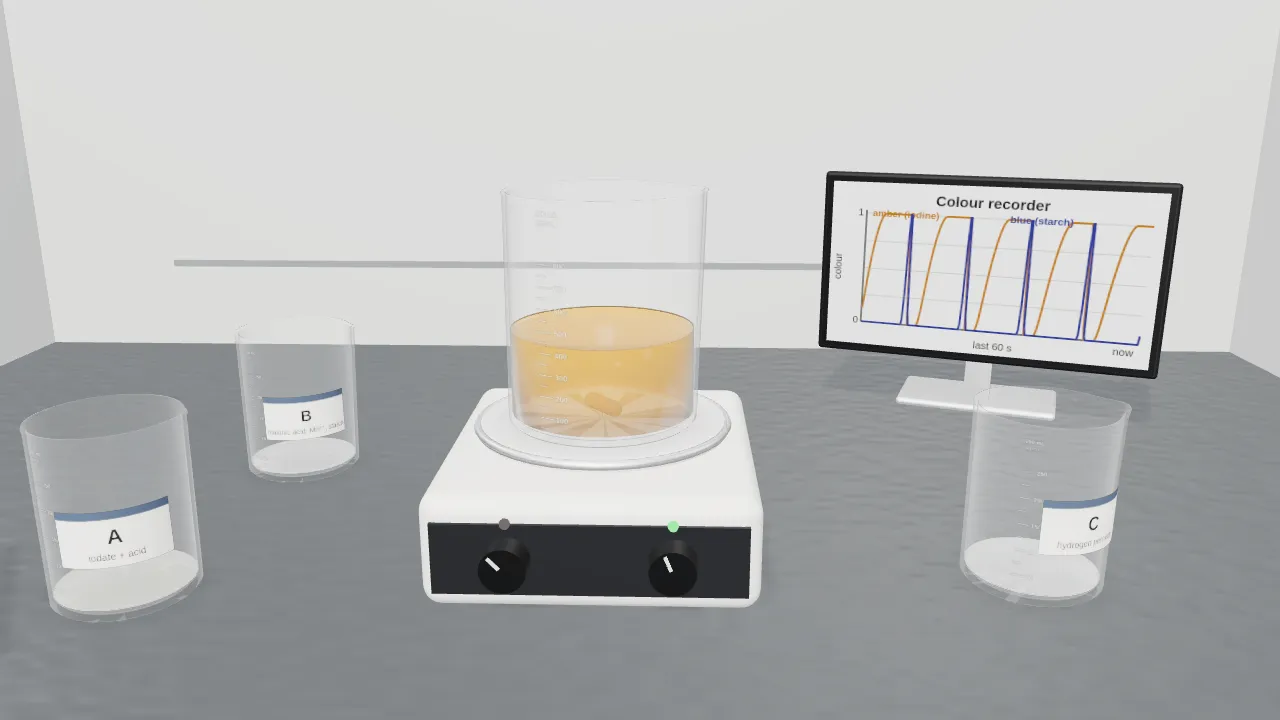
- Drag beaker A over the big beaker and keep pushing to tip it. Pour B and C the same way: the cycles begin once all three are in.
- Turn the right-hand knob on the hot plate to stir, and the left-hand knob to warm the mixture.
- Follow the colour recorder: the amber trace is iodine, the blue trace the starch complex. Read the period in the corner.
- Try the three Challenges, or open Lab for Mix for me and Fresh solutions.
Challenges
- Pour all three solutions into the big beaker
- Let the mixture swing from amber to blue-black five times
- Warm it above 30 °C until one cycle takes less than 8 seconds
Try this
- Note the period at 25 °C, then warm it to 35 °C. The cycles come roughly twice as fast.
- Let it run. As the reagents are used up the cycles stretch out, and eventually the oscillation stops.
- Watch the order of the colours closely: amber always builds slowly, the blue-black flash comes suddenly.
Fun facts
- The reaction was published in 1973 by Thomas Briggs and Warren Rauscher, chemistry teachers at Galileo High School in San Francisco.
- They built it by combining ideas from two earlier oscillating systems, the Belousov–Zhabotinsky and Bray–Liebhafsky reactions.
- Oscillating reactions do not break the laws of thermodynamics: the colours cycle, but the reaction as a whole keeps running downhill until its fuel is spent.
A chemical clock that ticks by itself
Most reactions go one way: reactants turn into products, steadily, until they are used up. The Briggs–Rauscher reaction is different. Mix three colourless solutions and the beaker turns amber, then suddenly blue-black, then clears, and does it all again, over and over, for minutes. It is one of the most striking oscillating reactions in chemistry.
The ingredients
One solution contains potassium iodate and acid; one contains malonic acid, a manganese(II) catalyst and starch; the third is hydrogen peroxide. Between them they produce iodine (I₂) and iodide (I⁻) and then consume them again.
Why it oscillates
The heart of the reaction is two competing routes. When there is little iodide, a fast, self-accelerating route takes over: it makes iodine faster and faster, and the solution turns amber. Peroxide then turns some of that iodine back into iodide. Once enough iodide has built up, it switches the fast route off and a slower route takes over. Iodide and iodine are now present together and form triiodide, which the starch locks into a blue-black complex. Meanwhile the malonic acid soaks up iodine, so both fall away, the solution clears, iodide drops low again, and the fast route restarts.
The key ingredients are feedback: a product that speeds up its own production (autocatalysis), and a second product that later shuts that process down. The same pattern of fast positive feedback and slower negative feedback drives heartbeats, predator–prey cycles and many other natural rhythms.
Why it stops
Every cycle uses up a little iodate, peroxide and malonic acid. The oscillations slow down, and once the reagents are low enough the mixture settles to a steady state. Energy keeps flowing downhill the whole time, which is why oscillating reactions are allowed by thermodynamics.
For the curious: the model
The full mechanism involves around ten steps. This simulation uses a much simpler stand-in with the same kind of behaviour, the Brusselator, developed in Brussels by Ilya Prigogine and René Lefever:
dX/dt = A − (B + 1)X + X²Y, dY/dt = BX − X²Y
Here Y plays the part of iodine and X of iodide. When B is greater than 1 + A², the steady state is unstable and the system falls into a limit cycle: a repeating loop. The equations are integrated with the fourth-order Runge–Kutta method. B is made to decline slowly as “reagents” are used up, so the cycles lengthen and finally die out, and an Arrhenius factor speeds everything up as the temperature rises. The periods are therefore illustrative rather than predictions for a particular recipe.
Safety
The real reaction uses concentrated hydrogen peroxide, sulfuric acid and potassium iodate, and it gives off iodine vapour. It should only be done by trained people in a fume cupboard with goggles and gloves. Please read our disclaimer.
Questions people ask
How does the Briggs–Rauscher reaction work?
Two competing reaction routes take turns. A fast, self-accelerating route makes iodine (amber) until the iodide it produces switches it off; iodine and iodide together then form a blue-black complex with starch, and both are consumed, which lets the fast route start again.
How long does the Briggs–Rauscher reaction oscillate?
Typically for several minutes. Each cycle uses up some of the reagents, so the cycles slow down and eventually stop, leaving a steady colour.
What makes the colours in the Briggs–Rauscher reaction?
The amber colour is dissolved iodine. The blue-black colour is a complex formed when triiodide ions, made from iodine and iodide together, are trapped inside the coils of starch molecules.