Bottle Flip
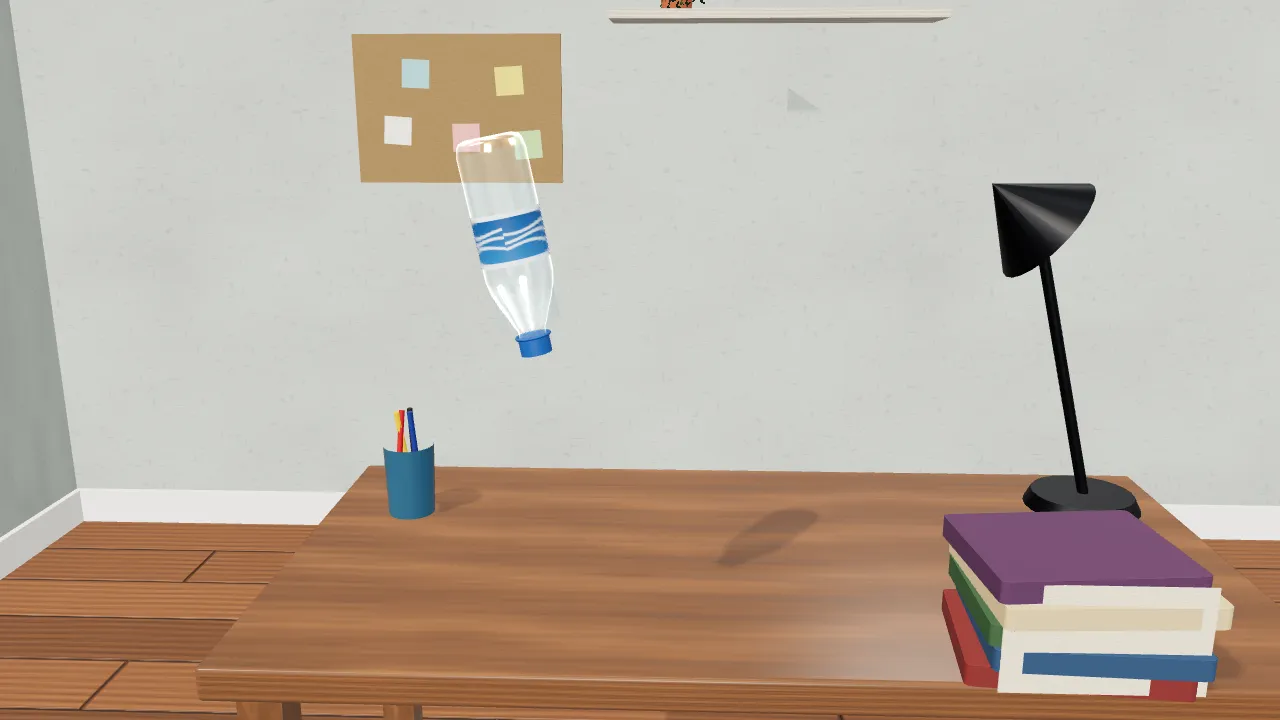
Flip a part-filled water bottle and land it standing up.
On Amazon.in. As an Amazon Associate I earn from qualifying purchases.
How to play
- Put your finger on the bottle and swipe up quickly to toss it. A quicker swipe throws it higher and spins it faster.
- Swipe a little to the right to send it toward the books or the stool. The ring shows where to land it.
- Five flips make a round: the desk twice, then the books, then the stool twice. A flip counts only if the bottle ends up standing on the right surface.
- Try the three Challenges, or change the Water in the bottle in Lab and compare an empty, a third-full and a full bottle.
Challenges
- Land a bottle flip standing upright
- Land three flips in a row
- Land a flip on the stool
Try this
- Empty the bottle in Lab and try to land it. It turns at the same speed all the way round and bounces off the desk like a ball.
- Fill it to the top. It is heavy and steady, but it keeps spinning just as fast, so it comes down still turning and topples over.
- Choose slow motion with a third-full bottle and watch the water: it slides up along the bottle as it turns, and the spin slows down before it lands.
Fun facts
- Bottle flipping became a worldwide craze in 2016, when videos of flips landing on tables and shelves spread online.
- Half a litre of water has a mass of about half a kilogram, many times more than the thin plastic bottle around it, so the water decides how the bottle moves.
- A spinning ice skater uses the same physics in reverse: pulling the arms in lowers the moment of inertia, so the spin speeds up. Water spreading out in a flipped bottle raises it, so the spin slows.
- Most single-use water bottles are made of PET plastic, the same light, tough plastic used for many fizzy-drink bottles.
The physics of a bottle flip: why the water matters
A bottle flip looks like pure luck, but a part-filled bottle lands far more often than an empty or a full one for a good physical reason. It comes down to angular momentum and the moment of inertia, and to what the water does on landing.
Spin that slows down by itself
Once the bottle leaves your hand, nothing twists it: gravity pulls on its centre of mass and makes no turning effect about it. So its angular momentum, the moment of inertia I times the rate of spin ω, stays the same for the whole flight. The moment of inertia measures how far the mass sits from the turning axis. If I goes up, ω must go down.
In a bottle about a third full, the water starts as a short column at the bottom. As the bottle turns, the water is flung outward along it and spreads up toward the cap. Mass moves away from the turning axis, I rises, and the spin slows. For the half-litre bottle in this game, with a third of a litre of water, I grows about four times during the flip, so the bottle arrives turning a quarter as fast as it left your hand. A slowly turning bottle that reaches the table upright stays upright.
Empty and full bottles
An empty bottle has nothing to slosh: it spins at the same rate all the way down, and its springy plastic bounces off the table. A full bottle has nowhere for the water to go, so it also keeps its spin, and it is heavy and fast when it lands still turning. In both cases the angle and the timing have to be almost perfect.
The landing
When a part-filled bottle lands, the plastic stops first and then the water crashes down into the base a moment later. Like the loose shot inside a dead-blow hammer, this soaks up the bounce and the remaining spin instead of throwing the bottle back up. The water then lies at the bottom, so the centre of mass is low and the bottle can lean quite far and still rock back onto its base.
For the curious
In flight the angular momentum J = I·ω is constant, so ω₂ = ω₁·I₁/I₂. The water’s free end is flung outward with an acceleration of about ω² times its distance from the turning axis. A column of water of mass m and length ℓ has its own moment of inertia m·ℓ²/12, and up to about twice that when the spinning water is pressed toward the ends of the bottle. A bottle stands back up after a knock while its centre of mass stays over its base: the tipping angle is about arctan(r/h), with r the radius of the base and h the height of the centre of mass.
Questions people ask
Why does a bottle flip work best when the bottle is partly full?
The water moves along the bottle as it spins, which raises the bottle’s moment of inertia and slows its spin, because angular momentum is conserved in the air. The bottle reaches the table turning slowly, and the water crashing into the base on landing soaks up the bounce.
Why does an empty bottle bounce off?
With no water inside, the bottle keeps spinning at the same rate, and its light, springy plastic bounces when it hits the table. Nothing soaks up the impact, so it hops and tips over.
How much water should I put in for a bottle flip?
Something between a quarter and a half full works best. That leaves room for the water to move and slow the spin, and it is heavy enough to keep the bottle steady after it lands. Try different amounts in the Lab.