Block Tower
Pull wooden blocks from a tower and stack them on top without a crash.
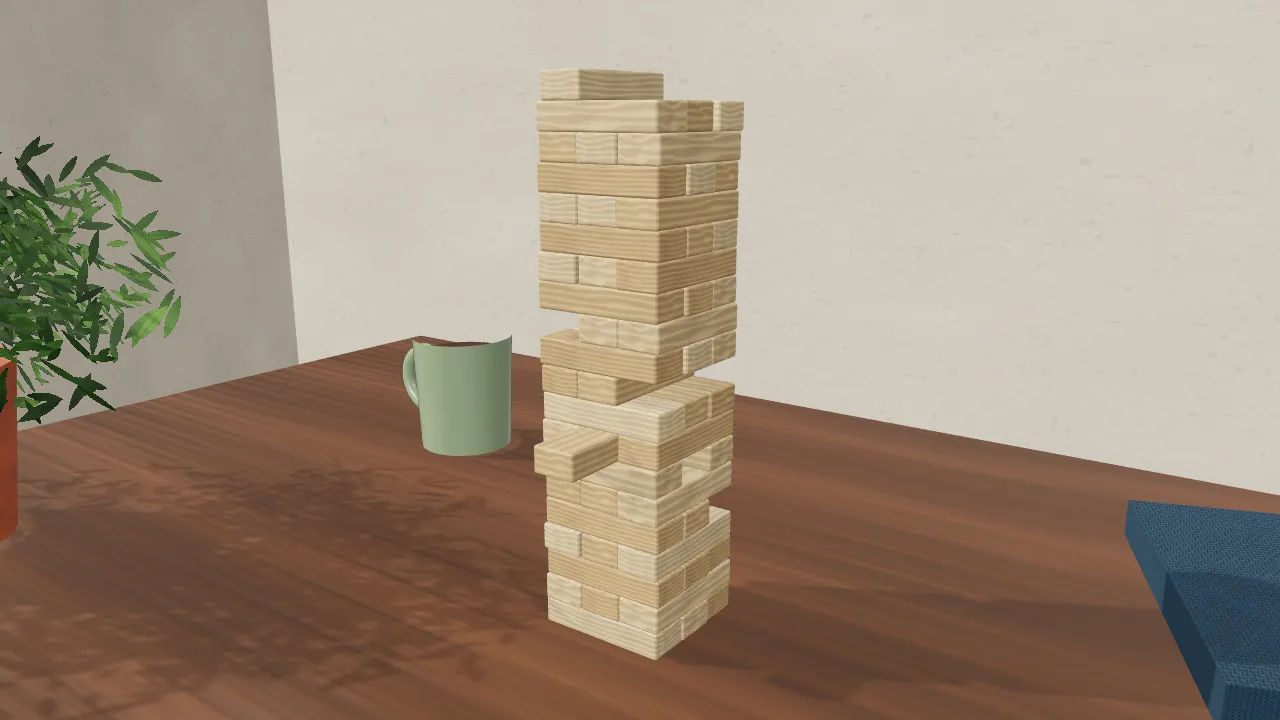
How to play
- Grab the end of a block and slide it along its length. Loose blocks glide out; tight ones stick, then jerk.
- Once it is free, lift it up and drop it onto one of the pale spots on top. Finish each top layer before starting a new one.
- Blocks in the top layer, and in the layer under an unfinished top, stay put: that’s the rule. Drag empty space to walk around the tower.
- If it falls, tap the table for a fresh tower. Try the three Challenges, and open Lab to see which blocks carry the weight.
Challenges
- Slide three blocks out of the tower
- Stack five blocks on top of the tower
- Make 20 moves, out and onto the top, without the tower falling
Try this
- Try the middle block of a layer, then an edge block. Often one glides out at a touch while the other will not budge, because they are not quite the same thickness.
- Take both edge blocks out of one layer. The tower still stands on the middle block alone, because the weight above sits right over it.
- Now take a middle block and an edge block from the same layer. The weight above is left beside its only support, and over it goes.
- Open the Lab and switch on the weight view: warm blocks carry the tower, cool ones are loose. Set the variation to zero and build a new tower to see the weight shared evenly.
Fun facts
- The best-known block-stacking game, Jenga, was created by Leslie Scott and launched in 1983. Its name comes from kujenga, the Swahili word for “to build”.
- A standard tower has 54 blocks in 18 layers of three, each layer laid at right angles to the one below.
- Each block is three times as long as it is wide, so three blocks side by side make a square layer.
- Wooden blocks are never exactly the same thickness, so in most layers some blocks carry the weight above while others are loose. Finding the loose ones is most of the skill.
Why a block tower stands or falls: friction, load and balance
A tower of wooden blocks looks simple, but it is a neat lesson in statics, the physics of things that do not move. Three ideas explain almost everything that happens: how the weight is shared, how friction grips, and where the centre of mass sits.
Loose blocks and tight blocks
Each layer rests on the three blocks below it. If those blocks were exactly the same thickness they would share the weight equally. Real wooden blocks differ by a fraction of a millimetre, so the layer above settles onto the thickest ones and may not touch a thinner one at all. Wood squashes very slightly under load, so near the heavy bottom of the tower most blocks end up carrying some weight, while near the top it is common for one block in a layer to carry nothing. That loose block is held only by its own weight, and it slides out at a touch.
Friction and stick–slip
Friction grows with the force pressing two surfaces together. A loaded block is squeezed from above by the weight it carries and from below by that same weight plus its own, so the force needed to slide it is the friction coefficient times both. Wood also grips harder before it starts to move than once it is moving. Pull a tight block and it sticks, then lurches a few millimetres, then sticks again, a stick–slip motion you can hear as a creak. If a block carries most of the weight above it, the friction on its top face can beat the friction holding the rest of that weight in place, and the whole upper tower slides along with it.
Centre of mass and support
A stack stays up as long as the centre of mass of everything above any layer lies over the area where that layer touches the one below. The middle block alone is enough, because the weight above is centred over it. A single edge block is not: the centre of mass is then beside the support, gravity turns the upper tower about the edge, and it topples. That is why experienced players never leave one edge block on its own. Pushing the upper tower sideways moves its centre of mass too, and so does a tower that leans.
For the curious
The force to slide a block carrying a load N with mass m is F = μ(2N + mg), with μs ≈ 0.42 to start and μk ≈ 0.32 while sliding. The upper tower, of weight W, slides along with the block when μkN > μs(W − N), that is when N > μsW/(μs + μk) ≈ 0.57W. Here each layer rests on its strips like a stiff plate on springs: the contact forces Fi = k·max(0, ti − h − s·ci) must add up to W and balance its moment, which fixes the plate height h and tilt s. The tower stands while every centre of mass lies inside the convex hull of its contact patches; at the moment one does not, the blocks above are handed to a rigid-body solver and fall for real.
Questions people ask
Why are some blocks loose and others stuck?
The blocks differ very slightly in thickness. Each layer settles onto the thickest blocks below it, so a thinner block may carry none of the weight above. With nothing pressing on it, only friction from its own small weight holds it, and it slides out easily.
Which blocks are safest to take?
Loose ones first. An edge block is usually safe while the middle block of its layer is still there, and a layer can stand on its middle block alone. Avoid leaving a single edge block in a layer: the weight above would then sit beside its only support.
Why does a tight block drag the tower with it?
Friction on its top face pulls the layer above along. If that block carries most of the weight above, its friction is stronger than the friction holding the rest of the weight on the other blocks, so the upper tower slides with it instead of staying put.