Bonfire Night Fireworks
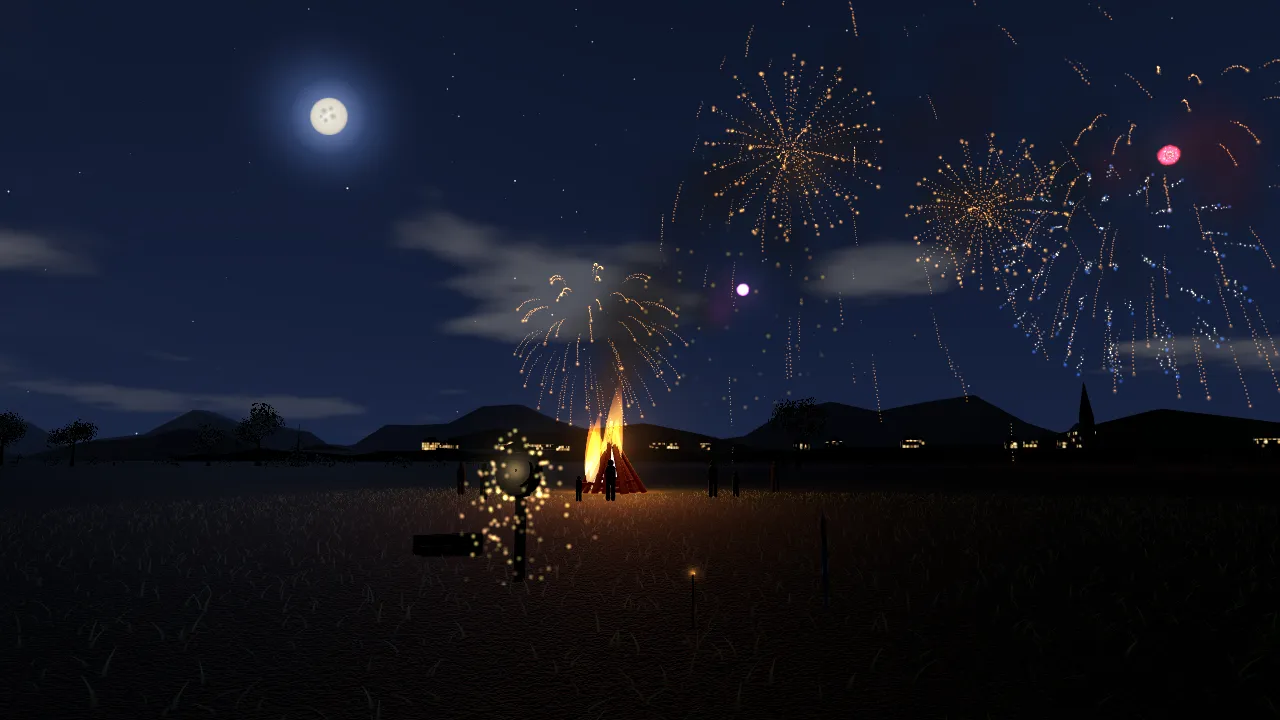
Light a rocket and a Catherine wheel with a portfire by a bonfire.
How to play
- Pick up the glowing portfire and touch it to the rocket’s blue touch paper. Stand back: the view follows the rocket up.
- Touch the portfire to the Catherine wheel’s fuse and watch it spin up to its top speed.
- Drag a log from the woodpile onto the bonfire to make it blaze, or press the sky to aim a firework of your own.
- Try the three Challenges, or open Lab for stick rockets, colours and star patterns.
Challenges
- Light a rocket’s blue touch paper with the portfire and stand well back
- Light the Catherine wheel and let it spin up to its top speed
- Drag a log onto the bonfire and watch the embers fly higher
Try this
- Light the Catherine wheel and watch the spin readout. It speeds up quickly, then levels off when air drag and friction balance the push of its jets.
- Switch to stick rockets and compare their climb with the mortar shells: a rocket keeps pushing for about a second, while a shell gets all its speed at once.
- Watch the embers above the bonfire. Hot air rises and carries them up, and they cool from yellow to red as they drift with the wind.
Fun facts
- Bonfire Night marks the failure of the Gunpowder Plot of 1605, when a group of conspirators planned to blow up the House of Lords in London.
- Guy Fawkes was arrested in a cellar beneath the House of Lords around midnight on 4–5 November 1605, guarding barrels of gunpowder.
- Hedgehogs often crawl into bonfire piles to shelter, so wildlife charities advise checking a bonfire, or building it on the day, before lighting it.
- A rocket flies because it throws hot gas backwards, and the gas pushes the rocket forwards; it doesn’t need air to push against.
Three ways to burn: bonfire, rocket and wheel
On 5 November, people across the UK light bonfires and set off fireworks to remember the night in 1605 when a plot to blow up Parliament was foiled. Many towns and villages hold an organised display, often with a bonfire, hot food and toffee apples. This field brings together three of the night’s favourites, and each one runs on a different piece of physics.
The bonfire: hot air rising
A fire heats the air above it, and hot air is less dense than the cooler air around it, so it rises in a column called a plume. Fresh air rushes in at the bottom to replace it, feeding the flames with oxygen. The rising plume carries glowing embers high into the air; as they rise they cool, and their colour changes from yellow to orange to dull red, just as a cooling poker does. The smoke and embers in the scene drift with the wind as they rise.
Stick rockets: thrust
A firework rocket is a tube of tightly packed propellant with a narrow opening. As it burns, hot gas rushes out of the back, and by Newton’s third law the gas pushes the rocket forwards. The stick keeps it pointing straight, like the feathers on an arrow. In the scene a rocket gets a thrust of about nine newtons for about a second, getting lighter as its propellant burns, then coasts upwards, slowed by gravity and drag, and bursts near the top.
The Catherine wheel: torque
A Catherine wheel is a coil of fireworks pinned to a post. Its jets point sideways, along the rim, so their push turns the wheel instead of moving it. A force acting at a distance from a pivot is called a torque. The wheel speeds up until friction at the pin and air drag, which grows with spin speed, balance the torque from the jets; then it spins steadily, throwing sparks in a spiral.
Staying safe
Real fireworks and bonfires injure people every year, and they frighten pets and wildlife. Going to an organised display is the safest way to enjoy the night, and if you build a bonfire, check it for hedgehogs before you light it.
For the curious
The wheel follows I dω/dt = 2Fr − τf − kω², where I is its moment of inertia, F the thrust of each jet and r the rim radius, so its top speed is ω = √((2Fr − τf)/k). A rocket’s acceleration is a = F/m − g − (drag/m), and it grows as the propellant burns away and m falls.
Questions people ask
Why do we have bonfires on Bonfire Night?
Bonfires were lit in 1605 to celebrate the foiling of the Gunpowder Plot, and the custom has continued ever since. Today most people enjoy them at organised community displays.
How does a Catherine wheel spin?
Its fireworks are coiled so their jets point along the rim. Pushing sideways at a distance from the pin creates a torque, and the wheel spins faster until friction and air drag balance that push.
How should I check a bonfire for hedgehogs?
Wildlife charities suggest building the bonfire on the day you light it, or gently lifting the base with a pole and checking with a torch before lighting it, so any sleeping hedgehogs can be moved to safety.