Bird Feeder Garden
Fill garden feeders with seed, peanuts or nectar and see who visits.
How to play
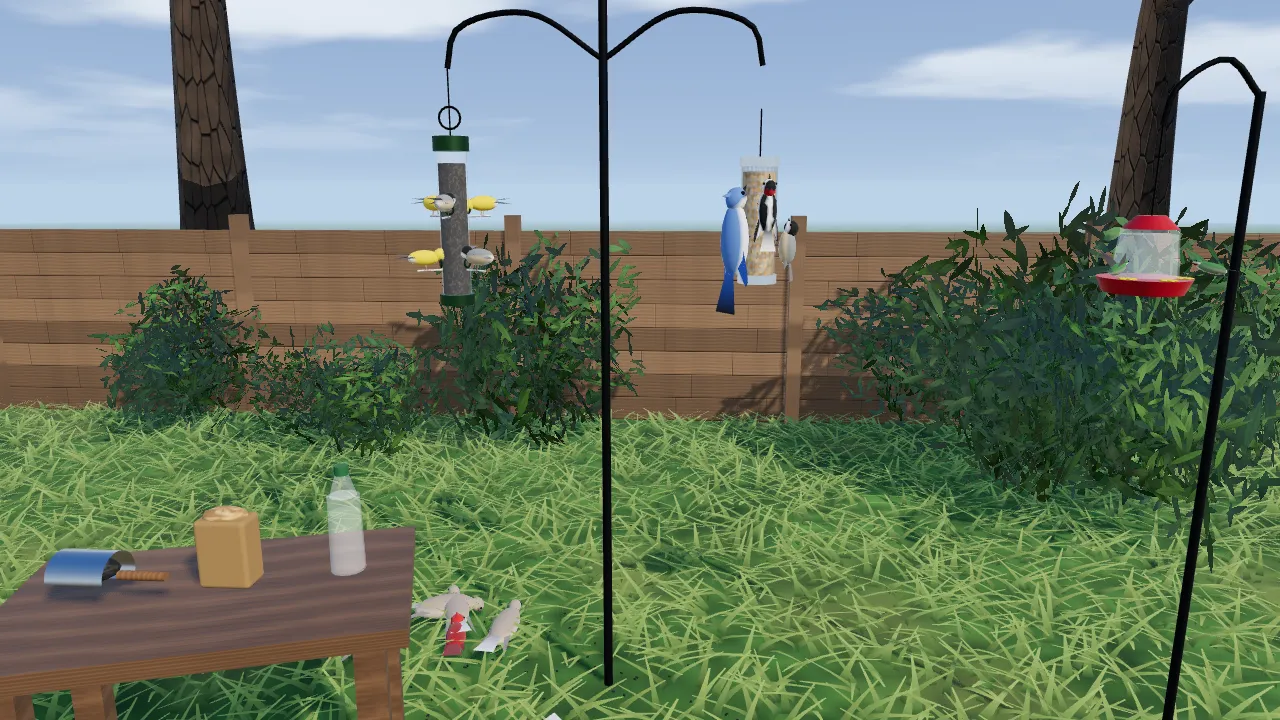
- Drag the seed scoop onto the tube feeder, the peanut bag onto the mesh feeder or the nectar bottle onto the red saucer feeder.
- Drop the seed scoop on the lawn to scatter seed for birds that feed on the ground.
- Tap a bird to learn its name and what it is doing.
- Open Lab to fill every feeder at once or rake the lawn. Drag empty space to look around; pinch or scroll to zoom.
Challenges
- Bring three different species to your feeders
- Get ten birds feeding at the same time
- Spot the ground feeder: tap a mourning dove pecking on the lawn
Try this
- Fill only the nectar feeder and wait. Only the ruby-throated hummingbirds come, because no other bird here drinks nectar.
- Fill the tube feeder and watch the chickadees: each one takes a single seed and flies off to a branch to eat it, while goldfinches stay and feed on the perches.
- Rake the lawn clean and watch the doves leave. Then let the messy seed eaters at the tube feeder drop seed again, and the doves come back to the ground below.
Fun facts
- The ruby-throated hummingbird is the only hummingbird that regularly nests in eastern North America. Its wings beat about 50 times a second as it hovers.
- Nectar for hummingbird feeders is simply one part white sugar dissolved in four parts water. Red dye is not needed: the red parts of the feeder are enough to attract them.
- The American goldfinch eats almost nothing but seeds, even feeding seeds to its young. The bright yellow males turn a dull olive-brown in winter.
- Black-capped chickadees and blue jays hide food to eat later. Jays bury acorns, and the ones they never come back for can grow into oak trees.
A bill for every food
Fill one feeder and a garden fills with a few kinds of bird; fill another and a different crowd arrives. That is no accident. Each species has a bill, a body and a way of feeding shaped by the food it eats in the wild, and a set of feeders is a small, easy-to-watch test of those differences.
Seed crackers, nut hammerers and nectar sippers
The northern cardinal and the American goldfinch have short, cone-shaped bills, strong at the base, made for cracking seeds open and peeling off the husk. The blue jay and the downy woodpecker can hammer and pry: woodpeckers chisel into wood for insects in the wild, and a peanut held in a wire mesh is an easy meal for them. Woodpeckers cling upright, propped on stiff tail feathers. The ruby-throated hummingbird has a long, thin bill and a tongue that laps nectar from flowers, so it ignores seed entirely and goes straight to the sugar water.
Grab and go
Feeding in the open has a price: while a bird eats it can be seen by a hawk or a cat. A black-capped chickadee deals with this by taking one seed at a time and flying off to a branch in cover, where it holds the seed with its feet and hammers it open. Chickadees and jays also hide food to eat later, a habit called caching. Goldfinches, by contrast, settle on the perches and feed for minutes at a time.
The ground floor
Not every bird feeds off the ground. The mourning dove is a ground feeder: it walks around picking up seeds and swallows them whole, storing them in a pouch in its throat called the crop to digest later. At a garden feeder it is often the messy eaters above that feed it, scattering seed as they pick through the mix. That is why a feeding station works best with food at several levels.
Hovering is expensive
A hovering hummingbird beats its wings in a figure-of-eight, making lift on both the forward and the backward stroke, and it burns energy faster for its size than almost any other animal. To fuel that it drinks nectar many times an hour, which is why a filled feeder brings it back again and again.
For the curious
Each bird here waits a moment, then decides whether to visit: the chance rises with how much of its favourite food is out and whether a perch, a patch of lawn or a port is free. A feeding bird empties its feeder slowly; seed eaters at the tube drop some seed, which builds up on the lawn and draws the doves. Real visits also depend on season, cover, predators and the birds’ memories of your garden, which is why a new feeder can take days to be found.
Questions people ask
What food attracts the most kinds of birds?
Black-oil sunflower seed is eaten by a wide range of garden birds, including chickadees, cardinals, finches and jays, because the shells are thin and the seed is rich in oil. Peanuts suit jays, woodpeckers and chickadees, and nectar only hummingbirds and a few others.
Do I need red dye in hummingbird nectar?
No. Nectar is simply one part white sugar dissolved in four parts water. The red parts of the feeder are enough to attract hummingbirds, and plain sugar water is closest to the nectar in flowers. Change it every few days, more often in hot weather.
Why do mourning doves feed on the ground under feeders?
Mourning doves are ground feeders. They walk about picking up seeds, including the ones that other birds drop from the feeders above, and store them in their crop to digest later. A clean patch of ground or a low tray gives them a place to feed.