Benzene Ring
Stretch and bend a benzene ring and feel it spring back flat.
How to play
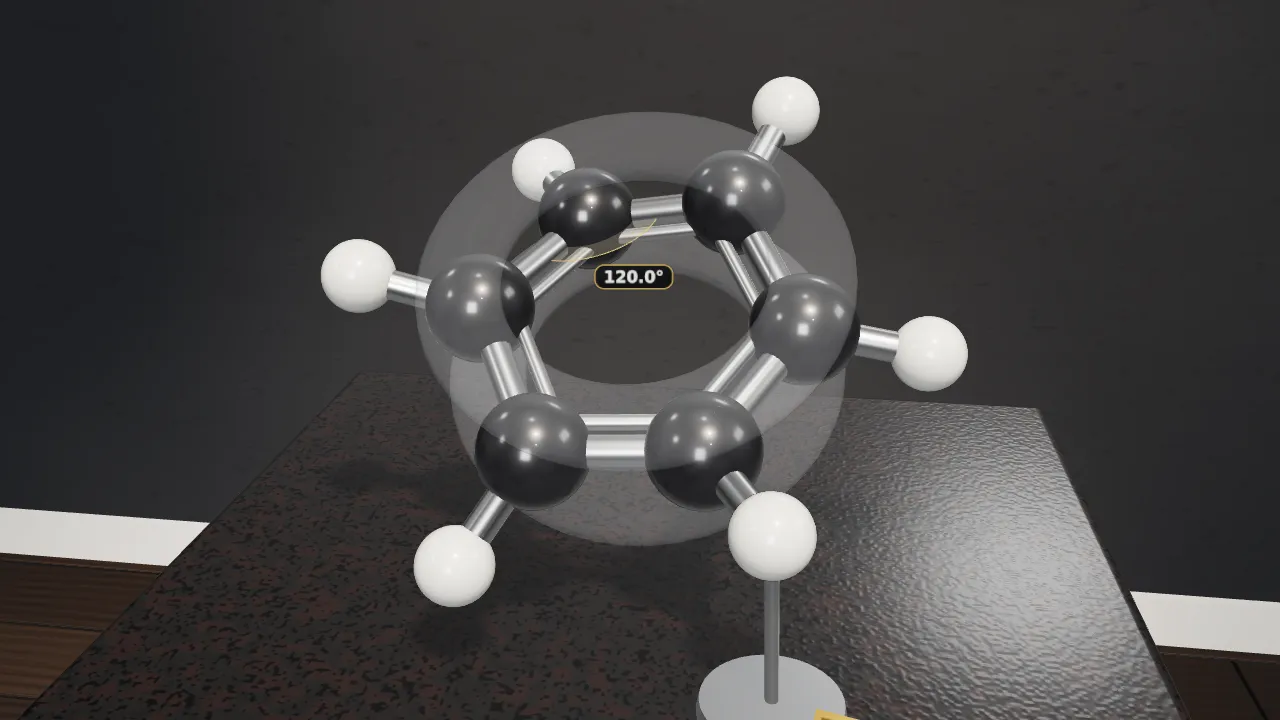
- Grab a carbon and pull it outwards: the ring stretches and rings when you let go.
- Push a hydrogen up or down, out of the flat plane, and watch it spring back. Try the same with a carbon.
- Read Out of the plane while you push: the ring returns to exactly flat.
- Open Lab to compare Kekulé’s alternating structures, hide the π cloud or change the view.
Challenges
- Pull a carbon outwards to stretch the ring, then let it ring
- Push a hydrogen well out of the plane and let it spring back
- Lift a carbon out of the ring’s plane and watch the ring flatten again
Try this
- Switch to Kekulé structure A and read the bond lengths: 1.34 Å and 1.54 Å. Real benzene shows 1.40 Å for all six.
- Flip between Kekulé A and B. Real benzene isn’t switching between them: it is a single structure in between.
- Walk round the plinth until the ring is edge-on. All twelve atoms lie in one flat plane.
Fun facts
- Michael Faraday isolated benzene in 1825 from the oily residue left by compressed lighting gas.
- August Kekulé proposed the six-membered ring structure for benzene in 1865.
- All six carbon–carbon bonds in benzene are the same length, about 1.40 Å, between a typical single bond (1.54 Å) and a double bond (1.34 Å).
- Kathleen Lonsdale confirmed that the benzene ring is flat in 1929, using X-ray crystallography of hexamethylbenzene.
Six carbons sharing six electrons
Benzene, C₆H₆, puzzled chemists for decades. Six carbons and six hydrogens is not enough hydrogen for a chain of single bonds, so there had to be double bonds somewhere. Yet benzene does not behave like other molecules with double bonds: it is unusually stable and reluctant to react.
Kekulé’s ring
In 1865 August Kekulé suggested that the six carbons form a ring with alternating single and double bonds. It was a brilliant step, but it raised a problem: single bonds are longer than double bonds, so his ring should have two different bond lengths. When X-ray and electron diffraction measured benzene, they found all six C–C bonds the same, about 1.40 Å, between the single (1.54 Å) and double (1.34 Å) values. The ring is a perfect, flat hexagon with all angles 120°.
Delocalised electrons
Each carbon uses three of its four outer electrons in bonds that lie in the plane of the ring: two to neighbouring carbons and one to its hydrogen. The fourth electron sits in a p orbital sticking up and down from the ring. Six such orbitals side by side overlap all the way round, and the six electrons spread out over the whole ring instead of pairing into three fixed double bonds. This shared ring of electrons above and below the plane is the π (pi) system, and the electrons are said to be delocalised.
Chemists still draw Kekulé structures, sometimes with a double-headed arrow between the two versions to show resonance, or draw a circle inside the hexagon. Either way, the real molecule is not flipping between the two: it is one structure, a blend of both.
Why it is so stable
Spreading electrons out lowers their energy. Adding hydrogen to benzene releases about 150 kJ/mol less energy than you would expect for three ordinary double bonds, and that difference, the resonance energy, is why benzene resists reactions that would break up its ring of electrons. Rings with this special stability are called aromatic. Hückel’s rule says flat rings with 4n + 2 π electrons (2, 6, 10…) are aromatic; benzene, with six, is the classic case.
For the curious: the model
Real benzene is drawn with measured lengths (C–C 1.397 Å, C–H 1.084 Å). The Kekulé options rebuild the ring with alternating 1.34 Å and 1.54 Å bonds and 120° angles, the shape a real alternating ring would need; that molecule doesn’t exist. The atoms are joined by springs chosen so that the ring breathes at about 990 cm⁻¹ and the hydrogens wag out of the plane at about 673 cm⁻¹, close to the measured values, slowed about 40 trillion times. Benzene itself is toxic and causes cancer, so it is used only under strict controls.
Questions people ask
Why are all the bonds in benzene the same length?
The six π electrons are not locked into three double bonds. They are shared evenly around the whole ring, so every carbon–carbon bond is identical, about 1.40 Å long, between a single and a double bond.
Is benzene flat?
Yes. All six carbons and six hydrogens lie in the same plane, with 120° angles, which lets the p orbitals overlap all the way around the ring.
What is a delocalised π system?
It is a set of electrons in overlapping p orbitals that spread across several atoms instead of sitting between two. In benzene six electrons are shared around the whole ring, above and below its plane.