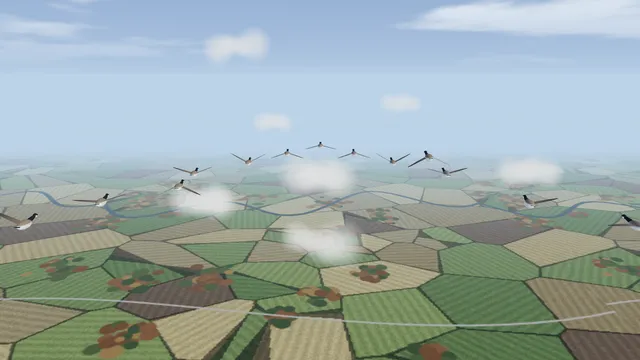
Bats Leaving the Cave at Dusk
Stir bats out of a cave at dusk and fly a hawk into their spiral.
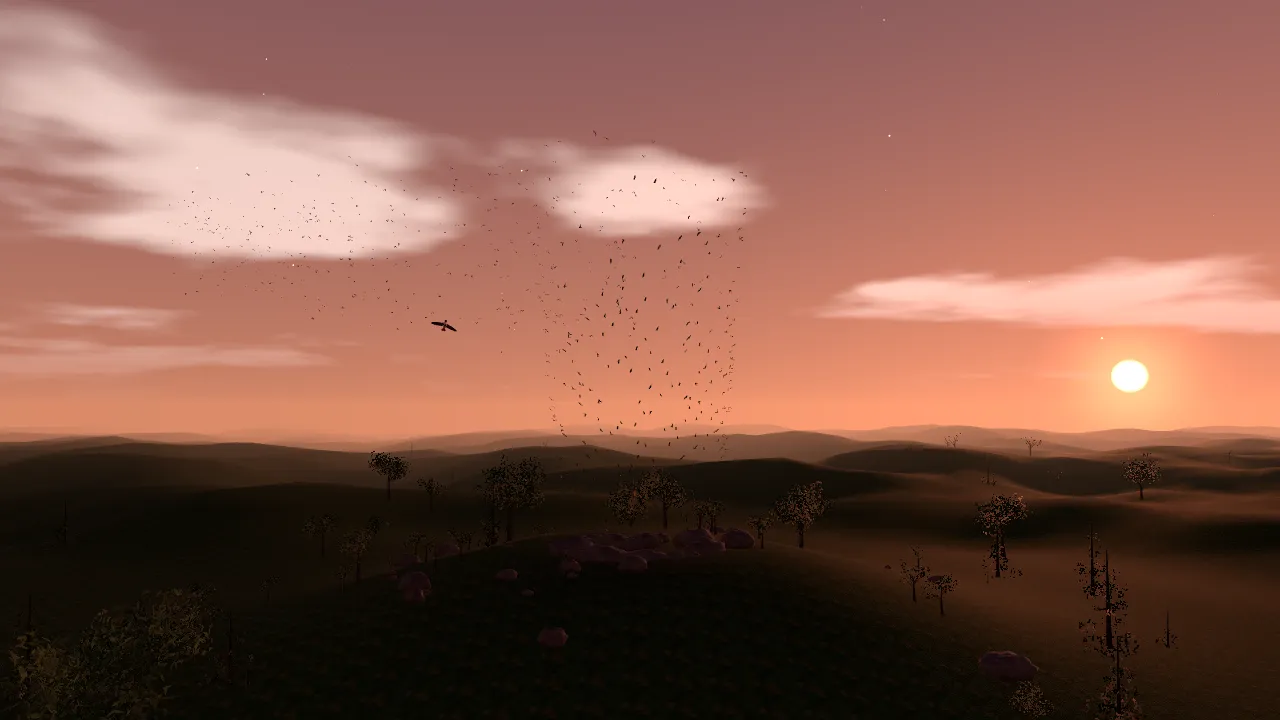
How to play
- Tap the dark cave mouth on the hilltop to stir up the colony: a rush of bats pours out and climbs in a spiral.
- Drag in the sky to fly the hawk at the column. Let go and it peels away. Watch the bats swerve out of its path.
- Try the three Challenges, or open Lab to change how fast bats leave, switch the spiral off, or turn on the bat detector.
- Right-drag, or turn off hawk dragging in the Lab, to look around. Pinch or scroll to zoom.
Challenges
- Tap the cave mouth and send a rush of two hundred bats into the sky
- Fly the hawk into the spiralling column of bats
- Dive the hawk through the column until a hundred bats swerve at once
Try this
- Turn on the bat detector, then zoom in close to the column. The ticks speed up as more bats fly past you, just as they would on a real detector.
- Switch off “Climb in a spiral” and compare: the bats now rise straight up and head off at once, instead of circling to gain height above the cave.
- Drive the hawk through the column. Bats near it swerve away and the hole closes behind it within seconds.
Fun facts
- Bracken Cave in Texas is the summer home of millions of Mexican free-tailed bats, often described as the largest bat colony in the world.
- Mexican free-tailed bats hunt flying insects, including moths whose caterpillars damage crops such as corn and cotton.
- Most of a free-tailed bat’s echolocation calls are too high-pitched for people to hear, which is why researchers listen with bat detectors.
- A female Mexican free-tailed bat usually raises a single pup each year.
How millions of bats leave a cave without crashing
On summer evenings at the biggest bat caves, the sky above the entrance fills with a dark, twisting plume that can take a long time to pass. Each bat is making split-second decisions on its own, yet the crowd moves like a single living thing.
Why spiral?
Bats leaving a cave are surrounded by others and need height before they can head out to feed. Circling above the entrance lets each bat climb steadily while staying close to the crowd, which also helps protect it: hawks wait at some caves, and a predator finds it hard to pick one target out of a dense, turning column. Once high enough, the bats peel off into a long stream toward their feeding grounds, often many kilometres away.
In this simulation each bat steers toward a circle around the cave whose radius grows with height, while climbing at a steady rate. It also keeps clear of its nearest neighbours and dodges the hawk. Once it reaches its own chosen height it joins the outgoing stream, which meanders gently across the sky.
Seeing with sound
Bats find insects and avoid obstacles by echolocation: they shout short, high-pitched calls and listen for the echoes. Sound travels at about 343 metres per second in air, so an echo from an object 10 metres away comes back after about 58 thousandths of a second. The higher the pitch, the shorter the wavelength, and short wavelengths reflect well from small targets like moths. In a dense crowd, thousands of calls overlap. Studies of free-tailed bats suggest that they shift the pitch of their calls slightly when neighbours call at similar frequencies, which may help each bat pick out its own echoes.
Why bats matter
A big colony eats an enormous number of insects every night, including crop pests, which makes these bats valuable to farmers. Disturbance at roosts is one of the threats bats face, which is why many large colonies are protected.
For the curious
Each bat aims for a desired velocity: tangential at speed v around the cave axis, plus a radial correction k(R(y) − r) that pulls it toward the circle of radius R(y) = R₀ + 0.1y, plus a steady climb. Its acceleration is 2.2 × (desired − current velocity), plus separation from its three nearest neighbours, found with a spatial hash grid, plus escape from the hawk. Bats bank into turns at tan φ = vω/g. The echo delay is t = 2d / c, so an echo returning after 20 milliseconds means an object about 3.4 metres away. The bat detector here works like a simple frequency-division detector, turning each nearby call into an audible tick.
Questions people ask
Why do bats fly in a spiral when they leave a cave?
Circling above the entrance lets bats gain height while staying in a tight crowd, and a dense, turning column makes it hard for hawks to single one out. Once high enough, they leave in a long stream toward their feeding areas.
How do bats avoid hitting each other in the dark?
They use echolocation, sending out high-pitched calls and listening for echoes, along with their eyesight. Studies of free-tailed bats suggest they also shift the pitch of their calls slightly in crowds, which may help each bat hear its own echoes.
Can people hear bats echolocating?
Mostly not. Many bat calls are pitched above the range of human hearing. A bat detector converts the calls into sounds people can hear, such as clicks or ticks, which is how researchers and bat watchers follow them.