Bastille Day Fireworks
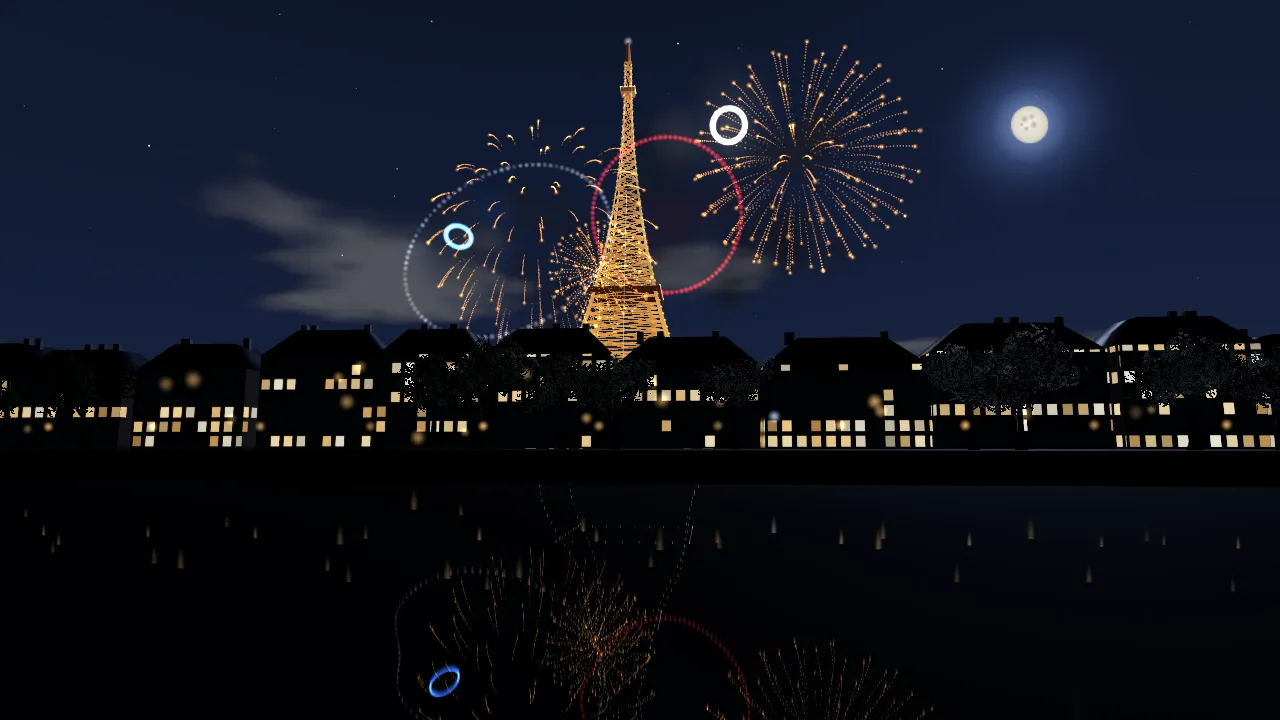
Fire blue, white and red shells around an iron tower by the river.
How to play
- Press the sky to aim: a ring shows where the shell will burst and dots show its flight. Let go to fire. Each flight is traced as a thin line.
- Your shells come in turn: blue, then white, then red. Aim them left to right for a tricolour.
- Aim higher for bigger shells: they need faster launches and longer fuses to reach the ring.
- Try the three Challenges, or open Lab for the Wind slider and a Tricolour volley.
Challenges
- Burst blue, white and red side by side, in that order from left to right
- Launch a low 3-inch shell and a high 8-inch shell, and compare their speeds
- Burst a shell level with the top platform of the iron tower
Try this
- Turn the wind up to 6 m/s and launch a few shells. The traces lean downwind, and the bursts drift as their stars slow down.
- Compare the Time fuse readout for a 3-inch and an 8-inch shell. The bigger shell climbs higher, so its fuse must burn for longer.
- Watch a single trace closely. The shell climbs fast at first and slows near the top, where its speed is lowest and the burst is most even.
Fun facts
- France’s national day is officially called la Fête nationale; in English it is usually known as Bastille Day.
- The date recalls both the storming of the Bastille prison on 14 July 1789 and the Fête de la Fédération held a year later, on 14 July 1790.
- The day traditionally includes a military parade in Paris in the morning and fireworks in towns and cities across France at night.
- Air drag grows with the square of speed, so a firework shell loses speed fastest just after it leaves the mortar.
The flight of a firework shell
On 14 July, France celebrates its national day with parades, dances and, after dark, fireworks in towns and cities across the country. This riverside scene, with its mansard rooftops and an iron lattice tower, is an invented backdrop for the physics of the shells themselves: how they climb, why they burst where they do and what the wind does to them.
Leaving the mortar
A display shell is fired from a tube called a mortar by a small charge of black powder underneath it. All the speed it will ever have comes in that first instant, which is very different from a rocket, which keeps pushing as it burns. A shell meant to burst high has to leave fast: in this scene a 3-inch shell leaves at about 60 m/s and an 8-inch shell at about 95 m/s.
Why the climb is not a parabola
Without air, a shell would trace a symmetrical parabola. Real air pushes back with a drag force that grows with the square of the speed, so the shell sheds speed quickly at first and more gently near the top. Big shells have more mass for each square metre of front area, so drag slows them proportionally less; that is why shell size, not just launch speed, sets how high a firework can go. Turn on the traces and you can see each climb flatten as it nears the top.
Bursting at the top
A time fuse, lit at launch, sets off the burst charge. Display makers cut it so the shell bursts close to the top of its flight. There the shell is moving slowest, so the stars are thrown out almost evenly in every direction and the burst forms a round, symmetrical sphere. The scene computes the exact time to the top of each flight and shows it as the Time fuse readout.
Wind
Drag acts on the shell’s speed relative to the air, so a crosswind pushes it sideways during the climb. After the burst, the slow-moving stars drift with the wind even more. Display teams watch the forecast closely and can delay a show if the wind would carry stars or debris towards spectators.
For the curious
Each shell obeys m dv/dt = −mg ŷ − ½ρCdA |v − w| (v − w), where w is the wind. For a vertical launch the top is reached after t = atan(v₀√(c/g)) / √(gc) with c = ρCdA / 2m. Because c falls as a shell gets bigger (its mass grows faster than its area), larger shells climb more efficiently.
Questions people ask
Why is 14 July France’s national day?
It recalls the storming of the Bastille prison in Paris on 14 July 1789, an early turning point of the French Revolution, and the Fête de la Fédération celebrated on the same date in 1790.
Why do fireworks burst at the top of their flight?
The time fuse is cut so the burst happens near the highest point. There the shell is moving slowest, so the stars spread out evenly and the burst looks round.
Does wind affect fireworks?
Yes. Wind pushes shells sideways as they climb and carries the slow-falling stars and smoke after the burst, which is why displays can be delayed or moved in strong winds.