Archerfish Sharpshooter
Aim an archerfish’s water jet and knock insects off mangrove leaves.
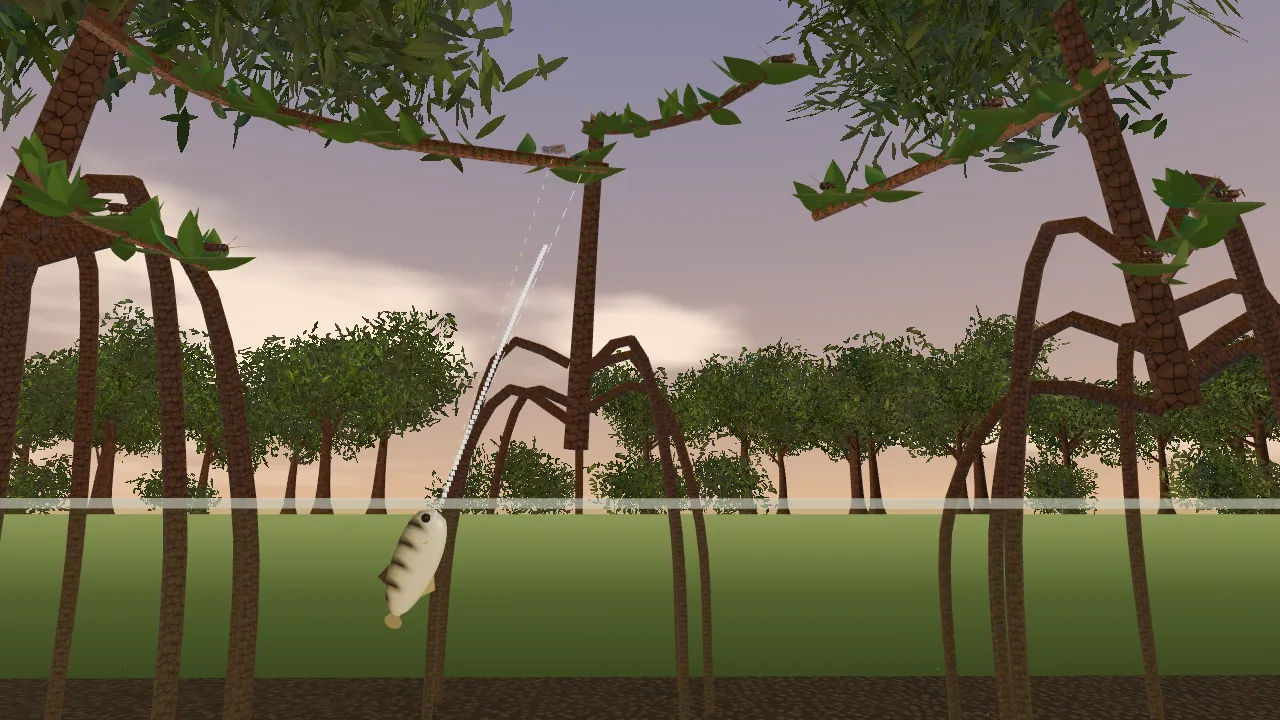
How to play
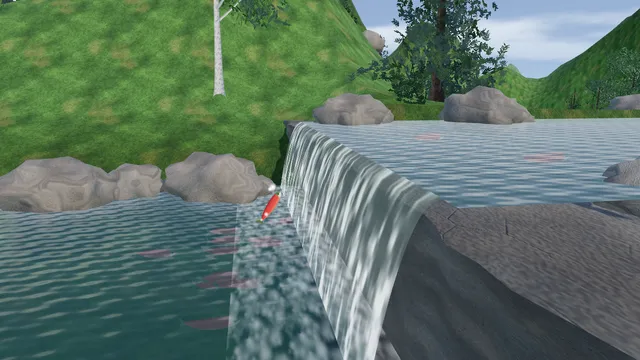
- Press on the fish and drag upward to aim. The dotted arc shows where the jet will fly; let go to shoot.
- Drag the fish sideways to swim it along under the leaves, closer to the insect you want.
- While you aim, the dashed line shows the light from the insect bending at the surface, and the faint ghost shows where the fish sees it.
- Open Lab to switch off the fish’s refraction correction, hide the line of sight or change the jet speed.
Challenges
- Knock an insect off its leaf with a jet of water
- Hit an insect with a steep shot, aimed more than 70° up
- Hit three insects in a row without a miss
Try this
- Aim at an insect off to one side and watch the “Insect looks higher by” readout. The farther from overhead the insect is, the more the surface bends its light, and the higher it seems.
- Switch off The fish corrects for refraction in the Lab and shoot at an insect off to the side. The fish now aims where the insect appears, and the jet sails over the top.
- Lower the jet speed and try a high insect. A slow jet has to be aimed well above its target, because it starts falling the moment it leaves the mouth.
Fun facts
- Archerfish live in mangrove swamps and estuaries from India and Southeast Asia to northern Australia, where insects rest on leaves that hang over the water.
- An archerfish makes its jet by pressing its tongue against a groove in the roof of its mouth, forming a narrow tube, then snapping its gill covers shut to squeeze the water out.
- Adult archerfish can knock prey off leaves well over a metre above the water, and they also leap out of the water to snatch insects from low branches.
- Within a split second of a hit, an archerfish turns and swims straight to where the falling insect will land, so that other fish don’t get it first.
Two corrections for one shot
An archerfish hunts from below the water, and its prey sits in the air above. Every shot has two problems to solve: the light it sees by bends as it crosses the surface, and the water it fires bends too, curving down under gravity. A good shot allows for both.
The bent line of sight
Light travels more slowly in water than in air, so a ray that crosses the surface at an angle changes direction. This is refraction, and Snell’s law tells you by how much. A ray coming down from an insect bends toward the vertical as it enters the water, and the fish’s eye traces the ray straight back along the direction it arrives from. So the insect seems to sit higher and closer to overhead than it really is. Straight above the fish there is no bending at all; the farther off to the side the insect is, the bigger the error. Everything above the water is squeezed into a cone of about 97° overhead, called Snell’s window.
If the fish simply fired at what it sees, it would shoot over the top of its target. In experiments archerfish hit targets from many different positions, so they must be making up for the bending. In this toy the fish does it for you, until you switch the correction off in the Lab.
The falling jet
Once the water leaves the fish’s mouth, at the surface, it is a projectile. It keeps its sideways speed but starts falling at once, so its path is a parabola that sags below the line it was fired along. To hit the insect the jet must be aimed a little above it, and the slower the jet or the farther the target, the higher the aim. The dotted arc shows the path before you let go.
Researchers have found that archerfish also shape their jets: water squeezed out later moves a little faster and catches up with the front, so the jet bunches into a blob that arrives at the prey with extra force.
Why steep shots are easier
From right underneath, the insect appears where it is and the jet barely curves sideways. Shooting from far off to the side means a bigger refraction error and a longer, more curved flight. Swim under the leaf first and the shot becomes much simpler.
For the curious
Snell’s law: nair·sin θair = nwater·sin θwater, with nair ≈ 1.00 and nwater ≈ 1.33, angles measured from the vertical. The edge of Snell’s window is where θair = 90°: sin θwater = 1/1.33, so θwater ≈ 48.6°. The jet, launched at speed v₀ and angle θ above the horizontal, follows y = x·tan θ − g·x² / (2·v₀²·cos² θ). Here the fish’s eye finds the surface point where the light bends by solving Snell’s law numerically, and the jet leaves at 5.4 m/s unless you change it.
Questions people ask
How does an archerfish shoot water?
It presses its tongue against a groove in the roof of its mouth to make a narrow tube, then snaps its gill covers shut. The squeeze forces a thin jet of water out through the tube, aimed at an insect resting above the surface.
Why does an insect look higher from under the water?
Light from the insect bends toward the vertical as it passes from air into water. The fish sees along the bent ray, so the insect appears higher and closer to overhead than it really is. Directly overhead there is no bending at all.
How high can an archerfish shoot?
Adult archerfish can hit insects well over a metre above the water, and they are most accurate at shorter ranges. Their aim improves with practice.