Ammonia Molecule
Push ammonia’s nitrogen through its hydrogens and flip it inside out.
How to play
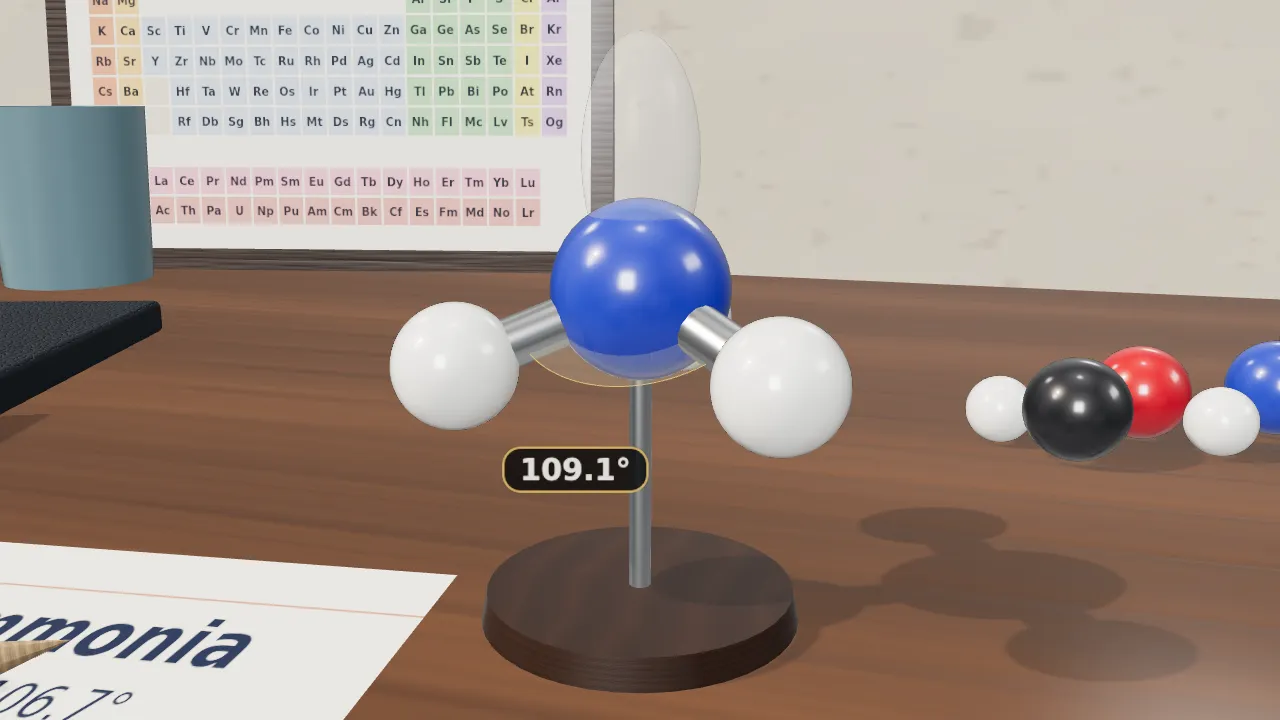
- Press on the nitrogen and push it down through the three hydrogens: the umbrella flips inside out and stays that way.
- Grab a hydrogen and pull to stretch an N–H bond. Let go and it rings; the Last ring readout gives its frequency.
- Hold the nitrogen exactly level with the hydrogens to find the flat shape at the top of the barrier.
- Open Lab for an automatic flip, the two vibrations and a space-filling view.
Challenges
- Pull a hydrogen to stretch an N–H bond, then let it ring
- Push the nitrogen down through the hydrogens to turn the umbrella inside out
- Hold the nitrogen exactly level with the three hydrogens for a moment
Try this
- Watch the angle readout during a flip. It climbs from 106.7° to exactly 120° when the molecule is flat, then falls back.
- Read the height of the nitrogen above the hydrogens: about 0.38 Å at rest, zero halfway through a flip.
- Hide the lone pair and look from below. The three hydrogens form a perfect equilateral triangle.
Fun facts
- Ammonia’s H–N–H angle is about 107°, squeezed below the tetrahedral 109.5° by the lone pair on nitrogen.
- The first maser, built in 1953–54 by Charles Townes and colleagues, used ammonia molecules flipping at about 24 GHz.
- The Haber–Bosch process makes ammonia from nitrogen and hydrogen, and most of it ends up as fertiliser.
- Household ammonia cleaners are solutions of ammonia gas in water.
A pyramid with a lone pair on top
Ammonia, NH₃, is a nitrogen atom bonded to three hydrogens. Nitrogen has five outer electrons: three go into the bonds and the other two form a lone pair. That gives four electron pairs around the nitrogen, which spread out towards the corners of a tetrahedron, just as in methane. But only three corners hold atoms, so the shape we see is a trigonal pyramid, with the nitrogen at the top and the three hydrogens forming the base.
Why 107° and not 109.5°
The lone pair isn’t shared with another atom, so it sits closer to the nitrogen and spreads out more than a bonding pair does. It pushes the three N–H bonds slightly closer together, and the H–N–H angle shrinks to about 106.7°. Water, with two lone pairs, is squeezed even further, to 104.5°: a neat sequence from methane (no lone pairs) through ammonia (one) to water (two).
The umbrella flip
The pyramid can turn inside out, like an umbrella in the wind. The nitrogen passes through the plane of the hydrogens, the molecule is momentarily flat with 120° angles, and then it is a pyramid pointing the other way. This inversion has to climb an energy barrier of about 24 kJ/mol. Remarkably, ammonia doesn’t need to climb it: thanks to quantum mechanics the molecule tunnels through the barrier, flipping back and forth about 24 billion times a second. That frequency, about 24 GHz in the microwave range, was used in the first maser and in one of the first atomic clocks.
The lone pair at work
The lone pair makes ammonia a base: it can grab a hydrogen ion to form the ammonium ion, NH₄⁺. With four bonding pairs and no lone pair, ammonium is a perfect tetrahedron with 109.5° angles. The lone pair also makes ammonia polar and lets it form hydrogen bonds, which is why it dissolves so readily in water.
For the curious: the geometry
For three equal bonds of length d at an angle θ to each other, the hydrogens lie on a circle of radius ρ = d·√((1 − cos θ)/1.5) around the axis, and the nitrogen sits h = √(d² − ρ²) above their plane. With d = 1.012 Å and θ = 106.7° that gives h ≈ 0.38 Å. In the simulation the atoms are joined by springs fitted to ammonia’s four measured vibrations (3337, 950, 3444 and 1627 cm⁻¹). Because those springs only care about bond lengths and angles, the inverted pyramid is just as comfortable as the original, and the flat shape in between costs about 17 kJ/mol, somewhat less than the real 24 kJ/mol. The vibrations are slowed down about 40 trillion times.
Safety
Ammonia gas is irritating and toxic at high concentrations, and concentrated solutions burn skin and eyes. Never mix ammonia cleaners with bleach: the mixture gives off toxic gases. Please read our disclaimer.
Questions people ask
Why is ammonia pyramidal and not flat?
Nitrogen has three bonding pairs and one lone pair. All four pairs repel each other and point roughly towards the corners of a tetrahedron, so the three hydrogens form the base of a pyramid with the nitrogen at the top.
What is ammonia inversion?
It is the molecule turning inside out like an umbrella: the nitrogen passes through the plane of the hydrogens. Real ammonia does this by quantum tunnelling, about 24 billion times per second.
Is ammonia polar?
Yes. The N–H bonds are polar and the pyramid shape, with the lone pair on top, means their effects do not cancel, so ammonia has a dipole moment.