Air Hockey
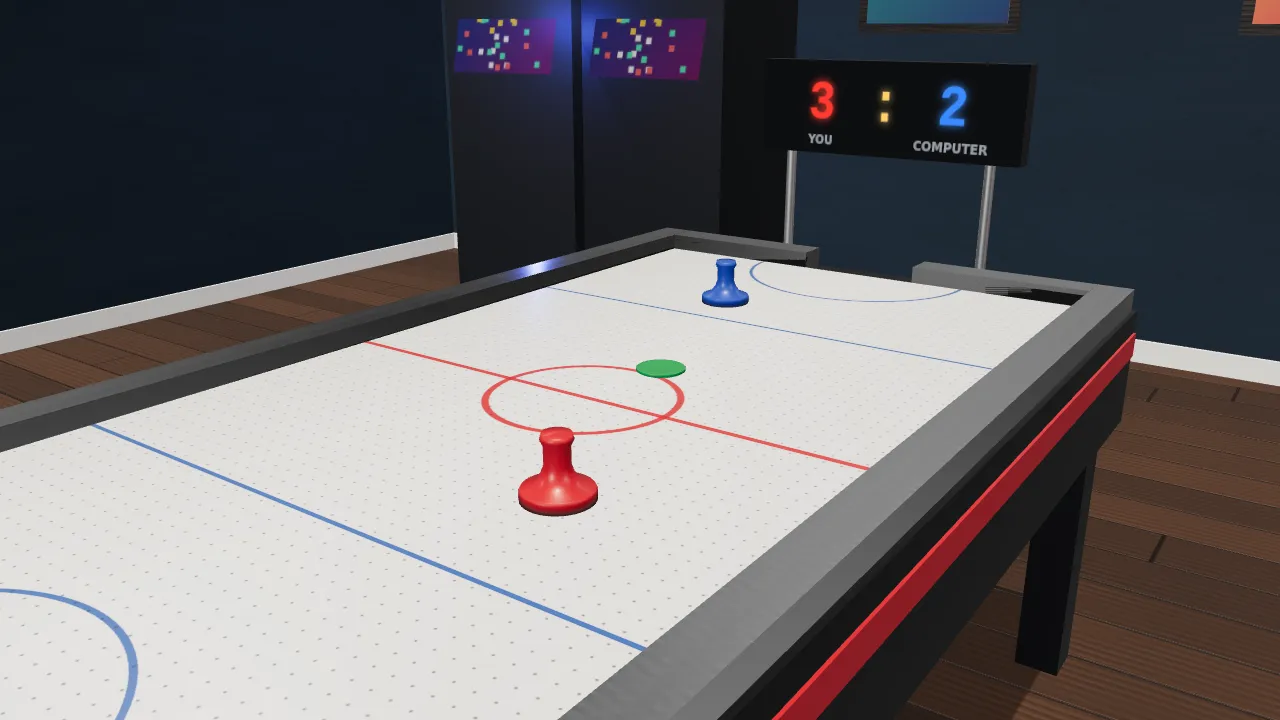
Drag your mallet and slam the puck past the computer.
How to play
- Drag your mallet anywhere in your half. It follows your finger like a hand would, with a top speed, and the faster it moves the harder it hits the puck.
- Knock the puck into the slot at the far end to score. The first to 7 wins the game; then tap New game for another.
- Bounce shots off the side rails to get round the computer’s mallet. The readouts show the puck’s speed and your fastest hit so far.
- In Lab, choose an easy, normal or hard computer, or play a friend on the same phone: the view turns to look straight down and each of you drags the mallet in your own half.
Challenges
- Hit the puck faster than 6 m/s (about 22 km/h)
- Score with a bank shot off a side rail
- Win a game to 7 against the computer
Try this
- Hold your mallet still and let the puck hit it: it bounces back slower than it came. Now swing into it, and watch the speed readout climb with your swing.
- Aim a bank shot by imagining the goal’s mirror image on the far side of a rail. Aim at the mirror image and the rail sends the puck to the real goal.
- Switch to slow motion in Lab and watch the puck glide. On its cushion of air it loses only a few percent of its speed each second.
Fun facts
- In 1969 three engineers at an American billiards company, Phil Crossman, Bob Kenrick and Brad Baldwin, began work on a game played on a low-friction surface. Bob Lemieux later revived the project, and it went on sale as air hockey.
- Under the basic rules, the first player to reach 7 points wins the game.
- When the puck touches the centre line, either player is allowed to hit it.
- Air hockey pucks are discs of polycarbonate plastic. Pucks approved for tournaments are yellow, red or green.
The physics of air hockey
Air hockey is a game about momentum. A fan blows air up through rows of tiny holes in the table, and the puck rides on a thin cushion of that air, so it hardly touches the surface at all. With almost no friction, the puck behaves the way Newton’s first law says a moving object should: it keeps going in a straight line at a steady speed until something hits it.
A light puck and a heavy mallet
The puck in this game weighs 28 g. Your mallet is heavier, and it is backed by your hand and arm, so in a collision it acts like a much heavier body moving at the speed you swing it. When a heavy object hits a light one at rest, the light one leaves faster than the heavy one arrived: up to twice as fast for a perfectly bouncy hit. Real collisions lose some energy, so here a puck at rest leaves at about 1.7 times the speed of your mallet. That is why a short, sharp swing beats a long push.
Bouncing off the rails
The rails give back most of the speed aimed straight into them, about 85 percent here, while the speed along the rail is hardly changed. So a puck comes off a rail at a slightly flatter angle than it went in. A neat way to aim a bank shot is to imagine the goal reflected in the rail, like a mirror image, and aim at the reflection.
Why it feels so fast
A puck at 6 m/s crosses a two-metre table in a third of a second. A person typically needs around a fifth of a second just to react to something they see, which leaves very little time to move a mallet into the way. Good players therefore defend by standing their mallet in front of the goal early, rather than chasing the puck. The computer opponent here works the same way: it sees the puck a moment late, its hand has a top speed, and its aim is not perfect.
For the curious
Between hits only air drag acts: v(t) = v₀·e−kt with k = 0.05 per second. A mallet of effective mass M moving at V hits a puck of mass m at rest: the impulse along the line of centres is J = (1 + e)·V / (1/m + 1/M), so the puck leaves at v = (1 + e)·M/(M + m)·V. With M = 0.6 kg, m = 0.028 kg and e = 0.78, v ≈ 1.7 V. At a rail, the speed into the rail becomes vn′ = −e·vn with e = 0.85, and the simulation takes steps short enough that the puck never moves more than 3 mm between collision checks.
Questions people ask
How does an air hockey table work?
A fan under the table blows air up through hundreds of tiny holes in the playing surface. The puck floats on a thin cushion of that air, so there is almost no friction and it keeps its speed between hits.
How do you get better at air hockey?
Keep your mallet between the puck and your goal, and strike with short, sharp moves rather than long pushes. Bank shots off the side rails are hard to read, so mixing them with straight shots keeps your opponent guessing.
How fast can you hit the puck?
It depends on how fast you swing. In this simulation a puck at rest leaves the mallet at about 1.7 times the mallet’s speed, so a quick swing at 4 m/s sends it off at almost 7 m/s, across the whole table in about a third of a second.