Acid–Base Titration
Turn a burette’s stopcock and catch the faint pink end point.
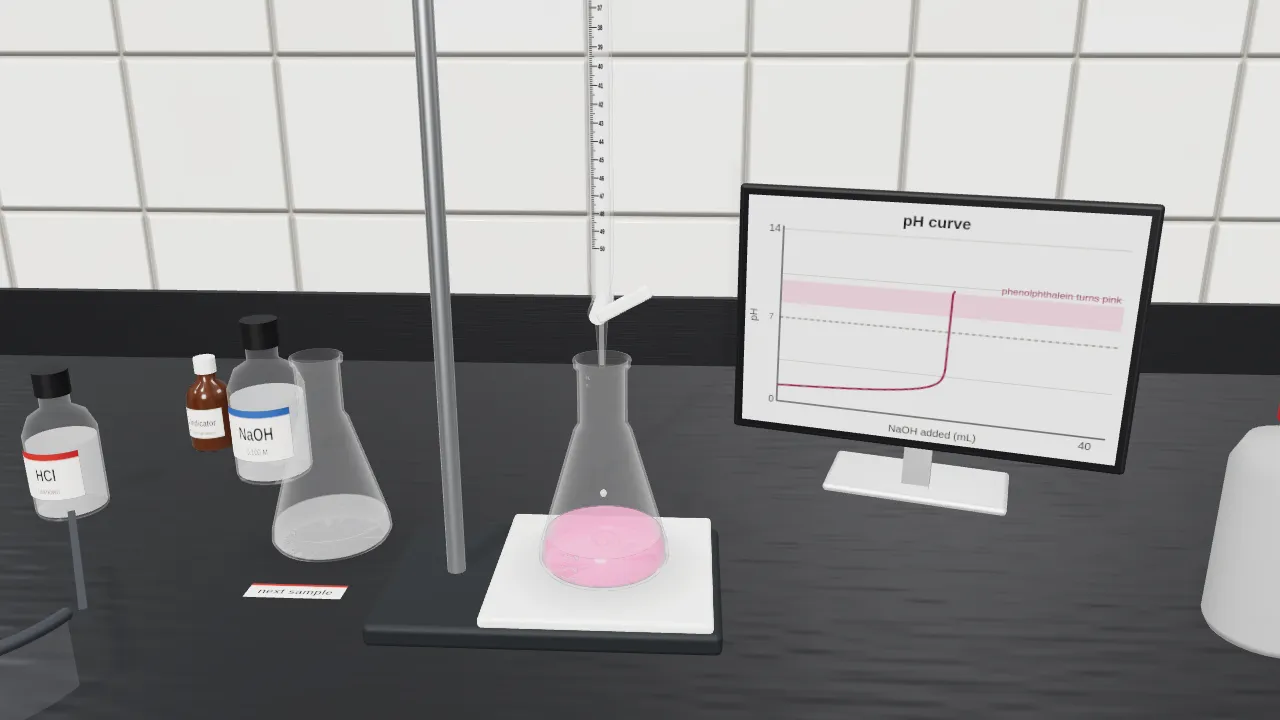
How to play
- Drag the white stopcock handle round to open the burette: a little for single drops, upright for a fast jet. A quick tap on the handle lets just one drop fall.
- Drag the flask in small circles to swirl it. Near the end point a pink cloud appears where each drop lands, then fades as you swirl.
- Stop when one drop leaves the whole flask a faint pink that lasts. The burette reading is your titre.
- Tap the spare flask for a fresh sample of the same acid, and tap the NaOH bottle to refill the burette. Lab has Titrate for me and a new unknown acid.
Challenges
- Reach the end point: a faint pink that stays when you swirl
- Stop within 0.2 mL of the end point
- Work out the acid’s concentration from your titre
Try this
- Open the stopcock fully and race to the end. You will almost certainly overshoot: the colour jumps from clear to deep pink within a couple of drops.
- Do one rough titration quickly, then tap the spare flask and go slowly for the last 2 mL. Two careful titres that agree within 0.10 mL are called concordant.
- Watch the pH curve during the last few drops: the pH leaps by several units for a tiny fraction of a millilitre.
Fun facts
- Phenolphthalein is colourless in acidic and neutral solutions and turns pink from about pH 8.2.
- When a strong acid exactly neutralises a strong base at 25 °C, the resulting salt solution is neutral, with a pH of 7.
- A drop from a burette is about 0.05 mL, so twenty drops make roughly one millilitre.
- Burettes are read at the bottom of the curved meniscus, with your eye level with it to avoid parallax error.
Counting molecules with a burette
A titration measures how much of one solution exactly reacts with a known amount of another. Here the flask holds 25.0 mL of hydrochloric acid of unknown concentration, and the burette holds sodium hydroxide whose concentration you do know: 0.100 mol per litre. The two react one to one, HCl + NaOH → NaCl + H₂O, so when you have added just enough alkali to use up the acid, the moles you let out of the burette equal the moles of acid in the flask.
Spotting the end point
You can’t see neutralisation happen: salty water looks exactly like acid. An indicator makes it visible. Phenolphthalein is colourless in acid and pink in alkali, so the end point is the first drop that leaves the whole flask a faint, lasting pink. The white tile makes that first blush easier to spot, and swirling matters: each drop lands as a small patch of strong alkali that flashes pink, then fades as it mixes into the acid. Those flashes linger longer as you get close, a useful warning to slow down to single drops.
Why the change is so sudden
pH is a logarithmic scale: a tenfold change in hydrogen-ion concentration moves it by only one unit. While plenty of acid is left, each drop removes a tiny share of it and the pH creeps up. Near the equivalence point the leftover acid runs out, and a drop or two of alkali swings the solution from about pH 4 to about pH 10. That steep cliff on the pH curve is why a single drop can change the indicator, and why a titration can be so precise.
Good technique
Chemists usually run a quick rough titration first, then repeat carefully: stopcock wide open for most of the way, single drops for the last millilitre or two. Readings are taken at the bottom of the meniscus with the eye level with it, to the nearest 0.05 mL. Repeats that agree within 0.10 mL are called concordant, and their average goes into the calculation.
Safety
Hydrochloric acid and sodium hydroxide are corrosive even when dilute enough for school use, and alkali is especially harmful to eyes. Real titrations need goggles, a supervised lab and a pipette filler, never a mouth. In this experiment they stay virtual. Please read our disclaimer before trying real chemistry.
For the curious
Moles of alkali added: n = c × V = 0.100 mol/L × titre in litres. Because the reaction is 1 : 1, cacid = cbase × Vbase ÷ Vacid. Before the end point [H⁺] ≈ (nacid − nbase) ÷ Vtotal and pH = −log₁₀[H⁺]; after it [OH⁻] ≈ (nbase − nacid) ÷ Vtotal and pH = 14 + log₁₀[OH⁻] at 25 °C. The simulation solves the full charge balance with Kw = 1.0 × 10⁻¹⁴ and draws phenolphthalein’s colour from the fraction 1 ÷ (1 + 109.4 − pH) in its pink form.
Questions people ask
What is the end point of a titration?
It is the moment the indicator changes colour for good, which tells you the acid has just been used up. With phenolphthalein it is the first faint pink that lasts after swirling. A well-chosen indicator changes colour very close to the equivalence point, where the reacting amounts match exactly.
Why do you use a white tile in a titration?
A white background makes faint colours much easier to see, so you notice the first hint of pink as soon as it appears and can close the stopcock before you overshoot.
How do you calculate a concentration from a titration?
Multiply the alkali’s concentration by its titre in litres to get the moles of alkali. The equation gives the moles of acid (one to one for hydrochloric acid and sodium hydroxide); divide by the volume of acid in litres. For example, 21.00 mL of 0.100 M NaOH is 0.00210 mol, so 25.0 mL of acid held 0.00210 mol and its concentration is 0.0840 mol/L.