Turing Patterns
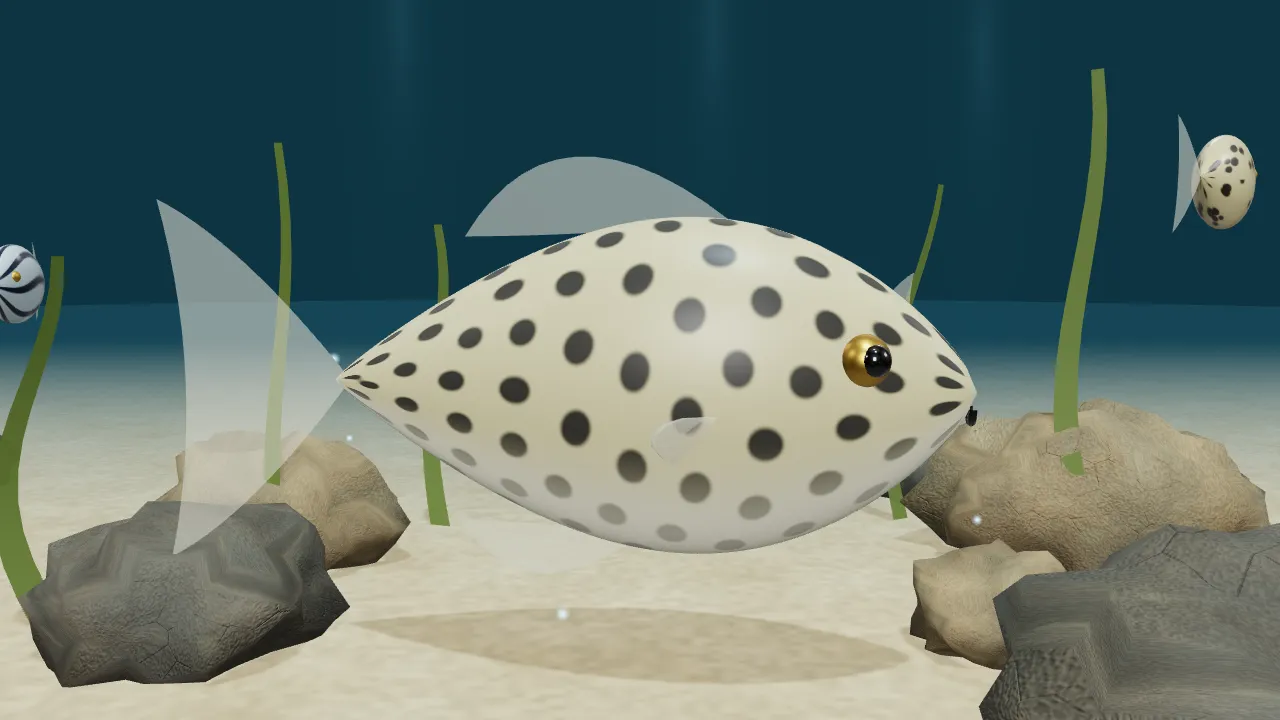
Paint on a fish’s skin and watch spots and stripes form by themselves.
How to play
- Drag on the fish to paint fresh chemicals onto its skin, and watch the pattern heal around your mark.
- Tap one of the small fish swimming past to give yours its recipe: spots, stripes or a maze.
- Open Lab to nudge the feed rate F and kill rate k between patterns, or pick another recipe.
- Switch the shape to a doughnut in the Lab to see the pattern wrap round seamlessly.
Challenges
- Drag across the fish to paint fresh chemicals onto its skin
- Tap the striped fish and watch your fish’s spots rearrange into stripes
- Give your fish all three patterns in turn: spots, stripes and a maze
Try this
- Drag a stripe of paint across the spotted skin. The pattern heals around it, and the stripe breaks back up into spots.
- Start with stripes and raise the kill rate a little at a time. Watch the stripes break up into spots.
- Switch to the doughnut. Its surface has no edges, so the pattern wraps all the way round without a seam.
Fun facts
- Alan Turing proposed in 1952, in “The Chemical Basis of Morphogenesis”, that two reacting, diffusing chemicals could create patterns such as spots and stripes.
- In 1995 Shigeru Kondo and Rihito Asai showed that the stripes of the angelfish Pomacanthus rearrange as the fish grows, much as a Turing model predicts.
- The Gray–Scott model was developed by Peter Gray and Stephen Scott in the 1980s to study chemical reactions.
- In 1993 John Pearson showed how many different patterns the Gray–Scott model can make as its two rates change.
Two chemicals that paint themselves
How does a leopard get its spots, or a fish its stripes? In 1952 the mathematician Alan Turing suggested an answer that surprised everyone. Two chemicals that react with each other and spread at different speeds can turn a smooth, even mixture into a pattern of spots or stripes, all by themselves. Such patterns are now called Turing patterns.
Reaction plus diffusion
This simulation uses the Gray–Scott model. Picture two chemicals, U and V, spread through the skin. U is fed in steadily from outside. Where U meets V, they react to make more V: each reaction uses one U and two V and produces three V, so V makes more of itself. Meanwhile V is slowly removed. Both chemicals spread out by diffusion, but V spreads more slowly than U.
That difference in speed is the key. A small patch of V grows by eating the U around it. Because U spreads quickly, the patch draws U in from a wide area and leaves its surroundings starved, so another patch cannot grow too close. Patches therefore end up roughly evenly spaced, with a size and spacing set by the chemistry rather than by the animal. Depending on how fast U is fed in (the feed rate F) and how fast V is removed (the kill rate k), the result is spots, stripes, mazes, wriggling worms or holes.
Patterns that heal
Paint a blob or a line onto the fish and watch what happens. The pattern does not simply keep your mark: it reorganises it into the same family of shapes, at the same spacing. That self-repair is a sign that the pattern comes from the chemistry, not from a template. Tap one of the small fish and yours takes on that fish’s feed and kill rates: the marks on its skin slowly rearrange into the new family without being redrawn.
And real animals?
Turing-style mechanisms have been proposed for many patterns in nature, and studies of fish skin have found striking agreement with them. Real pigment patterns involve living cells signalling to one another, which is more complicated than two chemicals in a dish, but the core idea of short-range growth and longer-range inhibition appears again and again.
For the curious
The model is ∂u/∂t = Du∇²u − uv² + F(1 − u) and ∂v/∂t = Dv∇²v + uv² − (F + k)v. Here it runs on the graphics card on a 256 × 192 grid, with Du = 1, Dv = 0.5 in grid units, a time step of 1, and a nine-point Laplacian. Spots appear near F = 0.037, k = 0.065, and a coral-like maze near F = 0.055, k = 0.062. The grid is wrapped around the fish’s body, and the result is used as the colour of its skin.
Questions people ask
What is a Turing pattern?
It is a pattern, such as spots or stripes, that forms on its own when two substances react with each other and spread at different speeds. Alan Turing first described the idea in 1952.
Do Turing patterns really make animal markings?
They are thought to play a part in some. Experiments on fish skin have matched Turing-type predictions closely, though real patterns are made by living cells interacting, which is more complex than a simple chemical model.
What do the feed and kill rates mean?
In the Gray–Scott model the feed rate is how fast the first chemical is topped up, and the kill rate is how fast the second chemical is removed. Small changes in these two numbers switch the pattern between spots, stripes, mazes and more.