TRAPPIST-1: Seven Worlds in Rhythm
Drag seven Earth-sized planets round a red dwarf and hear their tune.
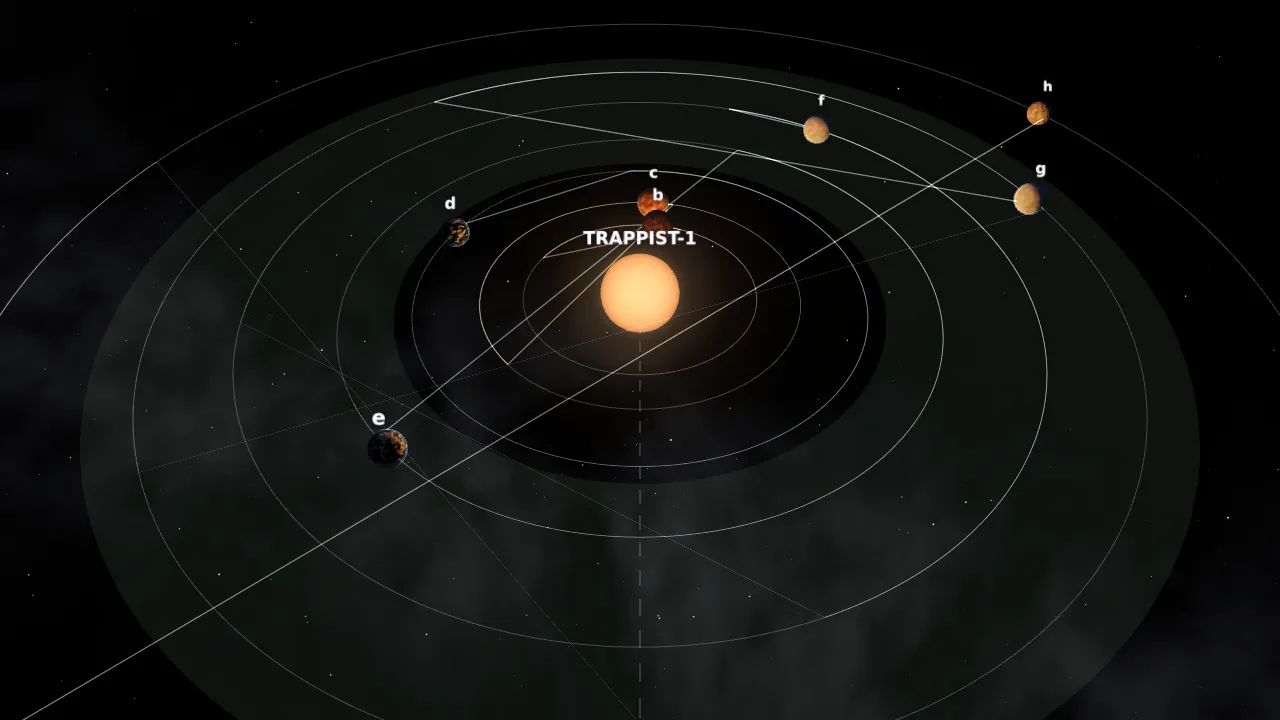
How to play
- Drag a planet to a new place. Time pauses while you hold it; let go and it settles onto a circular orbit there, and a note tells you its new year.
- Listen: each planet plays its own note as it crosses the dashed line towards Earth, as a transit would. Inner planets go round fastest.
- Drag on empty space to fling a rogue planet through the system; the dotted line shows its path.
- Try the three Challenges, or open Lab to change the time speed or turn the notes and the temperate zone on and off.
Challenges
- Drag planet b out into the faint green temperate zone
- Drag planet h inwards until its note comes twice as often
- Fling a rogue Jupiter that knocks a planet out of the chain
Try this
- Listen for repeating patterns. Neighbouring planets keep near-whole-number ratios like 8:5, 5:3 and 3:2, so the tune keeps coming round.
- Fling an Earth-mass rogue far outside the system, then a Jupiter-mass one through the middle, and compare what happens to the chain.
- Watch planets e, f and g inside the faint green band: the region where water could be liquid if the conditions are right.
Fun facts
- TRAPPIST-1 is about 40 light-years from Earth.
- Three of its planets were announced in 2016, and all seven in February 2017, found by the dips in starlight as they pass in front of the star.
- All seven planets orbit closer to their star than Mercury is to the Sun.
- The star is an ultracool red dwarf only a little larger than Jupiter.
A planetary system that keeps time
TRAPPIST-1 is a small, cool red dwarf star with seven rocky planets, all about the size of Earth. They are packed astonishingly close: the outermost planet, h, is only about 0.06 astronomical units from its star, less than a sixth of Mercury’s distance from the Sun. The innermost, b, races round in just a day and a half.
A resonant chain
Their periods line up in near-whole-number ratios. For every 8 orbits of planet b, c makes about 5; for every 5 of c, d makes about 3; then come 3:2, 3:2, 4:3 and 3:2 further out. Neighbours keep meeting at nearly the same places in their orbits, so their small gravitational tugs repeat, and over time they shepherded each other into this chain. In this simulation every planet pulls on every other, with masses measured from tiny variations in their transit times, and the chain holds on its own.
Hearing the rhythm
Astronomers found these planets by transits: when a planet passes between its star and us, the star dims very slightly. Here each planet plays a note when it crosses the dashed line pointing towards Earth, so the near-resonant periods turn into a repeating tune, higher notes for faster planets.
Fragile clockwork
A chain this tight is delicate. Fling a heavy rogue planet through it and the delicate timing is broken: periods change, and some planets may be thrown out. Long-lived resonant chains suggest the TRAPPIST-1 system has lived a quiet life since its planets formed.
Could they be habitable?
Planets e, f and g orbit roughly where starlight is gentle enough that water could be liquid on the surface, if they have the right kind of atmosphere. Whether they do is one of the big questions for the James Webb Space Telescope. Red dwarfs are often stormy in their youth, and that could strip atmospheres away. Nobody has seen these planets’ surfaces, so the colours here are only guesses.
For the curious
Units are AU, days and solar masses. The star has 0.0898 solar masses; the periods (1.51 to 18.77 days) and planet masses are from published measurements, and each planet starts at the distance Kepler’s third law gives for its period. Leapfrog integration takes steps of about three minutes. Distances are drawn to scale with each other; the star and planets are drawn far larger than real.
Questions people ask
How far away is TRAPPIST-1?
About 40 light-years, in the constellation Aquarius. That is close by galactic standards but far too far to visit with current spacecraft.
Are the TRAPPIST-1 planets habitable?
Three of them, e, f and g, orbit where liquid water could exist on the surface if they have suitable atmospheres. Whether they have atmospheres at all is still being studied.
What is an orbital resonance?
When the orbital periods of two bodies form a simple ratio, such as 3:2, so they keep meeting at the same places and their gravitational tugs repeat and add up.