Thomas Attractor
Drop probes into a looping knot and set them loose in a labyrinth.
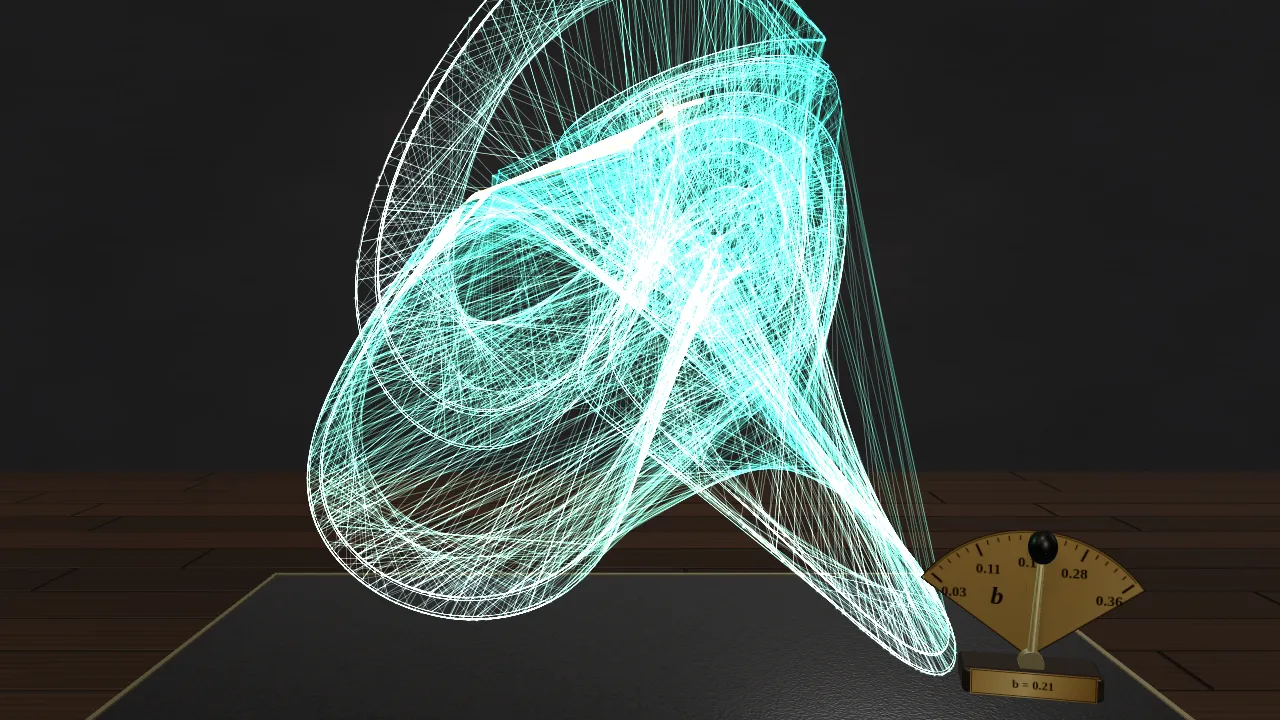
How to play
- Tap anywhere around the knot to drop a cloud of probe particles, and watch the flow pull them onto it.
- Pull the brass b lever on the plinth: b is friction. Lower it to 0.1 and the probes wander off through a labyrinth of cells.
- Raise b to 0.3 and the chaos winds down into one loop; above about 0.33 everything stops.
- Drag the bright state point to set it loose somewhere new. Try the three Challenges, or open Lab for the presets.
Challenges
- Tap the dark space beside the knot and watch the probe cloud get pulled onto it
- Lower the b lever to 0.1 and watch a probe wander off into the labyrinth
- Raise the b lever to about 0.3 and watch the chaos wind down into one loop
Try this
- Lower b to 0.1 and watch the particles escape the knot and wander through an endless lattice of cells.
- Raise b to 0.3: the chaos is gone and every particle follows one loop.
- Push b above about 0.33 and everything comes to a stop at a single point.
Fun facts
- The equations look exactly the same if you replace x by y, y by z and z by x, which gives the attractor its three-fold symmetry.
- The parameter b acts as friction: every time unit, a blob of starting points shrinks in volume by a factor e^(−3b).
- Because sin repeats every 2π, the whole pattern of motion repeats in a lattice of cells filling all of space.
- With very little friction the motion becomes a random-looking walk from cell to cell, sometimes called labyrinth chaos.
Friction and feedback
The Belgian biologist René Thomas studied how genes and cells regulate each other through loops of feedback. In 1999 he described an especially elegant system built from three identical feedback links, each variable driven by the sine of the next:
dx/dt = sin y − b·x, dy/dt = sin z − b·y, dz/dt = sin x − b·z.
Each variable is pushed by the sine of its neighbour and held back by friction b. Because the three equations are identical apart from a rotation of the letters, the attractor looks the same from three directions, a property called cyclic symmetry.
One dial, many behaviours
The friction b controls everything. At Thomas’s value, b ≈ 0.208, the flow traces a knotted chaotic loop that never quite repeats. In our measurements it is only weakly chaotic, with a chaos rate of about 0.01 per time unit, so neighbouring particles drift apart slowly and the knot stays crisp. At b = 0.18 the attractor grows wider and wilder. At b = 0.3 the chaos disappears and every particle settles onto a single cycle, and above about 0.33 the motion dies away entirely to a still point. We checked each preset numerically.
Labyrinth chaos
Turn the friction right down and something unusual happens. Because the sine function repeats every 2π, the equations describe the same landscape in every cell of an endless three-dimensional lattice. With little friction a particle wanders from cell to cell in a way that looks random, even though the rules are completely deterministic. This is sometimes called labyrinth chaos. The view zooms out to follow the swarm as it spreads.
Squeezing space
Friction makes the flow dissipative. Each equation drains its own variable at rate b, so a blob of starting points loses volume at rate 3b: it keeps a fraction e^(−3b) of its volume every time unit, about 54% at b = 0.208. That steady squeezing is why particles from anywhere collapse onto the thin attractor. With b = 0 nothing is squeezed, there is no attractor, and the motion fills space.
For the curious
Every particle is advanced with fourth-order Runge–Kutta in fixed steps of 0.02, and particles start on the attractor, sampled from one long trajectory. At Thomas’s value there are two mirror-image copies of the knot in neighbouring cells; the swarm here lives on one of them. The view re-centres and re-scales itself automatically when a change of b moves or resizes the attractor.
Questions people ask
What is the Thomas attractor?
The strange attractor of René Thomas’s cyclically symmetric system, in which each of three variables is driven by the sine of the next and slowed by friction b.
What is labyrinth chaos?
Chaotic motion in which a particle wanders through an endless lattice of identical cells in a random-looking way, as in the Thomas system with very little friction.
Why does the friction b matter so much?
It sets how strongly the flow is squeezed. Too much friction and everything stops; less gives cycles, then chaos, and with almost none the motion spreads through space.