Saturn’s Rings and Shepherd Moons
Move Saturn’s moons and throw moonlets through its icy rings.
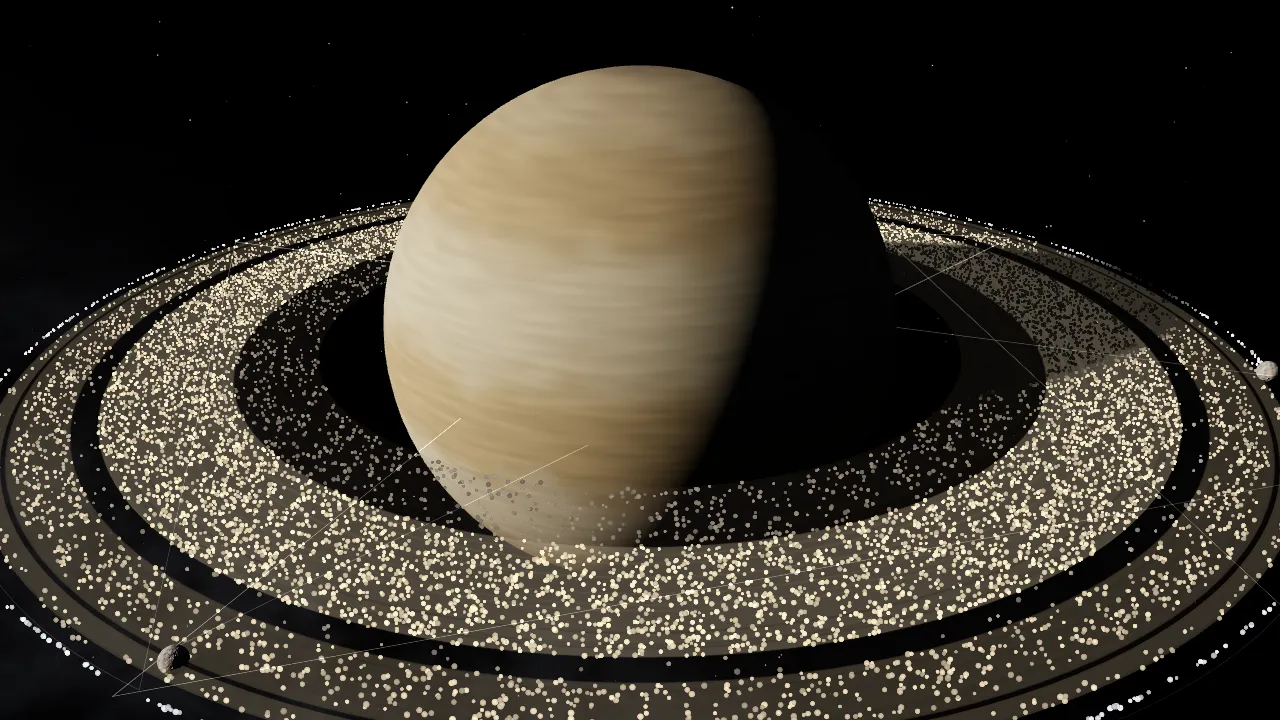
How to play
- Drag on empty space to throw a moonlet into the rings; the dotted line shows its path, and its mass is in Lab.
- Drag a moon or moonlet to a new place: time pauses while you hold it, and it settles onto a circular orbit there. A note tells you its new period.
- Watch the inner ring particles overtake the outer ones, and go dark as they pass through Saturn’s shadow.
- Try the three Challenges, or use “Close to the F ring” in Lab to fly in for a better look.
Challenges
- Throw a moonlet through the rings and stir up their orbits
- Park a moonlet in the Cassini Division and keep it there for two orbits
- Put a moonlet on a circular orbit that takes exactly 10 hours
Try this
- Throw a “Big moonlet” into the middle of the B ring and watch the “Stirred orbits” readout climb as it scatters particles out of their neat circles.
- Fly close to the F ring and watch Prometheus pull out streamers each time it passes.
- Press “Rings without moons” and compare: without the moons the ring edges stay smooth.
Fun facts
- Saturn’s main rings are about 270,000 km across, yet in most places they are only tens of metres thick.
- The Cassini Division, the dark gap between the A and B rings, was discovered by Giovanni Cassini in 1675.
- The tiny moon Pan, about 28 km across, orbits inside the Encke Gap and keeps it clear.
- The rings are made mostly of water ice, in pieces ranging from dust grains to boulders several metres across.
A billion tiny moons
Saturn’s rings look solid from afar, but they are made of countless separate pieces of ice, each one a tiny moon on its own orbit. Every particle obeys Kepler’s laws, so the inner ones go round faster than the outer ones: about 6 hours at the inner edge of the C ring and about 14 hours at the outer edge of the A ring. In this simulation each ring particle feels Saturn’s gravity and the pull of the moons, and the real ring layout is drawn from the faint C ring, through the dense, bright B ring and the Cassini Division, to the A ring and the narrow F ring.
Shepherd moons
Some small moons orbit among or beside the rings and shape them. When a moon passes a ring particle, it gives it a gentle sideways tug. Particles just inside the moon’s orbit move faster and pass it, those just outside are passed by it, and over many encounters the moon pushes material away from its own path. That is how Pan keeps the Encke Gap open and leaves wavy ripples on the gap’s edges. Prometheus and Pandora orbit either side of the narrow F ring and are called its shepherd moons; the Cassini spacecraft watched Prometheus drawing streamers out of the F ring each time it came close.
Resonances
Larger moons further out shape the rings in another way. A particle whose orbital period is an exact fraction of a moon’s period meets that moon at the same place again and again, and the repeated tugs add up. The outer edge of the B ring sits where particles go round exactly twice for each orbit of the moon Mimas, and that 2:1 resonance keeps the edge sharp.
What we exaggerated
Real ring moons are so light that their effects take months or years to build up, and the Encke Gap is only about 325 km wide, far too thin to see at this scale. To show the processes in minutes, the small moons here are made thousands of times heavier than they really are (Prometheus and Pandora about 6,000 times, little Pan about 300,000 times) and the Encke Gap is drawn wider. Mimas has its real mass. Ring particles are also massless here, and real rings have collisions and clumping that this model leaves out. Particle colours and sizes are artistic.
For the curious
Units are Saturn radii (60,268 km) and hours. G·M is set so that an orbit just above the cloud tops takes 4.19 hours, which reproduces real ring periods through Kepler’s law, P ∝ r^1.5. Moons and particles move with leapfrog integration in steps of 2.4 minutes.
Questions people ask
What are Saturn’s rings made of?
Mostly water ice, in pieces from tiny grains to boulders several metres across, with a little rock and dust mixed in. Each piece orbits Saturn like a tiny moon.
What is a shepherd moon?
A small moon whose gravity confines a ring or keeps a gap clear. Prometheus and Pandora shepherd Saturn’s narrow F ring, and Pan clears the Encke Gap.
Why do Saturn’s rings have gaps?
Some gaps are swept clear by moons orbiting inside them, like Pan in the Encke Gap. Others mark resonances, where the repeated pull of a larger moon removes or concentrates particles.