Rössler Attractor
Pull one lever: one loop doubles, doubles again, then turns to chaos.
How to play
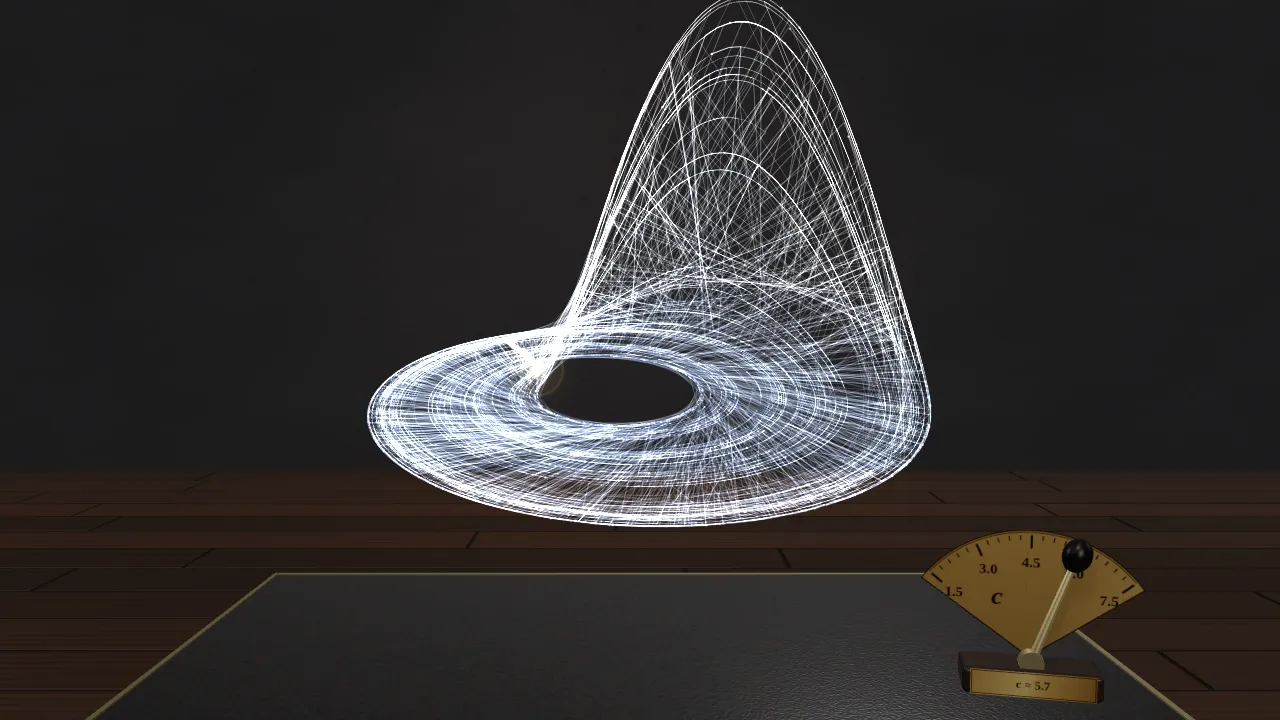
- Tap anywhere around the spiral band to drop a cloud of probe particles, and watch it get pulled in and folded.
- Pull the brass c lever on the plinth slowly upward from 2.5: one loop, then two, then four, then chaos.
- Read “Loops before it repeats”. After each move, give the flow a little while to settle into its new rhythm.
- Drag the bright state point to set it loose somewhere new. Try the three Challenges, or open Lab for a and b.
Challenges
- Tap the dark space beside the spiral and watch the probe cloud get pulled onto it
- Set the c lever near 3.5 and watch the single loop split into two
- Find the narrow setting near c = 4 where the loop goes round four times before repeating
Try this
- Step through the four c presets and count the loops in the drawing as well as in the readout.
- Slide c slowly from 4 to 4.3 and watch the four loops multiply: the doublings come faster and faster.
- Push c beyond 9: the chaotic band grows and its leaps up the spike get taller.
Fun facts
- Otto Rössler published this system in 1976 while looking for the simplest equations that could produce chaos.
- Only one term in the equations, z·x, is nonlinear.
- Mitchell Feigenbaum discovered that successive period doublings come closer together by a universal ratio of about 4.669.
- Period doubling on the way to chaos has been observed in real systems such as dripping taps and electronic circuits.
The simplest road to chaos
Otto Rössler wanted the simplest set of equations that could behave chaotically, simpler even than Lorenz’s. In 1976 he published this one:
dx/dt = −y − z, dy/dt = x + a·y, dz/dt = b + z·(x − c).
Most of the time the flow just spirals slowly outwards in the x–y plane, because of the a·y term. When x grows larger than c, the z equation suddenly switches on: the particle is flung upwards, lifted off the plane, and folded back towards the centre to start spiralling again. Stretching followed by folding, over and over, is the basic recipe for chaos, and here you can see it plainly, like a baker kneading dough.
Period doubling
The parameter c controls how far the spiral grows before it is folded back. With c = 2.5 the flow settles into a single closed loop. At c = 3.5 the loop has split into a double loop, so it takes two turns to repeat. At c = 4 it needs four turns. Keep raising c and the doublings come faster and faster, 8, 16, 32 turns, until at a finite value the period becomes infinite and the motion is chaotic: the band you see at c = 5.7. We checked each of these presets numerically; the readout counts the distinct loop heights live.
This cascade is one of the great universal patterns in science. Mitchell Feigenbaum found in the 1970s that the gaps between successive doublings shrink by the same ratio, about 4.669, in a huge range of systems, from simple formulas to fluids and electronic circuits.
Chaos, gently
At c = 5.7 the Rössler attractor is chaotic but mildly so. Its chaos rate λ, shown in the readout, is about 0.07 per time unit, more than ten times smaller than the Lorenz system’s. Nearby paths drift apart, but slowly, which is why the band looks so orderly.
For the curious
The classic values are a = b = 0.2 and c = 5.7. Every particle is advanced with fourth-order Runge–Kutta in fixed steps of 0.01. The “Different loop sizes” readout records the peak values of x for one particle over its last 16 loops and counts how many distinct heights appear. This page draws the attractor in ink on paper rather than glowing on black: the colours still show speed, from blue for slow to orange for fast.
Questions people ask
What is the Rössler attractor?
A strange attractor produced by three simple equations published by Otto Rössler in 1976. Its flow spirals outwards, then lifts and folds back, producing chaos with only one nonlinear term.
What is period doubling?
A route to chaos in which a repeating motion takes twice as long to repeat, then four times, then eight, faster and faster, until it never repeats at all.
What is the Feigenbaum constant?
About 4.669: the ratio by which the parameter gaps between successive period doublings shrink. It is the same for a wide range of different systems.