Klein Bottle
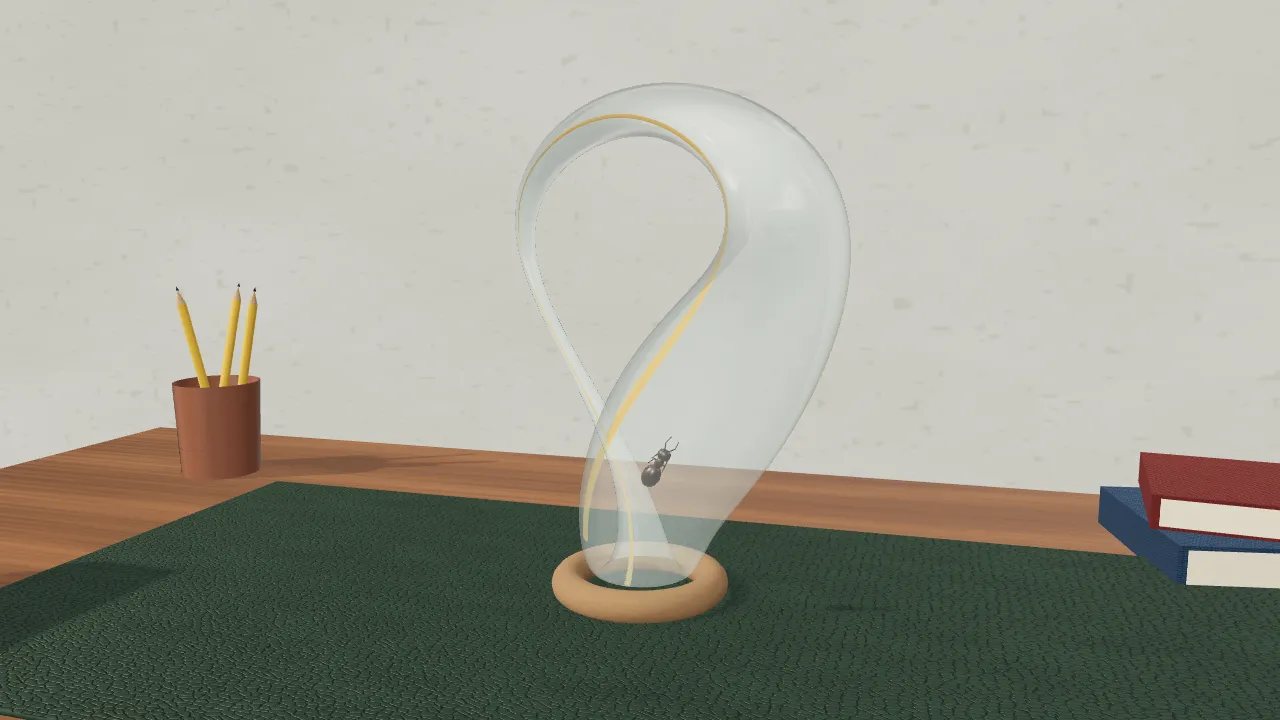
Walk an ant through a glass bottle with no inside, then split it in two.
How to play
- Tap the glass to set the ant down, or drag the ant to a new spot. It paints a gold line on the face it walks on.
- Follow it through the neck: it comes back out on the other face without crossing an edge.
- Drag one half of the bottle sideways to pull it apart along its mirror plane. Drag it back to join it.
- Open Lab to change the ant’s speed or clean the glass.
Challenges
- Set the ant down and follow it back to its start on the other face
- Pull the bottle apart into two halves: each one is a Möbius strip
- Put the ant on one half and show that the half has only one side too
Try this
- Pull the bottle apart along its mirror plane. Each half is a Möbius strip.
- Look at the place where the neck passes through the wall. In four dimensions the surface would not need to cross itself there.
- Let the ant walk two laps. Its gold line covers what looked like both the inside and the outside.
Fun facts
- The Klein bottle was first described by the German mathematician Felix Klein in 1882.
- A Klein bottle cannot be built in three dimensions without passing through itself; in four dimensions it can exist without any self-intersection.
- Cutting a Klein bottle in half along its plane of symmetry gives two Möbius strips.
- Like a doughnut-shaped torus, the Klein bottle has Euler characteristic 0, but unlike the torus it has only one side.
A surface with no inside
A sphere has an inside and an outside. So does a doughnut. You could paint the outside red and the inside blue, and the two colours would never meet. A Klein bottle is a closed surface with no edges at all, like a sphere, yet it has only one side. If you try to paint its outside, you end up painting its inside too.
Making one from a square
Mathematicians often build surfaces by gluing the edges of a square. Glue the left edge to the right and you get a tube. Glue the ends of the tube together the ordinary way and you get a torus, the surface of a doughnut. But glue them with a flip, so that the top of one end meets the bottom of the other, and you get a Klein bottle. In three dimensions that flip forces the tube to pass through its own wall, which is the place where the neck enters the body here. In four dimensions there is room to make the join without any crossing, so the self-intersection is a limitation of our space, not of the surface itself.
The ant’s walk
The ant paints a gold line on whichever face it is standing on, and because the bottle is glass you can follow it even when it is inside. It walks up the body, around the handle and down through the neck, and comes back out standing on what looked like the inside, without ever crossing an edge, because there are none. After a second lap it is back where it started. That is what it means for a surface to be non-orientable: there is no consistent choice of “outside”.
Two Möbius strips
Cut the bottle in half along its plane of mirror symmetry and each half turns out to be a Möbius strip. Put the other way round, gluing two Möbius strips together along their edges makes a Klein bottle. Drag one half of the bottle sideways to pull the two halves apart.
For the curious
The shape here is a well-known “bottle” immersion of the Klein bottle, given by trigonometric polynomials in two angles: u, along the length of the bottle, runs from 0 to π, and v, around the tube, runs from 0 to 2π. The end u = π joins the start with v replaced by π − v, and the normal vector flips there; that join is where the ant switches to painting the other face. Its Euler characteristic, vertices minus edges plus faces for any triangulation, is 0, like the torus. The difference is orientability.
Questions people ask
What is a Klein bottle?
It is a closed surface with no edges that has only one side. You can draw a continuous path from what looks like its outside to what looks like its inside without ever crossing an edge.
Can you make a real Klein bottle?
Not exactly in three dimensions, because the surface would have to pass through itself. Glassblowers make beautiful models in which the neck goes through the wall, and in four dimensions a true Klein bottle could exist without crossing itself.
Why does a Klein bottle have only one side?
Because of how its ends are joined. The tube meets itself with a flip, like a Möbius strip, so travelling once around brings you back on the opposite face. There is no way to divide it into an inside and an outside.