Jupiter’s Moons in Resonance
Drag Jupiter’s moons and hear their 1:2:4 beat hold or break.
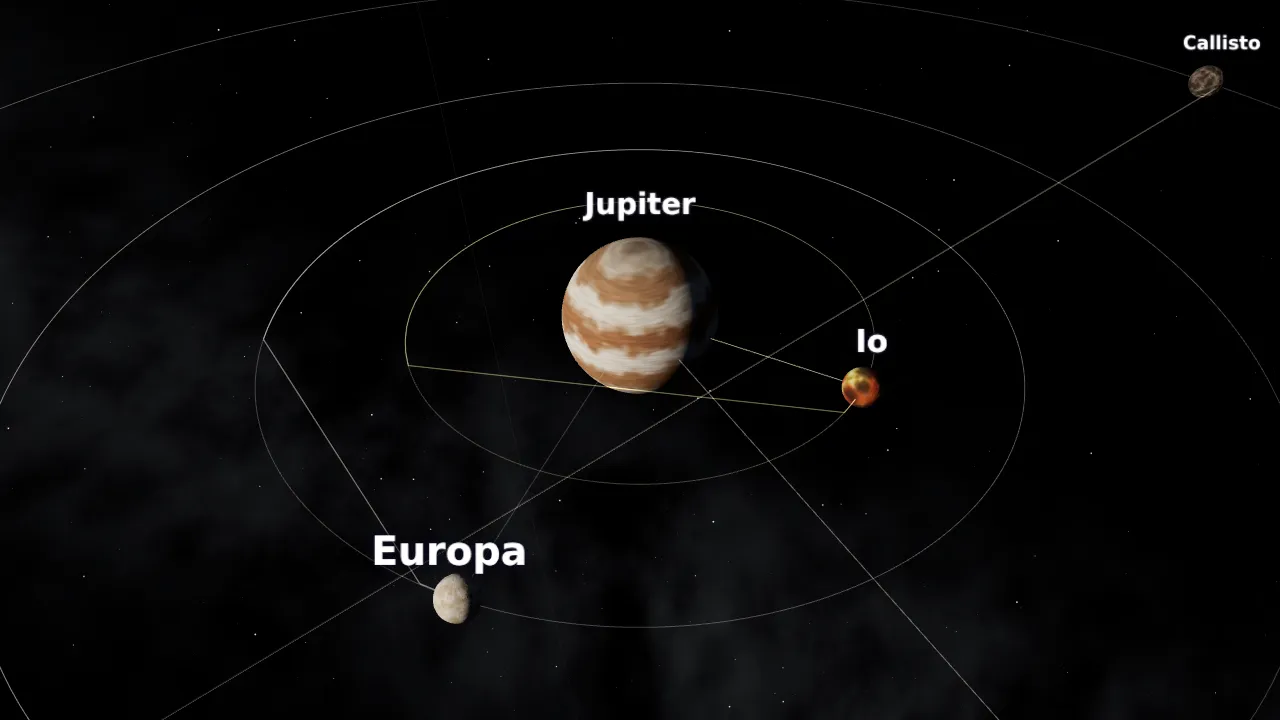
How to play
- Drag a moon to a new place. Time pauses while you hold it; let go and it settles onto a circular orbit there, and a note tells you its new period.
- Listen: each moon chimes as it passes in front of Jupiter from where you are looking. The “Laplace angle” readout stays near 180° while the resonance holds.
- Drag on empty space to fling in a moon of your own; the dotted line shows its path.
- Try the three Challenges, or open Lab to turn the chimes and lines on or off.
Challenges
- Drag Io to a new orbit and hear the 1 : 2 : 4 rhythm break
- Fling or nudge a moon fast enough to escape Jupiter
- Place a moon that laps twice for every orbit of Callisto (2 : 1)
Try this
- Count the chimes: four from Io for every two from Europa and one from Ganymede.
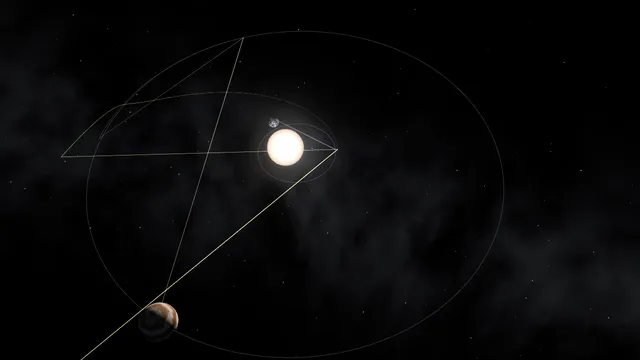
- Watch the lines from Jupiter. Whenever Io and Europa line up, Ganymede is always elsewhere: the three never line up on the same side.
- Add a heavy “Ten Ganymedes” moon near Europa and watch the Laplace angle wander away from 180°.
Fun facts
- Galileo Galilei discovered Jupiter’s four largest moons in January 1610.
- For every orbit Ganymede makes, Europa makes two and Io four, a chain called the Laplace resonance.
- Because of this resonance, Io, Europa and Ganymede can never all line up on the same side of Jupiter.
- Ganymede is the largest moon in the Solar System, bigger than the planet Mercury.
Three moons keeping time
Io takes 1.77 days to circle Jupiter, Europa 3.55 days and Ganymede 7.15 days. Those numbers are almost exactly in the ratio 1 : 2 : 4. That is no coincidence: the moons are locked in an orbital resonance, first explained by Pierre-Simon Laplace in the late 1700s and named after him.
In a resonance, two moons keep meeting at the same places in their orbits, so their small gravitational tugs repeat instead of averaging out. Over millions of years those repeated tugs nudged the moons into step and now hold them there. In this simulation every moon pulls on every other moon and on Jupiter, with their real masses, and the moons start in the arrangement astronomers observe. Each moon chimes as it passes in front of Jupiter from your point of view, so you can hear the rhythm.
The Laplace angle
Laplace found a neat way to check the lock. Take the angle of Io round Jupiter, subtract three times Europa’s and add twice Ganymede’s. For the real moons this combination stays at 180°, swinging only very slightly. It means that when two of the three moons line up, the third is always far away, so all three can never be on the same side together. The readout tracks it live. In our run it wobbles by a few degrees, because the moons start on perfect circles, but it keeps returning to 180°.
Why it matters: Io’s volcanoes
Resonance keeps the orbits of Io and Europa slightly stretched. As Io swings closer to Jupiter and then farther away, Jupiter’s enormous tide squeezes and relaxes it, heating its interior by friction. That tidal heating makes Io the most volcanically active world in the Solar System. Europa is flexed too, which helps keep an ocean of liquid water under its icy shell. Callisto, outside the resonance, is a quieter, heavily cratered world.
To scale, mostly
The orbits are drawn to scale with each other, from Io at about six Jupiter radii to Callisto at 26. The moons and Jupiter itself are drawn larger than real so you can see them; at true size the moons would be specks.
For the curious
Units are Jupiter radii (71,492 km) and days. Jupiter’s G·M comes from Io’s real orbit, and each moon starts at the distance Kepler’s third law gives for its measured period. Leapfrog integration takes steps of about three minutes. The Laplace angle is λ_Io − 3λ_Europa + 2λ_Ganymede.
Questions people ask
What is the Laplace resonance?
The 1:2:4 rhythm of Jupiter’s moons Io, Europa and Ganymede: four Io orbits take the same time as two of Europa’s and one of Ganymede’s. Their mutual gravity keeps them locked in this pattern.
Why is Io so volcanic?
The resonance keeps Io’s orbit slightly oval, so Jupiter’s tides squeeze and relax it on every orbit. The friction heats Io’s interior enough to power hundreds of volcanoes.
How many moons does Jupiter have?
Dozens, and new small ones are still being found. The four large Galilean moons, Io, Europa, Ganymede and Callisto, were discovered by Galileo in 1610.