Halvorsen Attractor
Drop probes into a three-lobed knot made by one rule used three ways.
How to play
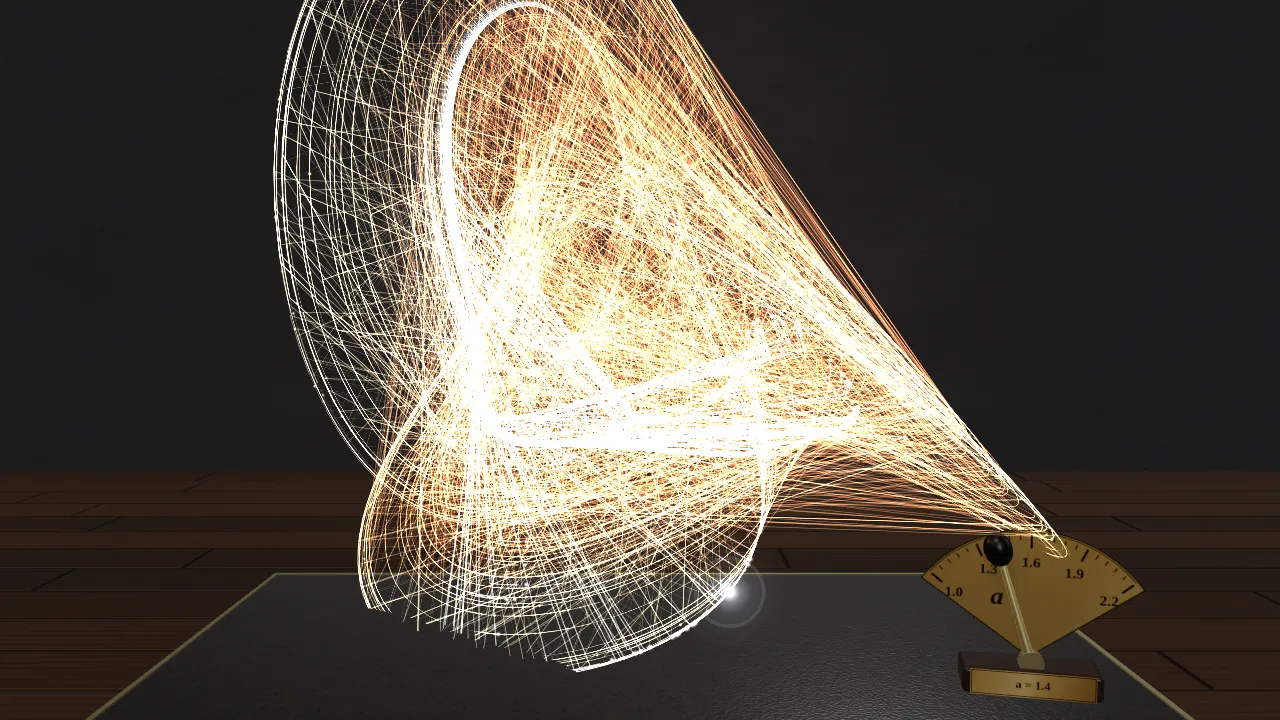
- Tap anywhere around the glowing lobes to drop a cloud of probe particles there, and watch the flow pull them in.
- Drag the bright state point to a new spot and let go. Its neighbours soon split up between the three lobes.
- Pull the brass a lever on the plinth to raise the damping. Near a = 1.89 the chaos collapses into a single loop.
- Drag empty space to turn the view. Try the three Challenges, or open Lab for the presets.
Challenges
- Tap the dark space beside the knot and watch the probe cloud get pulled onto it
- Drag the bright state point, let go, and watch its neighbours reach all three lobes
- Pull the a lever up to about 1.9 and watch the chaos collapse into one loop
Try this
- Compare a = 1.27 and a = 1.4. Both are chaotic, and the chaos rate tells you which is wilder.
- Try a = 1.89. The three lobes merge into a single repeating loop and λ drops to about zero.
- Slide a slowly upwards from 1.4 and find roughly where the chaos stops.
Fun facts
- The three equations are the same rule with the letters rotated, x → y → z → x, so the attractor has three-fold symmetry.
- The only nonlinear parts are the squared terms y², z² and x².
- In our measurements the chaos rate is about 0.67 per time unit at a = 1.4 and about 0.8 at a = 1.27.
- The value a = 1.89, often seen online, actually gives a periodic loop rather than chaos.
One rule, turned three ways
The Halvorsen system is a member of a family of “cyclically symmetric” flows, popular with researchers who look for the simplest equations that can be chaotic. It is written with one rule applied three times:
dx/dt = −a·x − 4y − 4z − y², dy/dt = −a·y − 4z − 4x − z², dz/dt = −a·z − 4x − 4y − x².
Swap x for y, y for z and z for x and you get the same three equations back, which is why the attractor has three matching lobes, like a tripod seen from above.
Reading the rule
Each variable is damped by −a times itself, which pulls it back towards zero. The linear terms −4y − 4z couple it strongly to the other two, which makes the flow circulate. Finally the squared term −y² always pushes downwards, whatever the sign of y. That one-sided push is what breaks the motion out of a simple spiral, and it bends and folds the flow. Stretching from the circulation and folding from the squares, repeated forever, give chaos.
Which value of a?
Different sources quote different values for this attractor, so we checked them numerically before choosing. At a = 1.27 and a = 1.4 the flow is chaotic, with chaos rates of about 0.8 and 0.67 per time unit: two particles that start a hair apart separate by a factor of about e every 1.5 time units. At a = 1.6 and above, including the value 1.89 that often appears online, the chaos rate drops to zero and the motion is a periodic loop. This page uses a = 1.4.
Why it glows
Each particle leaves a short fading trail, and colour shows speed, from cherry red for slow to warm white for fast. Where many trails overlap their light adds up, so the most visited parts of the attractor glow brightest. That glow is a picture of the attractor’s natural measure: how often a typical path visits each region.
For the curious
Particles start on the attractor, sampled from one long warmed-up trajectory, and are advanced with fourth-order Runge–Kutta in fixed steps of 0.004. The chaos rate λ is the largest Lyapunov exponent, measured live by Benettin’s method: a shadow particle starts 10⁻⁸ away, and after every 10 steps its separation is recorded and reset.
Questions people ask
What is the Halvorsen attractor?
A strange attractor produced by three cyclically symmetric differential equations with squared terms. Its paths circle three matching lobes chaotically.
What value of a should the Halvorsen attractor use?
Values of about 1.27 or 1.4 give chaos. Larger values, such as 1.89, give a periodic loop instead, as you can check in the Lab.
What does cyclically symmetric mean?
The equations stay the same when the variables are rotated, x to y, y to z and z to x, so the attractor looks identical from three directions.