Game of Life in 3D
Poke and seed glowing cells in a glass tank and see 3D Life evolve.
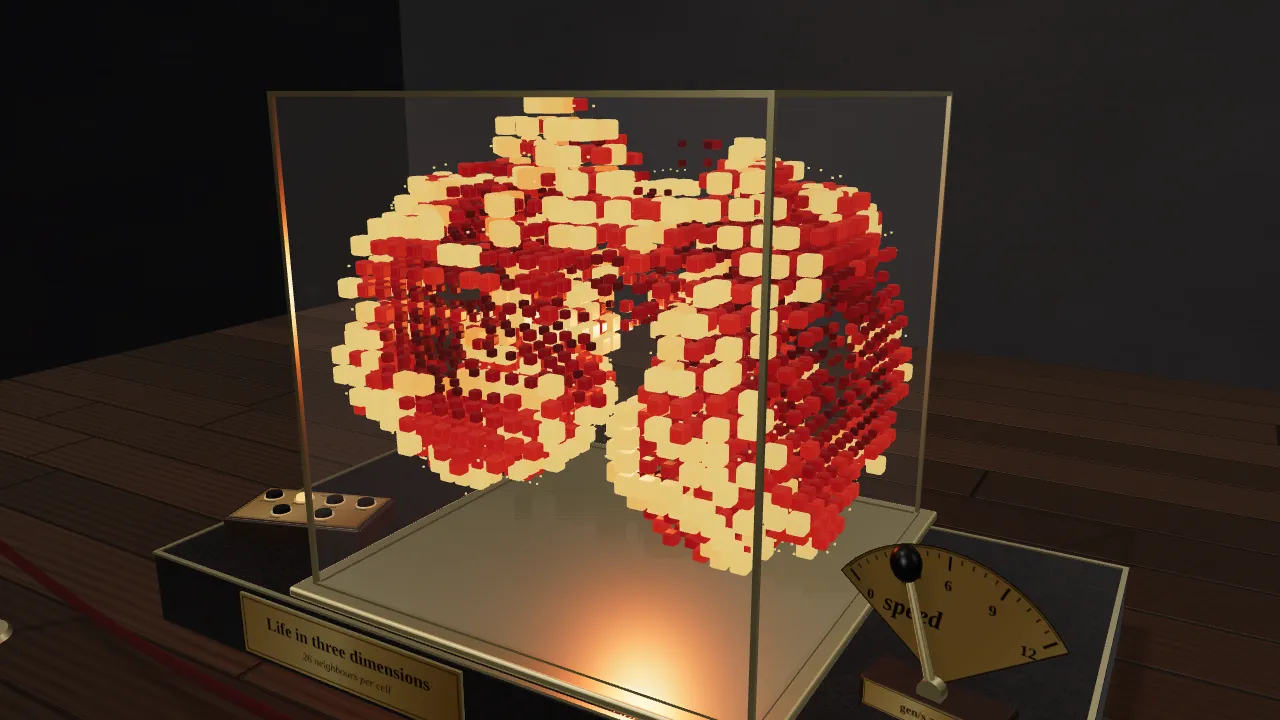
How to play
- Tap a glowing colony to poke a hole in it, or tap empty glass to seed a new colony there.
- Press the brass buttons on the walnut console to switch rules, step one generation or reseed the tank.
- Pull the lever to set the speed. All the way down pauses the tank.
- Drag empty space to walk round the plinth. The Lab has the same controls as sliders.
Challenges
- Tap a living colony to poke a hole in it
- Tap an empty part of the tank to start a colony that lasts 20 generations
- Press 5766 on the console and wait for the cells to freeze into a still life
Try this
- Press 5766 for Bays’s rule. Random seeds mostly die away, which shows how hard it is to find 3D rules as lively as Conway’s.
- Pull the lever down to pause, then press Step a few times and watch which cells are born, which survive and which fade.
- Tap the tank to drop new cells beside a living blob and watch how the two merge.
Fun facts
- John Horton Conway invented the original two-dimensional Game of Life in 1970, and Martin Gardner made it famous in his column in Scientific American.
- In three dimensions each cell has 26 neighbours instead of the 8 it has on a flat grid.
- Carter Bays explored three-dimensional versions of Life in the 1980s and proposed rules such as 4555 and 5766.
- Conway’s two-dimensional Game of Life can in principle carry out any computation, given enough space and time.
Simple rules, crowded neighbourhoods
A cellular automaton is a grid of cells, each either alive or dead, that updates in steps called generations. Every cell looks at its neighbours and follows the same simple rule to decide whether it will be alive in the next generation. Nothing else steers it, yet the whole grid can produce gliding shapes, pulsing patterns and slow growth that look almost alive.
Conway’s Life
The most famous example is John Conway’s Game of Life, played on a flat grid. A dead cell is born if exactly three of its eight neighbours are alive, and a live cell survives if two or three are. In shorthand that is B3/S23. From these two lines come gliders that crawl across the grid, guns that fire them, and even patterns that work as computers.
Going up a dimension
In three dimensions each cell sits in a cube of 26 neighbours, so Conway’s numbers no longer work: with so many neighbours, almost everything either dies of loneliness or fills the whole tank. In the 1980s Carter Bays searched for 3D rules that behave as interestingly as Conway’s, and suggested rules such as 4555 (survive with 4 or 5 neighbours, born with exactly 5) and 5766. Most random starting patterns under those rules soon die out or freeze, leaving only special shapes. Press 5766 on the console to see.
Rules with fading cells
Some rules give cells more than two states. In the Pyroclastic rule here, a live cell that fails the survival test does not vanish at once: it fades through several dying states before it is gone, and dying cells do not count as live neighbours. The result is a flickering, fiery blob that keeps reinventing itself. The colours show it: pale gold for newborn cells, deep orange for old survivors, and reds fading to dark embers for dying cells.
A world without walls
The tank’s edges wrap around: a cell on the right face is a neighbour of the cell opposite it on the left face, and the same for the top and bottom and the front and back. Mathematically, the grid is a three-dimensional torus, so patterns that drift off one side come back on the other.
For the curious
Each generation counts, for every cell, how many of its 26 neighbours are alive. The rule is written as S (the neighbour counts that let a live cell survive) and B (the counts that bring a dead cell to life). Coral here is S5–8/B6–7, Foam is S4–6/B5–6 and Pyroclastic is S4–7/B6–8 with ten states. The grid is 24 cells on a side on computers, 13,824 cells in all, and 18 on phones.
Questions people ask
What is the Game of Life?
It is a cellular automaton invented by John Conway in 1970. Cells on a grid live or die according to how many of their neighbours are alive, and from that simple rule complex moving patterns emerge.
How does the 3D Game of Life work?
The same idea in a cube of cells. Each cell counts its 26 neighbours, and the rule decides from that count whether it is born, survives or dies. Because there are more neighbours, the 3D rules use different numbers from Conway’s.
What do the S and B numbers mean?
They are the neighbour counts in the rule. S lists the numbers of live neighbours that let a live cell survive, and B lists the numbers that make a dead cell come alive. Conway’s original rule is S23/B3.