Chen Attractor
Drop probes into a fiery cousin of Lorenz’s butterfly, twice as wild.
How to play
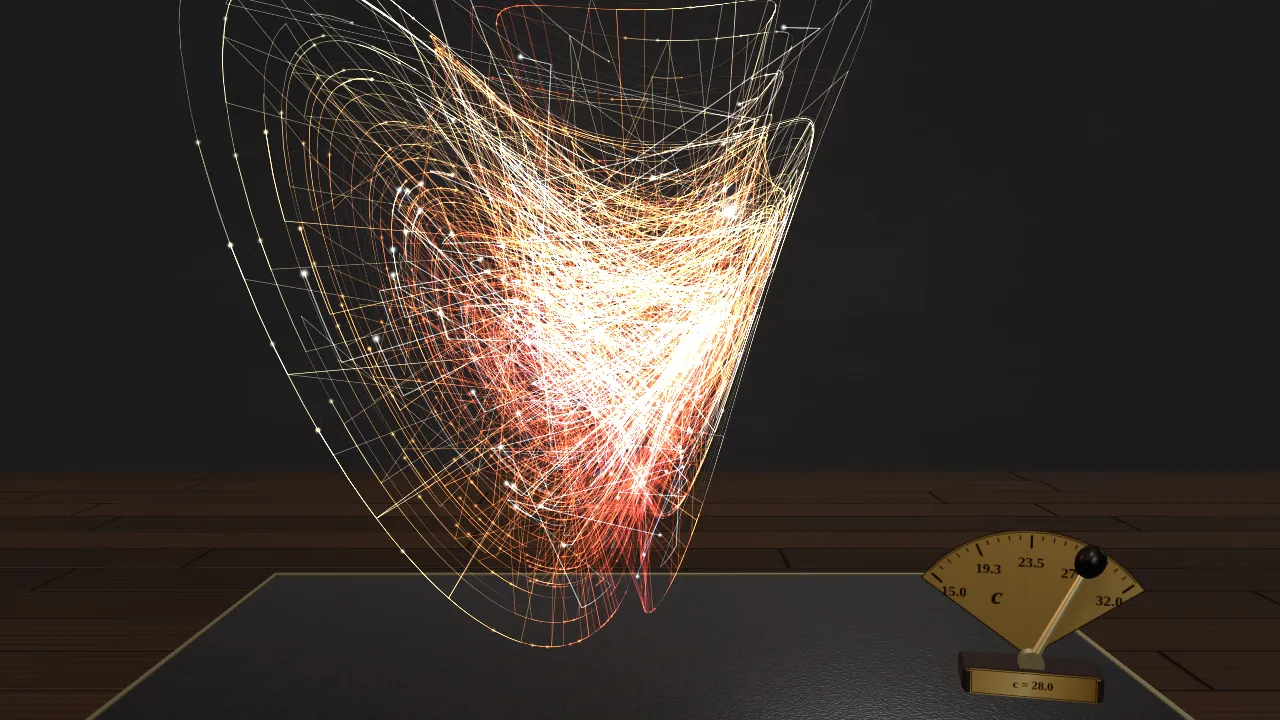
- Tap anywhere around the fiery wings to drop a cloud of probe particles there, and watch the flow pull them in.
- Drag the bright state point to a new spot and let go. Its neighbours part about twice as fast as in the Lorenz system.
- Pull the brass c lever on the plinth: near c = 30 the chaos folds into one loop, and much lower values make it stop.
- Drag empty space to turn the view. Try the three Challenges, or open Lab for a and b.
Challenges
- Tap the dark space beside the wings and watch the probe cloud get pulled onto them
- Drag the bright state point, let go, and watch its neighbours scatter
- Pull the c lever up to about 30 and watch the chaos fold into a single loop
Try this
- Try “c = 30: a loop”. A small change to c turns the chaos into a repeating orbit.
- Try “c = 18: stops”. The motion dies away and the swarm collects at two still points.
- Open the Lorenz attractor page alongside and compare the shapes and the chaos rates.
Fun facts
- Guanrong Chen and Tetsushi Ueta reported this system in 1999.
- It was found by deliberately adding feedback to a calm system to make it chaotic, the reverse of the usual goal of controlling chaos.
- Its equations differ from Lorenz’s only in the middle equation, which has (c − a)x + c·y where Lorenz has ρx − y.
- At the classic values our measured chaos rate is about 2.0 per time unit, roughly twice the Lorenz system’s 0.9.
Chaos on purpose
Much of chaos research in the 1990s was about taming chaos: nudging a chaotic system so it would behave predictably. Guanrong Chen and Tetsushi Ueta asked the opposite question. Could you take a calm system and add feedback to make it chaotic? In 1999 they reported a system found this way, now called the Chen system:
dx/dt = a(y − x), dy/dt = (c − a)x − xz + c·y, dz/dt = xy − b·z.
Put it next to Lorenz’s equations and the family resemblance is obvious. The first and third equations match Lorenz’s, and the products xz and xy are the same nonlinear ingredients. The difference is in the middle equation: where Lorenz has ρx − y, Chen has (c − a)x + c·y. That plus sign on c·y feeds the variable y back into itself, and it makes a big difference to how violently the flow stretches.
Twice as wild
The live chaos rate λ measures how fast two nearly identical states drift apart. For the Chen system at the classic values a = 35, b = 3, c = 28, it settles near 2.0 per time unit in our measurements, about twice the Lorenz system’s 0.9. The shape is also more tightly wound, with wings that twist round a stretched central column. The flow is fast, so this page runs it more slowly than the Lorenz page and uses a smaller time step.
Taming it again
Chaos lives only in certain ranges of the parameters. Lower c to 18 and the motion dies away to two still points, one in each wing. Raise it to 30 and the chaos gives way to a single repeating loop. At values like 20 or 22 it is still chaotic, but much less wild than at 28. We checked each preset numerically.
Strange attractors share a recipe
The Chen, Lorenz and Rössler systems look different, but each combines two ingredients: stretching, which pulls neighbouring paths apart, and folding, which squeezes them back into a bounded region. That combination is what makes an attractor strange: infinitely detailed, fractal, and impossible to predict in detail over long times, yet always the same overall shape.
For the curious
Every particle is advanced with fourth-order Runge–Kutta in fixed steps of 0.002. The steady states of the Chen system sit at x = y = ±√(b(2c − a)), z = 2c − a. Colour shows speed, from violet for slow, through cherry and orange, to gold for the fastest stretches.
Questions people ask
What is the Chen attractor?
A strange attractor of the Chen system, published by Guanrong Chen and Tetsushi Ueta in 1999. It has two wings like the Lorenz attractor but is more strongly chaotic.
How is the Chen system different from the Lorenz system?
Only the middle equation differs: Chen’s has (c − a)x + c·y where Lorenz’s has ρx − y. That change makes the flow stretch faster and twist more tightly.
Is the Chen attractor always chaotic?
No. For the classic values a = 35, b = 3, c = 28 it is, but other values of c give a periodic loop or a still point, as the Lab presets show.