Binary Star Dance
Drag two stars into new orbits and fling in a planet with two suns.
How to play
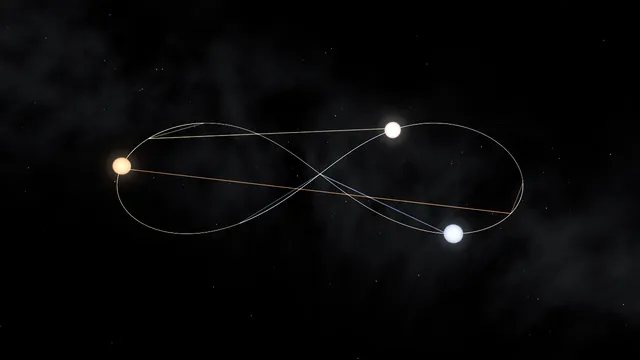
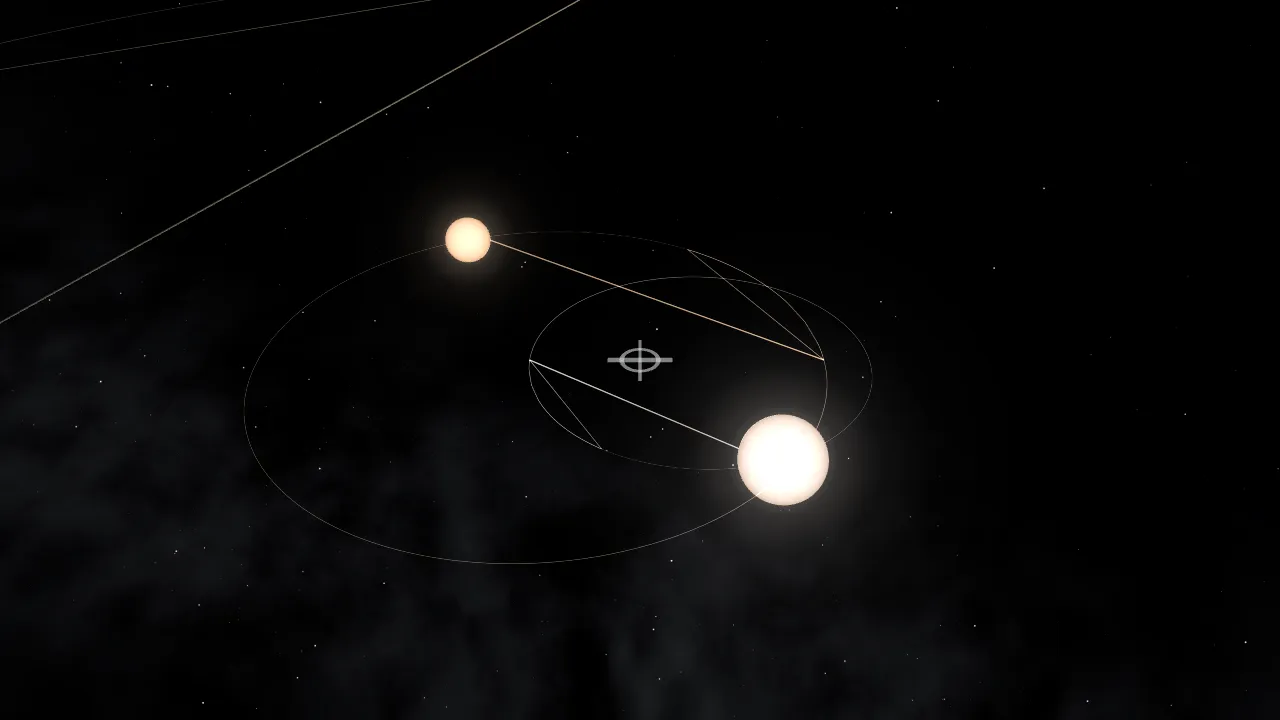
- Press on a star and drag out an arrow: that is its new velocity, and the dotted line shows its new path around the pale cross, the shared centre of mass. Time pauses while you aim.
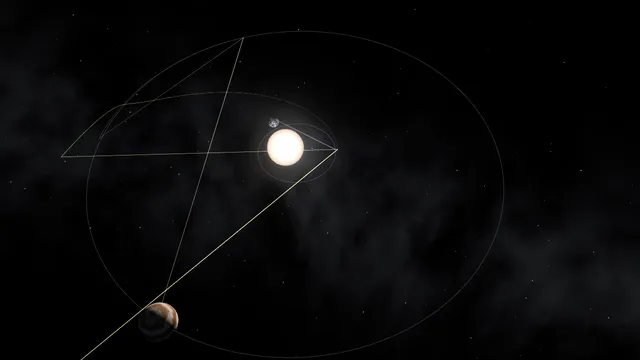
- Drag on empty space to fling in a planet; a quick tap drops one into a circular orbit. Drag out of a planet to re-aim it.
- Use “Edge-on view” in Lab to look along the orbit and watch the brightness dip during eclipses.
- Try the three Challenges, or open Lab to change each star’s mass and how stretched the orbit is.
Challenges
- Fling a planet in close and watch the two stars throw it out
- Fling a planet that circles both stars three times, like Kepler-16b
- Drag a star to make the pair’s orbit almost circular (e below 0.05)
Try this
- Make star A three times heavier than star B. The heavy star now makes small circles near the cross while the light one swings wide.
- Switch to the edge-on view and watch the “Brightness” readout fall as one star passes in front of the other.
- Compare the stable “Two-sun planet” with “Planet too close”. A planet orbiting too near the pair is soon thrown out or swallowed.
Fun facts
- Algol, the “Demon Star” in Perseus, is an eclipsing binary that fades noticeably about every 2.87 days.
- Sirius, the brightest star in the night sky, has a faint white-dwarf companion, Sirius B; the pair orbit each other about every 50 years.
- Kepler-16b, announced in 2011, was the first planet seen passing in front of two stars, so it has two suns in its sky.
- Binary stars are the main way astronomers measure the masses of stars, using Kepler’s third law.
Two stars, one balance point
When two stars are bound by gravity, neither one sits still while the other circles it. Both orbit their shared centre of mass, the barycentre, like two dancers holding hands and spinning. The balance point always lies on the line between them, closer to the heavier star, so that mass times distance is the same on both sides: m₁·r₁ = m₂·r₂. Make one star much heavier in the Lab and it barely wobbles, which is exactly how the Sun behaves with its planets.
Both stars trace ellipses of the same shape, with the barycentre at a shared focus, and they always sit on opposite sides of it. They complete their orbits together, so the lighter star must move faster. Watch the “towards you” readout: it rises and falls as star A swings towards and away from you. Astronomers measure exactly this back-and-forth through the Doppler shift of starlight, and the same wobble method has found hundreds of exoplanets.
Weighing stars
Kepler’s third law, as improved by Newton, links the period P to the size of the orbit a and the total mass: P² = a³/(m₁ + m₂), in years, astronomical units and solar masses. Measure how long a binary takes and how far apart its stars are, and you have weighed them. That is how most stellar masses are known. Change the masses here and watch the period readout respond.
Eclipses
If you happen to view the orbit edge-on, the stars take turns passing in front of each other and the combined light dips: an eclipsing binary. The brightness readout here uses the star discs you see on screen and lets brighter stars count for more, roughly following the rule that a star’s luminosity rises as its mass to the power 3.5. The dips are deepest when the dim star covers the bright one.
Planets around two suns
Planets can orbit both stars at once if they stay well outside the pair, typically several times the stars’ separation. Closer in, the two suns take turns pulling the planet one way and then the other, and its orbit soon becomes wild. The two buttons show both cases.
For the curious
Units: AU, years and solar masses (G = 4π²). The stars start 1.2 AU apart and move under leapfrog integration; star colours follow a rough main-sequence guide from red dwarfs to blue-white stars, and their sizes are greatly enlarged so the eclipses are easy to see.
Questions people ask
What is a barycentre?
The centre of mass of two or more bodies, the point they all orbit around. For two stars it lies on the line between them, closer to the heavier one.
How do astronomers find binary stars?
By seeing two stars move around each other in a telescope, by spotting regular dips in brightness when they eclipse, or by measuring the Doppler shift of their light as they swing towards and away from us.
Can planets orbit two stars?
Yes. Several such planets are known, the first transiting one being Kepler-16b in 2011. They need to orbit well outside the pair to stay stable.