Aizawa Attractor
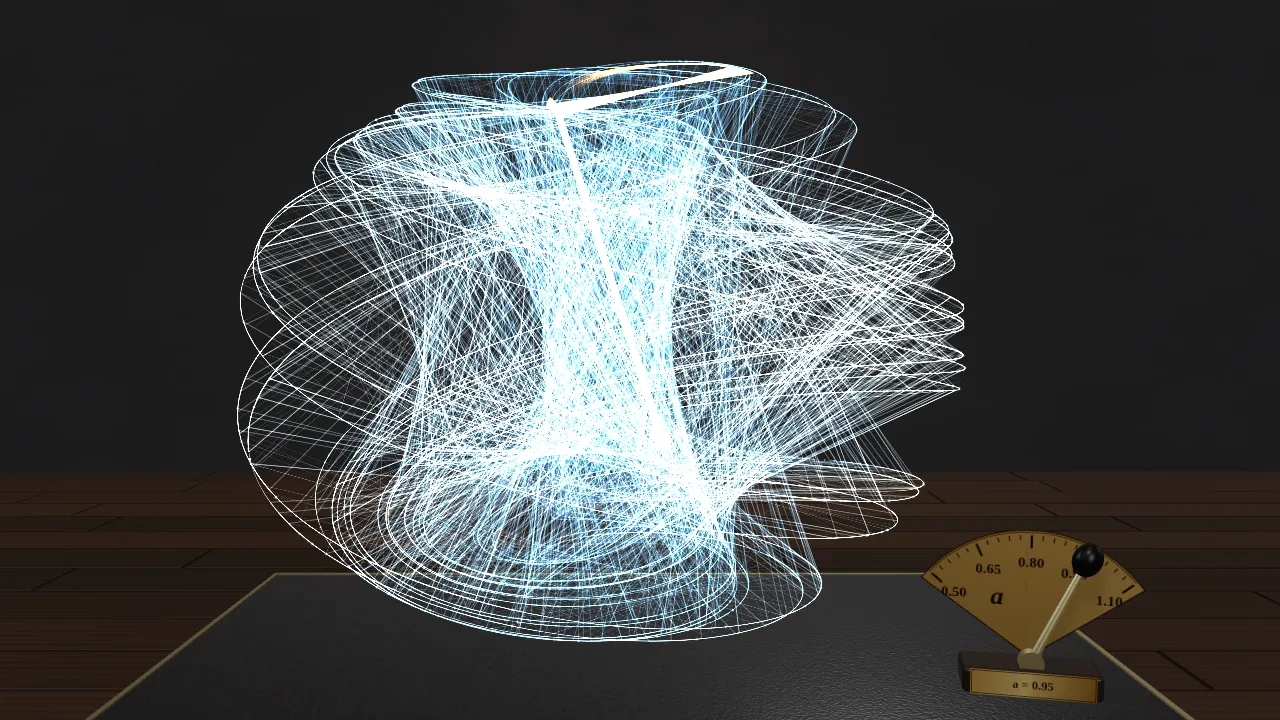
Drop probes on a glowing shell and watch them shoot up its core.
How to play
- Tap anywhere around the glowing shell to drop a cloud of probe particles, and watch the flow pull them onto it.
- Tap right on the central axis and the probes climb the tube, then spill out over the top and run down the shell.
- Drag the bright state point to a new spot and let go: its neighbours stay together for a while, then slowly part.
- Pull the brass a lever on the plinth. Try the three Challenges, or open Lab for d, e, f and the presets.
Challenges
- Tap the dark space beside the shell and watch the probe cloud get pulled onto it
- Drop a probe cloud and follow it until a probe shoots up the central tube
- Drag the bright state point, let go, and wait for its neighbours to spread out
Try this
- Try “e = 0.1: wilder”. The shell loosens and the chaos rate roughly doubles.
- Try “a = 0.7: a calm ring”. The chaos disappears and every particle joins one repeating loop.
- Lower d slowly and watch the swirl round the axis slow down.
Fun facts
- The rotation part of the equations, (z − b)x − d·y and d·x + (z − b)y, spins the flow round the vertical axis at a rate set by d.
- The cubic term −z³/3 stops particles flying off upwards or downwards: it always pulls large heights back.
- Like other strange attractors, this one has a fractal structure: its surface is made of layers within layers.
- At the usual parameter values the chaos is mild, with a chaos rate of about 0.1 per time unit in our measurements.
Spinning, rising, folding
The Aizawa attractor is a favourite of mathematical artists because its shape is so clear: a rounded shell, open at the bottom, with a narrow tube running up its axis, rather like an apple core. Its equations are:
dx/dt = (z − b)x − d·y, dy/dt = d·x + (z − b)y, dz/dt = c + a·z − z³/3 − (x² + y²)(1 + e·z) + f·z·x³.
Reading the equations
The first two equations mix x and y in a way that simply rotates them: d sets how fast the flow spins round the vertical axis, while (z − b) makes the swirl spread outwards when particles are high and draw inwards when they are low. The third equation decides the height. The terms c + a·z push particles upwards, the cubic −z³/3 pulls large heights back, and −(x² + y²) drags particles down when they are far from the axis. The small term f·z·x³ breaks the perfect symmetry round the axis, adding the twist that makes the motion chaotic.
Put together: a particle spirals outwards and downwards over the shell, falls towards the bottom, is drawn in to the axis, shoots up the central tube and is thrown out over the top again. Each circuit is slightly different, and nearby particles slowly drift apart.
Strange, but gentle
The live “Chaos rate λ” readout measures how quickly two nearly identical states separate. At the usual values it settles near 0.1 per time unit in our tests, mild compared with the Lorenz system’s 0.9. Turn e down to 0.1 and it roughly doubles. Raise a little or lower it to 0.7 and the chaos collapses into a single repeating loop: chaos lives only in certain regions of the parameter space. We checked each preset numerically.
Why it stays put
A strange attractor needs two ingredients: stretching, which makes neighbouring paths separate, and squeezing, which keeps everything in a bounded region. Here the rotation and the vertical rise do the stretching, and the strong pull back of the cubic term and the inward drag do the squeezing. The result is an object with no volume but infinite detail.
For the curious
Parameters: a = 0.95, b = 0.7, c = 0.6, d = 3.5, e = 0.25, f = 0.1, the set most often quoted for this attractor. Particles start on the attractor, sampled from one long trajectory, and are advanced with fourth-order Runge–Kutta in fixed steps of 0.005. Colour shows speed, teal for slow and pink to white for fast.
Questions people ask
What is the Aizawa attractor?
A strange attractor from a system of three differential equations whose solutions swirl round a sphere-like shell and up a tube along its axis, never exactly repeating.
What makes an attractor strange?
It has a fractal structure and the motion on it is chaotic: nearby starting points separate exponentially, yet everything stays on the same bounded shape.
Is the Aizawa attractor always chaotic?
No. Only some parameter values give chaos. Others, like a = 0.7 in the Lab, settle into a simple repeating loop.